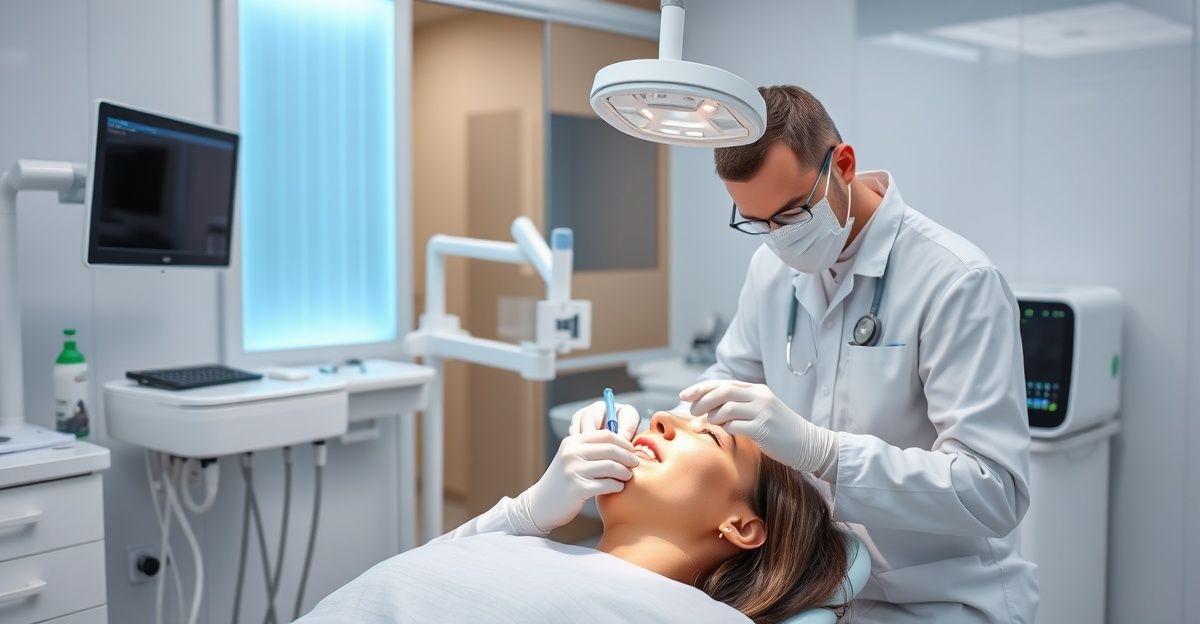
Ozone therapy is changing the way some dentists approach root canal treatment. Instead of relying solely on chemical irrigants like sodium hypochlorite to disinfect the intricate canal system inside a tooth, a growing number of practitioners are using ozone gas or ozonated water as an adjunct or alternative disinfectant. The goal: kill bacteria in areas that traditional methods struggle to reach, reduce post-procedure infection rates, and preserve more natural tooth structure.
But how strong is the evidence? And when can ozone actually prevent the need for a root canal altogether? Here is what the research shows.
Key Takeaways
- Ozone has strong antimicrobial activity against common root canal pathogens, including Enterococcus faecalis, the bacterium most associated with failed root canals.
- A 2020 systematic review found ozone therapy as an adjunct to conventional irrigation significantly reduced bacterial counts in root canals (Thammasitboon et al., 2020).
- Ozone cannot replace mechanical debridement (physical cleaning of the canal) but may improve disinfection in anatomically complex canals.
- For early-stage decay that has not yet reached the pulp, ozone can sometimes halt progression and prevent the need for a root canal entirely.
- Not all dentists offer ozone-assisted root canals. You may need to seek out a biological or integrative dentist.
How Ozone Is Used During Root Canal Procedures
A root canal involves removing infected pulp tissue from inside the tooth, shaping the canal system, disinfecting it, and sealing it. The disinfection step is critical because the canal system contains microscopic branches, isthmuses, and lateral canals where bacteria hide. Traditional irrigants like sodium hypochlorite (NaOCl) and EDTA are effective but have limitations: they cannot penetrate every microscopic space, and NaOCl is cytotoxic to surrounding tissue at higher concentrations.
Ozone enters the picture in three ways:
- Ozone gas: Delivered directly into the cleaned canal via a specialized handpiece. The gas diffuses into areas liquid irrigants cannot reach, contacting bacteria in dentinal tubules and lateral canals.
- Ozonated water: Used as an irrigant during the procedure, either alone or alternated with NaOCl. Ozonated water at concentrations of 4-20 mcg/mL shows significant bactericidal activity.
- Ozonated oil: Sometimes applied as a final medicament before sealing, providing prolonged antimicrobial activity.
The Evidence: Ozone vs Conventional Irrigation
Multiple studies have examined ozone as a root canal disinfectant. Here is what the most rigorous research shows:
| Study | Design | Key Finding |
|---|---|---|
| Thammasitboon et al., 2020 | Systematic review of in vitro and clinical studies | Ozone as an adjunct to NaOCl significantly reduced bacterial counts compared to NaOCl alone |
| Hubbezoglu et al., 2014 | In vitro, extracted teeth | Gaseous ozone (40 sec) eliminated 99.9% of E. faecalis in dentinal tubules |
| Nogales et al., 2008 | Review of ozone in dentistry | Ozone effective against Gram-positive and Gram-negative bacteria, viruses, and fungi relevant to endodontic infections |
| Case et al., 2012 | In vitro biofilm model | Ozonated water reduced E. faecalis biofilm by 2 log units but did not match NaOCl for biofilm disruption |
| Sinha et al., 2015 | Clinical comparative study | Ozone + NaOCl combination achieved higher disinfection rates than either agent alone |
The consistent finding across studies: ozone works best as a complement to standard irrigation, not a replacement for it. The combination of mechanical cleaning + NaOCl + ozone produces the most thorough disinfection. Ozone alone does not dissolve organic tissue the way NaOCl does, so the mechanical and chemical steps remain essential.
The combination of standard irrigation with ozone therapy reduced bacterial counts significantly more than irrigation alone, with ozone reaching anatomical spaces that liquid irrigants cannot effectively penetrate.
When Ozone Can Prevent a Root Canal
This is where ozone therapy gets particularly interesting. When decay has not yet reached the tooth pulp, ozone can sometimes arrest the carious process and promote remineralization, eliminating the need for invasive treatment.
The mechanism is straightforward: ozone kills cariogenic bacteria (primarily Streptococcus mutans) in the decay lesion and oxidizes the acidic byproducts they produce. Once the bacterial load drops and the acid environment neutralizes, saliva and fluoride can remineralize the affected enamel and dentin.
The HealOzone system (now discontinued but clinically validated) demonstrated this approach in multiple studies. Holmes (2003) showed that ozone application followed by a remineralizing solution reversed early root caries in 100% of treated teeth at 12-month follow-up. Baysan and Lynch (2004) found similar results in primary root caries lesions.
Key limitations:
- Only works for early lesions. Once decay has penetrated deeply into dentin or reached the pulp, ozone cannot reverse the damage. The tooth needs conventional treatment.
- Requires follow-up care. Ozone treatment for caries is not a one-time fix. It often needs repeated application along with remineralization protocols.
- Not all lesions respond. Cavitated lesions (where the tooth surface has physically broken down) are poor candidates for ozone reversal.
Advantages of Ozone in Root Canal Treatment
Beyond antimicrobial action, ozone offers several practical advantages during endodontic procedures:
- No bacterial resistance. Unlike antibiotics, ozone kills bacteria through oxidative mechanisms that do not promote resistance development. This is significant given the rise of antibiotic-resistant endodontic infections.
- Biocompatibility. At appropriate concentrations, ozone is far less cytotoxic to periapical tissues than high-concentration NaOCl. This matters because NaOCl extrusion beyond the apex is a known complication that can cause severe tissue damage.
- Reaches complex anatomy. Gas diffuses into areas that liquid irrigants struggle to penetrate, including isthmuses, lateral canals, and dentinal tubules where persistent bacteria cause reinfection.
- Stimulates healing. Ozone at controlled doses upregulates antioxidant enzymes and growth factors, potentially improving post-procedure healing of periapical tissues.
Limitations and Honest Assessment
The evidence for ozone in endodontics is promising but not yet definitive. Important limitations include:
- Most studies are in vitro. The majority of antimicrobial studies use extracted teeth or biofilm models, not living patients. Clinical outcomes data is limited.
- No standardized protocol. Concentration, exposure time, and delivery method vary across studies, making it difficult to determine the optimal clinical protocol.
- Cannot replace mechanical debridement. No irrigant, including ozone, substitutes for proper canal shaping and cleaning. The physical removal of infected tissue is the foundation of root canal success.
- Equipment cost. Dental ozone generators cost $5,000-15,000, which limits adoption. Not every dental practice can justify the investment.
- Regulatory status. Ozone devices are not FDA-cleared for endodontic use in the US, meaning their use is technically off-label.
Finding a Dentist Who Offers Ozone Root Canals
Ozone-assisted root canals are most commonly offered by:
- Biological dentists (also called holistic dentists) who incorporate biocompatible and minimally invasive approaches
- Integrative dental practices that combine conventional techniques with complementary therapies
- Endodontists (root canal specialists) who have adopted ozone technology
The International Academy of Oral Medicine and Toxicology (IAOMT) and the International Academy of Biological Dentistry and Medicine (IABDM) both maintain practitioner directories where you can search for ozone-capable dentists in your area.
When you contact a practice, ask whether they use ozone as part of their root canal protocol and whether they have specific training in dental ozone therapy. The answers will tell you whether they are genuinely experienced or simply marketing a buzzword.
The Bottom Line
Ozone therapy is a valuable adjunct to root canal treatment. The evidence supports its use as a supplementary disinfectant that reaches anatomical areas where conventional irrigants fall short. For early-stage tooth decay that has not yet reached the pulp, ozone may prevent the need for a root canal entirely by killing bacteria and promoting remineralization. However, ozone does not replace the core steps of root canal therapy: mechanical cleaning, proper shaping, and hermetic sealing. The best outcomes come from combining ozone with established endodontic techniques, not from substituting it for them.
- Thammasitboon K, et al. Ozone therapy in endodontics: a systematic review. Int Endod J. 2020;53(7):907-922. doi:10.1111/iej.13291
- Hubbezoglu I, et al. Antibacterial efficacy of aqueous ozone in root canals infected by Enterococcus faecalis. Jundishapur J Microbiol. 2014;7(7):e11558. doi:10.5812/jjm.11558
- Nogales CG, et al. Ozone therapy in medicine and dentistry. J Contemp Dent Pract. 2008;9(4):75-84. doi:10.5005/jcdp-9-4-75
- Holmes J. Clinical reversal of root caries using ozone, double-blind, randomised, controlled 18-month trial. Gerodontology. 2003;20(2):106-114. doi:10.1111/j.1741-2358.2003.00106.x
- Baysan A, Lynch E. Effect of ozone on the oral microbiota and clinical severity of primary root caries. Am J Dent. 2004;17(1):56-60.
- Sinha N, et al. Evaluation of the effect of ozone on the antimicrobial efficacy of endodontic irrigants. Indian J Dent Res. 2015;26(2):158-162. doi:10.4103/0970-9290.159145
- Bocci V. Ozone: A New Medical Drug. 2nd ed. Dordrecht: Springer; 2011. doi:10.1007/978-90-481-9234-2
Medical Disclaimer
The content on BaricBoost.com is for informational purposes only and is not intended as a substitute for professional medical advice, diagnosis, or treatment. Always seek the advice of your physician or other qualified health provider with any questions you may have regarding a medical condition. Never disregard professional medical advice or delay in seeking it because of something you have read on this website.

Author
Seph Fontane Pennock is the founder of BaricBoost.com and Regenerated.com, a clinic directory for regenerative medicine serving 10,000+ providers across the United States. He previously built and sold PositivePsychology.com, which grew to 19 million users and became the largest evidence-based positive psychology resource on the web. Seph brings direct experience as an HBOT patient, having completed protocols at clinics across three continents while navigating mold illness, systemic inflammation, and autoimmune conditions. His treatment journey includes hyperbaric oxygen therapy, peptide protocols, NAD+ therapy, and consultations with specialists from Dubai to Cape Town to Mexico. This combination of entrepreneurial track record and lived patient experience shapes everything published on BaricBoost.com. Every article is grounded in peer-reviewed research, informed by real clinical encounters, and written for patients making high-stakes treatment decisions. Seph's focus is on bringing transparency, scientific rigor, and practical guidance to the hyperbaric oxygen therapy space.