Affiliate Disclosure
This article contains affiliate links. If you purchase through these links, we may earn a commission at no additional cost to you. This does not influence our evaluations or rankings.
Aviv HBOT is a 60-session hyperbaric protocol delivered at 2.0 ATA that alternates 100% oxygen with ambient air roughly every 20 minutes. Developed by the research group at the Sagol Center for Hyperbaric Medicine at Shamir Medical Center in Israel, led by Prof. Shai Efrati, it has produced a 20 percent-plus increase in telomere length in a prospective trial and large cognitive effect sizes (0.745 for attention) in a randomized controlled trial of adults over 64. What separates it from standard HBOT is that the oxygen swings are the therapy, not a safety measure.
The hypothesis behind the protocol is that alternating between high oxygen and normal air at a fixed pressure of 2.0 ATA stimulates cellular responses more strongly than constant high oxygen. The intermittent oxygen drops create brief hypoxic stress signals that activate mitochondrial adaptation, growth factor release, and angiogenesis in ways that steady-state hyperoxia may not.
Table of Contents
How Is the Aviv Protocol Different From Standard HBOT?
A standard HBOT session delivers 100% oxygen at elevated pressure for the whole session. The Aviv protocol alternates between 100% oxygen and normal compressed air within the same session, typically switching every 20 minutes at 2.0 ATA. That creates repeated cycles of hyperoxia and relative hypoxia in a single treatment.
The theoretical basis comes from research showing that the transition from hyperoxia back toward normoxia generates reactive oxygen species (ROS) signaling that activates HIF-1 alpha (hypoxia-inducible factor), VEGF (vascular endothelial growth factor), and mitochondrial biogenesis pathways.1 These are the same pathways activated by exercise-induced hypoxia, which is why the research group describes the effect as interval training for cells.
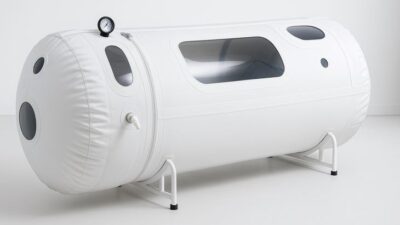
The key distinction from soft-shell portable chambers is pressure. The Aviv protocol runs at a hard 2.0 ATA (atmospheres absolute) in a medical-grade hard chamber. Soft portable chambers sold for home use reach 1.3 to 1.5 ATA and deliver ambient air, not 100% oxygen. The gap is not minor. At 2.0 ATA, dissolved oxygen in plasma increases substantially. At 1.3 ATA, the increase is modest. The published Efrati group research uses 2.0 ATA and cannot be extrapolated to lower-pressure consumer devices. For a side-by-side of the major clinical protocols, see our comparison of the Efrati and Harch protocols.
What Does the Evidence Actually Show?
The Efrati group has published multiple peer-reviewed trials using this protocol. These are the foundational studies:
| Condition | Sessions | Key Finding | Population |
| Cognitive aging | 60 | p=0.0017 global cognitive improvement; attention effect size 0.745 | 63 adults, randomized controlled trial |
| Telomere biology | 60 | 20%+ telomere lengthening; 37% senescent cell reduction | 35 adults, prospective trial (no sham) |
| Physical performance | 60 | VO2max +1.91 ml/kg/min; cardiac perfusion effect size 0.797 | 63 adults, randomized controlled trial |
| Post-COVID cognitive symptoms | 40 | Improved cognition, fatigue, sleep, and brain perfusion vs sham | 37 HBOT vs 36 sham, randomized controlled trial |
| Fibromyalgia | 40 | Brain SPECT changes and reduced pain medication use | 48 patients, crossover design |
The physical performance figures come from a 2024 randomized controlled trial in older adults, which found VO2max rose by 1.91 ml/kg/min alongside improved cardiac perfusion.4 The single strongest caveat across all of this work is that it originates from one research group, a point covered in the limitations section below.
Cognitive Enhancement Findings
The most rigorously tested application of the Aviv protocol is cognitive enhancement in aging adults. A 2020 randomized controlled trial enrolled 63 healthy adults over age 64 and assigned them to 60 HBOT sessions or a control group over 3 months.2
Effect size for attention in healthy adults over 64 after 60 sessions of the Aviv protocol, with 0.788 for information processing speed and global cognition improving at p=0.0017 (Hadanny et al., 2020).
The HBOT group showed significant improvements in global cognitive function (p=0.0017) with large effect sizes for attention (0.745) and information processing speed (0.788). MRI perfusion imaging confirmed increased cerebral blood flow to prefrontal and parietal regions, the areas most affected by age-related cognitive decline, and the improvements were on objective neuropsychological tests rather than self-reported questionnaires.
The proposed mechanism involves increased cerebral blood flow, angiogenesis (new vessel formation), neuroplasticity signaling via BDNF upregulation, and reduced neuroinflammation. Brain imaging in this trial showed new areas of increased perfusion across multiple prefrontal and parietal regions following treatment.
Does Aviv HBOT Reverse Aging Markers?
A prospective trial from the same group, published the same year, measured telomere length and senescent cell counts in 35 healthy adults over 64 before, during, and after 60 HBOT sessions at 2.0 ATA.3
Reduction in senescent T helper cells after 60 sessions of the Aviv protocol at 2.0 ATA (p<0.0001). Telomere length increased by over 20% across multiple immune cell types.
Telomere length increased by more than 20 percent across T helper, T cytotoxic, NK, and B cells. B cells showed the largest increase, at 29.4 percent by session 60 (p=0.0001). Senescent T helper cells decreased by 37.3 percent (p<0.0001). These are the most striking published findings tied to the Aviv protocol and the ones that drew the most media attention. See our deeper look at the HBOT anti-aging telomere data for the full breakdown.
The important caveat: this study had no sham control, a small sample (n=35), and measured blood cell biomarkers rather than clinical outcomes. Longer telomeres in isolated blood cells may or may not translate to longer healthspan or reduced disease incidence. Independent replication of these specific findings has not yet been published.
What Are the Side Effects and Risks?
Aviv HBOT at 2.0 ATA has a well-documented safety profile across the Efrati group’s published trials. Adverse events were predominantly minor: ear barotrauma (most common), temporary myopia, and transient fatigue or dizziness during the oxygen-switching phase. Oxygen toxicity seizures are rare at 2.0 ATA, estimated at roughly 1 in 10,000 sessions across the standard HBOT literature.
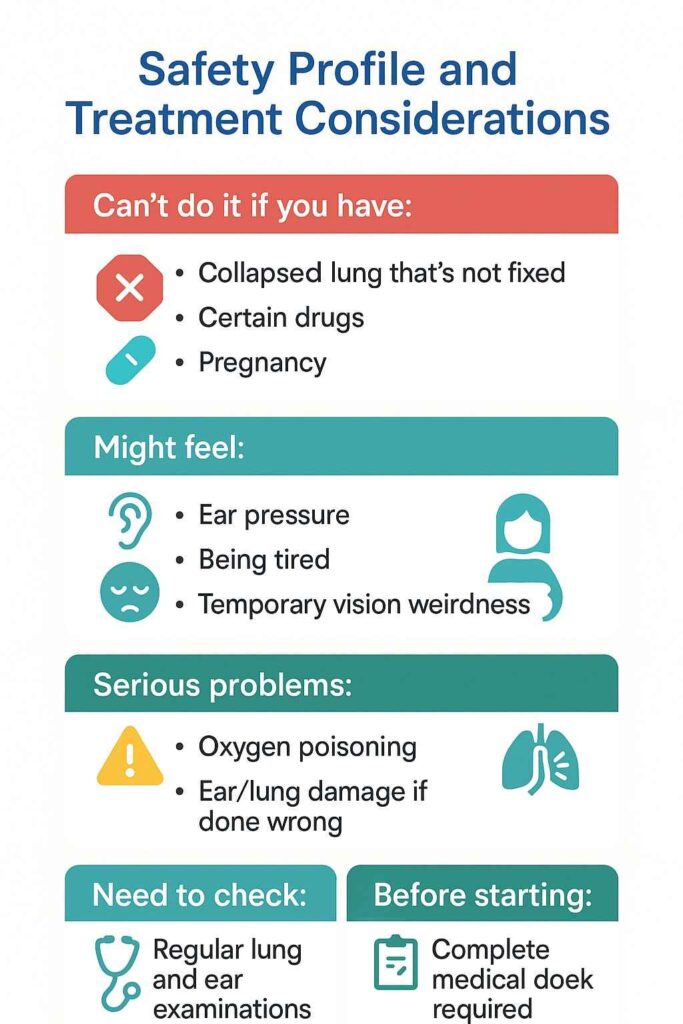
Absolute contraindications include untreated pneumothorax and certain chemotherapy drugs. Relative contraindications include claustrophobia, middle ear or sinus disease, and a history of seizures. All Aviv protocol treatments require medical evaluation before starting and ongoing monitoring during sessions. This is not a consumer wellness product. It is a clinical protocol administered in specialized facilities with trained medical staff.
How Long Is the Aviv Protocol?
| Phase | Duration | Sessions/Week | Oxygen Protocol | Pressure |
| Initial evaluation | 1 week | Medical assessment only | None | N/A |
| Treatment Round 1 | 4 weeks | 5 sessions | Intermittent hyperoxia | 2.0 ATA |
| Rest break | 1 week | No sessions | None | N/A |
| Treatment Round 2 | 8 weeks | 5 sessions | Modified protocol | 2.0 ATA |
| Follow-up monitoring | 3 months | Monthly visits | Assessment only | N/A |
Each session runs about 90 minutes including pressurization and depressurization. Active treatment time is roughly 60 minutes with the oxygen switching cycle. The sequence and timing of the oxygen cycles follow a defined protocol and cannot be replicated by a patient adjusting their own home chamber settings.
Limitations and Ongoing Questions
All of the published Aviv protocol evidence comes from a single research group at one institution in Israel. The findings appear in peer-reviewed journals and use objective measures, but independent replication by other groups has not yet been published. The scientific standard for generalizability requires that confirmation. This does not invalidate the work, but it means the landmark cognitive aging, telomere, and physical performance findings should be read as strong preliminary evidence awaiting confirmation, not established medical consensus.
The Aviv clinic model also operates commercially, providing a premium longevity service at significant cost. That does not mean the research is biased, but it is relevant context when weighing how enthusiastically the findings are communicated in public. For how these longevity applications sit within the broader performance literature, see our overview of HBOT for longevity and performance.
For patients and practitioners, the most defensible position is this: the Aviv protocol has produced the most rigorous HBOT research on cognitive aging published to date, the findings are clinically meaningful if replicated, and anyone pursuing this treatment should do so at a properly supervised medical facility using a hard chamber at 2.0 ATA, not a home soft-shell unit.
FAQs
How does Aviv HBOT differ from regular hyperbaric oxygen therapy?
Standard HBOT delivers a constant 100% oxygen concentration for the session duration. The Aviv protocol alternates between 100% oxygen and ambient air at 2.0 ATA, creating intermittent hyperoxia-hypoxia cycles designed to maximize cellular adaptation responses. The pressure (2.0 ATA) is similar to standard clinical HBOT, but the oxygen delivery pattern is different.
How long does it take to see results?
Published trials show measurable cognitive improvements on objective tests after completing the full protocol (40 to 60 sessions). Brain perfusion changes on MRI have been documented by the end of the treatment course. Individual variation exists, and preliminary results within the first 20 to 30 sessions are not consistently documented in the published literature.
Can the Aviv protocol be done in a home chamber?
No. Home soft-shell chambers cannot replicate the Aviv protocol. They operate at 1.3 to 1.5 ATA and typically deliver ambient air rather than pure oxygen. The published evidence requires hard-shell chambers at 2.0 ATA with medical-grade oxygen. The oxygen-switching component also requires clinical-grade equipment and medical supervision to execute safely.
Is the Aviv protocol covered by insurance?
In most cases, no. The cognitive aging, longevity, and anti-aging applications are not FDA-cleared indications and are typically not covered by insurance. Patients should expect to pay out of pocket. Some facilities offer financing for multi-month protocols.
How many sessions are typically needed?
The published cognitive aging RCT used 60 sessions over 3 months, five sessions per week. The post-COVID trial used 40 sessions. Most Aviv clinic programs are structured around 40 to 60 sessions depending on the indication and individual response. Some conditions may require modified approaches based on interim assessment.
Sources
- Efrati S, Ben-Jacob E. Reflections on the neurotherapeutic effects of hyperbaric oxygen. Expert Rev Neurother. 2014;14(3):233-236. DOI: 10.1586/14737175.2014.884928
- Hadanny A, Daniel-Kotovsky M, Suzin G, et al. Cognitive enhancement of healthy older adults using hyperbaric oxygen: a randomized controlled trial. Aging. 2020;12(13):13740-13761. DOI: 10.18632/aging.103571
- Hachmo Y, Hadanny A, Abu Hamed R, et al. Hyperbaric oxygen therapy increases telomere length and decreases immunosenescence in isolated blood cells: a prospective trial. Aging. 2020;12(22):22445-22456. DOI: 10.18632/aging.202188
- Hadanny A, Sasson E, Copel L, et al. Physical enhancement of older adults using hyperbaric oxygen: a randomized controlled trial. BMC Geriatr. 2024;24:537. DOI: 10.1186/s12877-024-05146-3
- Zilberman-Itskovich S, Catalogna M, Sasson E, et al. Hyperbaric oxygen therapy improves neurocognitive functions and symptoms of post-COVID condition: randomized controlled trial. Sci Rep. 2022;12:11252. DOI: 10.1038/s41598-022-15565-0
Medical Disclaimer
The content on BaricBoost.com is for informational purposes only and is not intended as a substitute for professional medical advice, diagnosis, or treatment. Always seek the advice of your physician or other qualified health provider with any questions you may have regarding a medical condition. Never disregard professional medical advice or delay in seeking it because of something you have read on this website.

Author
Seph Fontane Pennock is the founder of BaricBoost.com and Regenerated.com, a clinic directory for regenerative medicine serving 10,000+ providers across the United States. He previously built and sold PositivePsychology.com, which grew to 19 million users and became the largest evidence-based positive psychology resource on the web. Seph brings direct experience as an HBOT patient, having completed protocols at clinics across three continents while navigating mold illness, systemic inflammation, and autoimmune conditions. His treatment journey includes hyperbaric oxygen therapy, peptide protocols, NAD+ therapy, and consultations with specialists from Dubai to Cape Town to Mexico. This combination of entrepreneurial track record and lived patient experience shapes everything published on BaricBoost.com. Every article is grounded in peer-reviewed research, informed by real clinical encounters, and written for patients making high-stakes treatment decisions. Seph's focus is on bringing transparency, scientific rigor, and practical guidance to the hyperbaric oxygen therapy space.
Why Trust Our Evaluations
Our rankings are based on hands-on testing, published clinical data, and verified manufacturer specifications. We apply the same criteria to every product regardless of affiliate status. Editorial Process · Evaluation Methodology