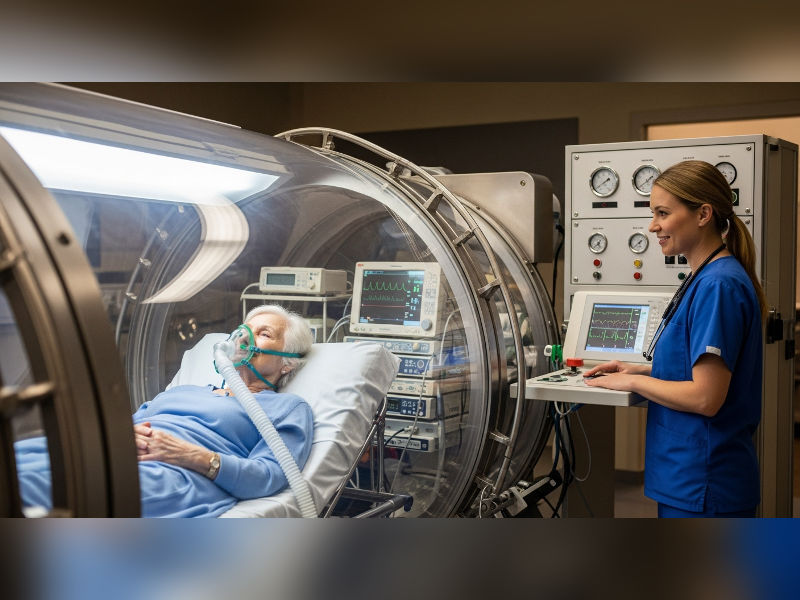
No FDA-approved HBOT protocol exists for Alzheimer’s disease, and zero large Western double-blind sham-controlled trials have been completed. The evidence is early. Animal models show reduced amyloid plaque burden, one meta-analysis of small China-only trials reports an average gain of roughly 3 points on the 30-point MMSE cognitive scale, and a handful of case reports document improvement over hundreds of sessions. HBOT is one of several hyperbaric therapies for brain conditions still under investigation, used off-label rather than as standard care.
Quick definitions
MMSE: Mini-Mental State Examination, a 0 to 30 cognitive screening score. Higher is better.
ADAS-Cog: Alzheimer’s Disease Assessment Scale, Cognitive subscale. Lower is better, so a negative change means improvement.
Off-label: a legal use of a treatment for a condition it is not FDA-approved to treat. Alzheimer’s is an off-label use of HBOT.
How Does Oxygen Deprivation Affect Alzheimer’s Progression?
The brain uses about 20% of the body’s oxygen while making up only 2% of body weight, so it is uniquely vulnerable when oxygen delivery falls. In Alzheimer’s, blood vessels become less efficient and struggle to supply neurons, plaques and tangles accumulate, and reduced blood flow appears years before symptoms begin. Low brain oxygen also runs through the wider research on hyperbaric oxygen therapy for mental health, where mood and cognition are closely linked.
The rationale for HBOT is to raise dissolved oxygen enough to reach tissue that red blood cells no longer supply well. Inside a hard chamber at 1.5 to 2.0 ATA breathing 100% oxygen, plasma oxygen rises to levels not reachable with normal breathing. Whether that translates into meaningful, durable cognitive benefit is exactly what the current evidence cannot yet confirm.
Does HBOT Increase Blood Flow in the Alzheimer’s Brain?
The most consistent laboratory finding is improved cerebral blood flow, mostly from animal work. Shapira and colleagues (2021) used the 5XFAD Alzheimer’s mouse model alongside a group of elderly patients with memory decline. In mice, HBOT increased arteriolar diameter, raised cerebral blood flow, and reduced amyloid plaque burden by shrinking existing plaques and limiting new formation. In the elderly cohort, increases in cerebral blood flow on imaging tracked with better cognitive performance after 60 sessions.
These are encouraging mechanistic signals, but the human portion was a small, uncontrolled cohort, not a randomized trial. The table below summarizes what the main studies actually reported, and at what level of evidence, so the mouse and human findings are not read as more than they are.
What the Alzheimer’s HBOT Studies Actually Report
| Finding | Where it comes from | Evidence type |
|---|---|---|
| Reduced amyloid plaque, wider arterioles, higher cerebral blood flow | Shapira et al., 2021 (5XFAD mice) | Animal model |
| Increased cerebral blood flow correlating with cognition after 60 sessions | Shapira et al., 2021 (elderly cohort) | Small uncontrolled human cohort |
| MMSE and ADAS-Cog improvement | Lin et al., 2024 meta-analysis | 11 small China-only RCTs |
| Restored mitophagy, reduced neuroinflammation | Yao et al., 2025 (5xFAD mice) | Animal model |
| Stable cognition over 400+ sessions | Mukaetova-Ladinska et al., 2023 | Single case report |
Does HBOT Reduce Brain Inflammation in Alzheimer’s?
Small trials report reductions in oxidative stress and inflammatory markers, though the underlying studies are limited in quality. The 2024 Lin meta-analysis found HBOT reduced malondialdehyde (an oxidative stress marker, SMD = -2.83, p=0.02), increased superoxide dismutase (an antioxidant enzyme, SMD = 2.12, p<0.0001), and reduced IL-1-beta (SMD = -1.00, p<0.0001). Participants completing 40 sessions showed the clearest marker changes. These are biochemical outcomes from the same pool of small China-only trials, so they support the biological rationale more than they prove clinical benefit.
Can HBOT Improve Memory in Alzheimer’s Patients?
Early trials report cognitive gains, but the size and quality of the evidence mean these numbers should be read with caution, not as settled proof. The Lin 2024 meta-analysis of 11 RCTs (847 participants) found an MMSE improvement of 3.08 points (95% CI 2.56 to 3.61, p<0.00001), an ADAS-Cog change of -4.53 (95% CI -5.05 to -4.00), and improved activities of daily living, with no significant increase in adverse events. Every one of those 11 trials was conducted in China between 2007 and 2021, none was a Western sham-controlled trial, and the authors flag methodological limits. So the 3.08-point figure travels only with that caveat: it comes from small, single-region studies that no rigorous Western replication has yet confirmed.
A long-term case report adds a striking but singular data point: a patient with probable Alzheimer’s who received over 400 HBOT sessions across 7 years maintained stable cognition, kept driving independently, and showed no major decline on neuroimaging (Mukaetova-Ladinska et al., 2023). A single case cannot establish efficacy, but its detailed documentation makes it noteworthy. Families exploring adjacent conditions can compare notes on our pages for HBOT for dementia and HBOT for memory loss.
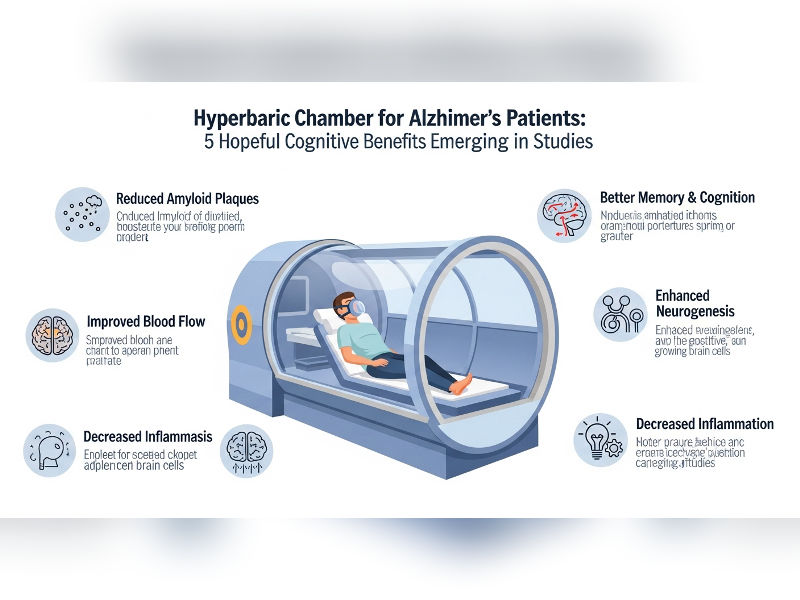
At the cellular level, neurons need constant ATP, and mitochondrial dysfunction is part of Alzheimer’s pathology. A 2025 study in the 5xFAD mouse model found HBOT restored mitophagy, the process that clears damaged mitochondria, and suppressed neuroinflammation, pointing to one possible pathway (Yao et al., 2025). This remains animal-model work.
How Reliable Is the Alzheimer’s HBOT Evidence?
Scientists are clear about the limits. The 11 trials in the main meta-analysis were all China-only and published between 2007 and 2021, and no large Western double-blind sham-controlled trial in Alzheimer’s patients has been published. The mechanisms are not settled either, whether benefit would come from oxygen delivery, vascular improvement, reduced inflammation, or mitochondrial repair, and genetic factors such as APOE4 status may change who responds.
An ongoing clinical trial (NCT05349318) is studying HBOT for prodromal Alzheimer’s disease and may provide the first large Western dataset. Until rigorous replication exists, HBOT for Alzheimer’s should be treated as investigational. The same pattern holds across HBOT for neurological conditions generally: early signals that need validation by larger, well-designed studies.
What Protocol and Safety Considerations Apply?
HBOT carries known risks, and these increase in elderly patients with multiple conditions. Common side effects are minor: ear discomfort from pressure changes, temporary vision changes, and some claustrophobia. The Lin 2024 meta-analysis reported no significant increase in adverse events across 847 patients (OR = 1.17, p=0.58), which is meaningful safety data even given the study limits.
Protocols used in the trials generally involve:
- Sessions of 60 to 90 minutes at pressure
- Pressures of 1.5 to 2.0 ATA
- Five sessions weekly for 8 to 12 weeks (40 to 60 sessions total)
- 100% oxygen in a hard chamber
The cost is substantial. Clinical sessions run $150 to $300, so a full protocol can total $6,000 to $18,000, and insurance rarely covers off-label use for Alzheimer’s. Anyone considering it should work with experienced physicians and treat it as a possible adjunct, not a replacement, for standard dementia care.
Who Should Not Try HBOT?
HBOT is generally safe under trained supervision, but it is not appropriate for everyone. Discuss your full medical history with your provider first.
Absolute contraindications
- Untreated pneumothorax (collapsed lung), because pressure changes can make it life-threatening
- Certain chemotherapy drugs (bleomycin, cisplatin, doxorubicin, disulfiram), which can interact dangerously with high-oxygen environments
Relative contraindications (extra caution or postponement)
- Upper respiratory infection or sinus congestion, which makes ear and sinus barotrauma more likely
- Seizure disorder, since high-pressure oxygen can lower the seizure threshold
- Chronic obstructive pulmonary disease (COPD), which may need modified protocols
- High fever, which raises oxygen-toxicity risk
- History of ear surgery or chronic ear problems
- Claustrophobia, which may require a different chamber approach or sedation
Can HBOT reverse Alzheimer’s disease?
No. No current evidence supports reversal of Alzheimer’s. What small trials have shown is measurable change in cognitive scores, activities of daily living, and markers of inflammation and oxidative stress, mostly from China-only studies of limited quality (Lin et al., 2024). The most honest framing is HBOT as a possible tool to support function in selected patients, not to reverse established neurodegeneration.
How many sessions are used?
Most trials used 40 to 60 sessions over 8 to 12 weeks at 1.5 to 2.0 ATA. A long-term case report suggests ongoing periodic sessions may help sustain benefit over years, though no controlled trial has established an optimal maintenance schedule (Mukaetova-Ladinska et al., 2023). Any protocol should be set by an experienced hyperbaric physician.
Is it safe for elderly Alzheimer’s patients?
The Lin 2024 meta-analysis found no significant increase in adverse events across 847 elderly patients (OR = 1.17, p=0.58). HBOT is generally well tolerated in older adults in a supervised clinical setting. A thorough medical evaluation beforehand is essential, particularly to rule out contraindications such as untreated pneumothorax or active respiratory infection.
Is HBOT FDA-approved for Alzheimer’s?
No. HBOT is not FDA-approved for Alzheimer’s disease and is used off-label. Some clinics offer it under informed consent. For what current evidence supports across conditions, see our HBOT research page.
Sources
- Lin G, Zhao L, Lin J, et al. “Clinical evidence of hyperbaric oxygen therapy for Alzheimer’s disease: a systematic review and meta-analysis of randomized controlled trials.” Frontiers in Aging Neuroscience, 2024;16:1360148. doi:10.3389/fnagi.2024.1360148
- Shapira R, Gdalyahu A, Gottfried I, et al. “Hyperbaric oxygen therapy alleviates vascular dysfunction and amyloid burden in an Alzheimer’s disease mouse model and in elderly patients.” Aging, 2021;13(16):20935-20969. doi:10.18632/aging.203485
- Chen J, Zhang F, Zhao L, et al. “Hyperbaric oxygen ameliorates cognitive impairment in patients with Alzheimer’s disease and amnestic mild cognitive impairment.” Alzheimer’s and Dementia: Translational Research and Clinical Interventions, 2020;6(1):e12030. doi:10.1002/trc2.12030
- Mukaetova-Ladinska EB, Steptoe J, Critchfield M, et al. “Hyperbaric oxygen therapy, a new hope for Alzheimer’s patients: a case report and literature review.” Exploration of Neuroprotective Therapy, 2023;3:271-286. doi:10.37349/ent.2023.00062
- Somaa F. “A Review of the Application of Hyperbaric Oxygen Therapy in Alzheimer’s Disease.” Journal of Alzheimer’s Disease, 2021;81(2):519-530. doi:10.3233/JAD-210157
- Yao M, Li Z, Lin Y, et al. “Hyperbaric oxygen therapy ameliorates Alzheimer’s disease pathology by restoration of mitophagy and suppressing neuroinflammation in 5xFAD mice.” Experimental Neurology, 2025;385:115534. doi:10.1016/j.expneurol.2025.115534
- Shapira R, Efrati S, Ashery U. “Hyperbaric oxygen therapy as a new treatment approach for Alzheimer’s disease.” Neural Regeneration Research, 2018;13(5):817-818. doi:10.4103/1673-5374.232475
Medical Disclaimer
The content on BaricBoost.com is for informational purposes only and is not intended as a substitute for professional medical advice, diagnosis, or treatment. Always seek the advice of your physician or other qualified health provider with any questions you may have regarding a medical condition. Never disregard professional medical advice or delay in seeking it because of something you have read on this website.

Author
Seph Fontane Pennock is the founder of BaricBoost.com and Regenerated.com, a clinic directory for regenerative medicine serving 10,000+ providers across the United States. He previously built and sold PositivePsychology.com, which grew to 19 million users and became the largest evidence-based positive psychology resource on the web. Seph brings direct experience as an HBOT patient, having completed protocols at clinics across three continents while navigating mold illness, systemic inflammation, and autoimmune conditions. His treatment journey includes hyperbaric oxygen therapy, peptide protocols, NAD+ therapy, and consultations with specialists from Dubai to Cape Town to Mexico. This combination of entrepreneurial track record and lived patient experience shapes everything published on BaricBoost.com. Every article is grounded in peer-reviewed research, informed by real clinical encounters, and written for patients making high-stakes treatment decisions. Seph's focus is on bringing transparency, scientific rigor, and practical guidance to the hyperbaric oxygen therapy space.