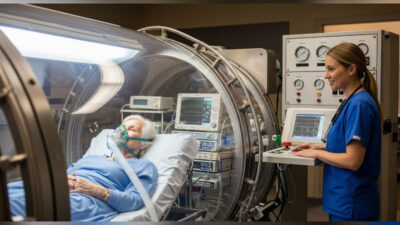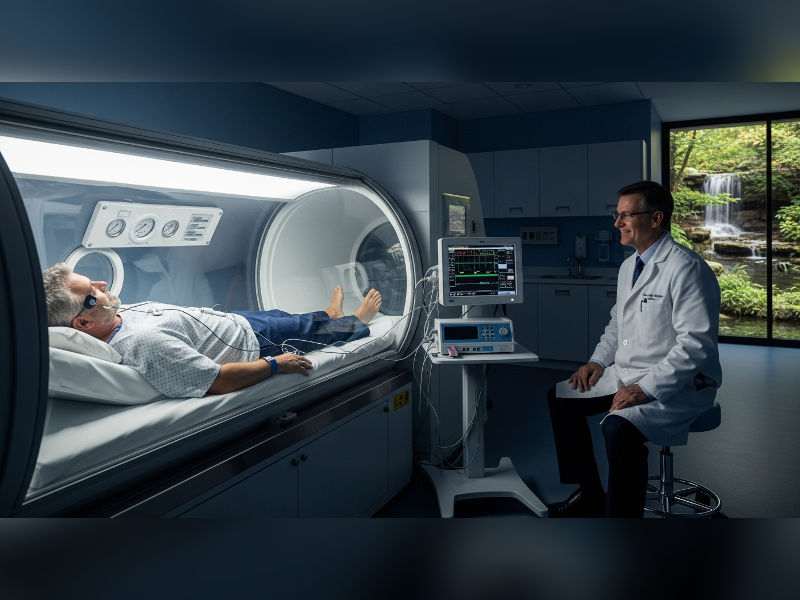
A 2024 meta-analysis of 14 randomized trials in 1,323 patients found that hyperbaric oxygen therapy improved motor and sensory nerve conduction velocity and raised the treatment-response rate in diabetic peripheral neuropathy when added to standard care. The effect is strongest for diabetic neuropathy at clinical pressures of 2.0 ATA and above. HBOT does not fully repair damaged nerves, and the trial evidence carries some publication bias.
Peripheral neuropathy is one of several neurological conditions studied with HBOT, and it overlaps with the broader group of pain conditions where hyperbaric oxygen has been investigated. Below is what the evidence supports, what it does not, and what treatment involves.
Table of Contents
How does HBOT work for neuropathy?
Nerve damage reduces local blood flow, which limits how much oxygen reaches the affected nerves. HBOT addresses that shortage directly. Inside the chamber you breathe 100 percent oxygen at 1.5 to 3 times normal atmospheric pressure, which dissolves oxygen straight into blood plasma rather than relying only on hemoglobin. Thom’s 2011 review in Plastic and Reconstructive Surgery describes how this raises oxygen delivery to poorly perfused tissue, reduces ischemia, and stimulates angiogenesis, the growth of new blood vessels.3
Higher tissue oxygen supports several repair processes at once: it reduces inflammation around nerve fibers, promotes new blood vessel formation, and supports the cellular machinery of nerve repair. Diabetic neuropathy, chemotherapy-induced neuropathy, and injury-related neuropathy all share reduced oxygen delivery as a common thread, which is the rationale for treating them with oxygen under pressure. Our guide to HBOT for diabetes covers the vascular side of diabetic nerve damage in more detail.
Key terms
- Nerve conduction velocity (NCV): the speed at which electrical signals travel along a nerve, a standard measure of nerve function; slower velocity indicates more damage.
- Peripheral neuropathy: damage to nerves outside the brain and spinal cord, causing pain, numbness, tingling, or weakness, most often in the hands and feet.
- Angiogenesis: the formation of new blood vessels, which restores oxygen and nutrient delivery to damaged tissue.
Does a hyperbaric chamber help neuropathy?
For diabetic peripheral neuropathy, the meta-analytic evidence points to measurable benefit. Weng and colleagues (2024) pooled 14 randomized controlled trials comparing HBOT plus standard therapy against standard therapy alone, covering 675 patients in the HBOT group and 648 controls.1 The HBOT group showed a significantly higher effective-treatment rate and significant gains in both motor and sensory nerve conduction velocity across the median, ulnar, peroneal, and tibial nerves. Adverse events were few. The authors also flagged publication bias in some outcomes, so the true effect may be smaller than the pooled estimate suggests.
For nerve injury more broadly, the signal is promising but earlier-stage. Brenna and colleagues (2023) published a scoping review of 51 studies on HBOT for perioperative peripheral nerve injury and reported HBOT as beneficial in 88 percent of them, with improved nerve regeneration or faster recovery and no major adverse events.2 The important caveat: 40 of those 51 studies were in animals and only 11 were in humans, so this is a positive direction that still needs randomized human trials, which the authors explicitly called for.
What the studies found
| Study | Design | Outcome |
|---|---|---|
| Weng et al., 2024 | Meta-analysis, 14 RCTs (1,323 patients) | Improved motor and sensory nerve conduction velocity and higher treatment-response rate in diabetic neuropathy |
| Brenna et al., 2023 | Scoping review, 51 studies (40 animal, 11 human) | HBOT beneficial in 88%; improved nerve regeneration and recovery time |
| Thom, 2011 | Mechanistic review | Oxygen dissolves into plasma, reduces ischemia, and stimulates angiogenesis |
Can a hyperbaric chamber heal nerve damage completely?
No. HBOT can improve nerve function and reduce symptoms, but it does not fully reverse established nerve damage. Nerve regeneration is inherently slow, with axons growing at roughly one millimeter per day, and severely damaged nerves may never recover completely. What the evidence supports is improved nerve conduction velocity and better symptom control in diabetic neuropathy, not a cure.
Some patients notice reduced pain within a few weeks, before any structural repair could be complete, likely because higher tissue oxygen and reduced inflammation change how damaged nerves signal pain. That early symptomatic change is real but should not be mistaken for full nerve regeneration. HBOT works best as an adjunct to the fundamentals: blood sugar control in diabetic neuropathy, and the same tissue-oxygen principles that make HBOT useful in wound healing and related chronic pain conditions such as fibromyalgia.
What to expect during treatment sessions
A neuropathy course typically runs 20 to 40 sessions. Each session lasts 60 to 90 minutes at 2.0 to 2.5 ATA while you breathe 100 percent oxygen, usually five days a week. Clinical-grade hard chambers reach the 2.0 ATA and above pressures the diabetic-neuropathy trials used; lower-pressure soft chambers were not the ones tested in that meta-analysis. During a session you rest in the chamber while it pressurizes over 10 to 15 minutes, holds pressure, then slowly depressurizes. Common short-term effects are ear or sinus pressure and, occasionally, temporary vision changes.
Is HBOT covered by insurance for neuropathy?
Coverage is limited. Medicare National Coverage Determination 20.29 covers HBOT for specific approved conditions, including diabetic wounds of the lower extremities that meet defined criteria, but peripheral neuropathy on its own is generally not a covered indication.4 Some private insurers follow similar rules. In practice, many neuropathy patients pay out of pocket unless they also have a qualifying diabetic foot wound. Confirm coverage in writing before starting a course, since a 20 to 40 session program is a significant cost.
Who should not try HBOT
HBOT is generally safe when delivered by trained professionals, but it is not appropriate for everyone. Discuss your full medical history with your provider first, and see our guide to HBOT side effects and risks for detail.
Absolute contraindications
HBOT should not be used if you have an untreated pneumothorax (collapsed lung), where pressure changes can become life-threatening, or if you take certain chemotherapy drugs (bleomycin, cisplatin, doxorubicin, and disulfiram may interact dangerously with high-oxygen environments). This is relevant for chemotherapy-induced neuropathy, where drug history must be reviewed carefully.
Relative contraindications
Extra precautions or postponement may be needed with an upper respiratory infection or sinus congestion (barotrauma risk), a seizure disorder, chronic obstructive pulmonary disease, high fever, a history of ear surgery or chronic ear problems, claustrophobia, or pregnancy. Always consult your physician first, especially if you use insulin, since blood sugar can drop during treatment, or have an implanted device.
Sources
- Weng J, Ren H, Guo Q, Huang K, Ding L. “Efficacy and safety of hyperbaric oxygen therapy for diabetes peripheral neuropathy: A systematic review and meta-analysis.” Medicine (Baltimore), 2024;103(36):e39699. doi:10.1097/MD.0000000000039699. PMID: 39252242
- Brenna CT, Khan S, Katznelson R, Brull R. “The role of hyperbaric oxygen therapy in the management of perioperative peripheral nerve injury: a scoping review of the literature.” Regional Anesthesia & Pain Medicine, 2023;48(9):443-453. doi:10.1136/rapm-2022-104113. PMID: 36418044
- Thom SR. “Hyperbaric Oxygen: Its Mechanisms and Efficacy.” Plastic and Reconstructive Surgery, 2011;127 Suppl 1:131S-141S. doi:10.1097/PRS.0b013e3181fbe2bf
- Centers for Medicare & Medicaid Services. “National Coverage Determination (NCD) for Hyperbaric Oxygen Therapy (20.29).” CMS.gov
Medical Disclaimer
The content on BaricBoost.com is for informational purposes only and is not intended as a substitute for professional medical advice, diagnosis, or treatment. Always seek the advice of your physician or other qualified health provider with any questions you may have regarding a medical condition. Never disregard professional medical advice or delay in seeking it because of something you have read on this website.

Author
Seph Fontane Pennock is the founder of BaricBoost.com and Regenerated.com, a clinic directory for regenerative medicine serving 10,000+ providers across the United States. He previously built and sold PositivePsychology.com, which grew to 19 million users and became the largest evidence-based positive psychology resource on the web. Seph brings direct experience as an HBOT patient, having completed protocols at clinics across three continents while navigating mold illness, systemic inflammation, and autoimmune conditions. His treatment journey includes hyperbaric oxygen therapy, peptide protocols, NAD+ therapy, and consultations with specialists from Dubai to Cape Town to Mexico. This combination of entrepreneurial track record and lived patient experience shapes everything published on BaricBoost.com. Every article is grounded in peer-reviewed research, informed by real clinical encounters, and written for patients making high-stakes treatment decisions. Seph's focus is on bringing transparency, scientific rigor, and practical guidance to the hyperbaric oxygen therapy space.