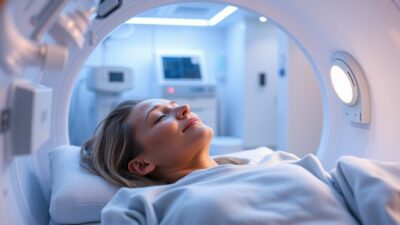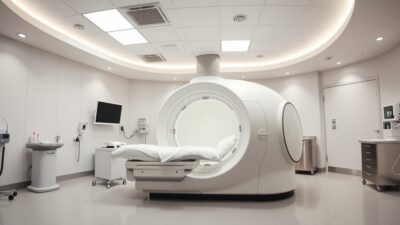
Hyperbaric oxygen therapy (HBOT) is a promising but not-yet-standard option for fibromyalgia. The strongest evidence is a 2015 randomized controlled crossover trial of 48 women (Efrati et al.) in which 40 sessions at 2.0 ATA reduced pain and normalized brain activity on SPECT imaging. Independent replication at scale has not been published, so HBOT remains an off-label choice to weigh with a clinician, not a proven treatment.
From the author
Fibromyalgia shares overlapping features with my own health journey, including central sensitization, fatigue, and widespread pain linked to systemic inflammation. The Efrati study was one of the papers that first drew my attention to HBOT as a serious clinical intervention rather than a wellness trend. Its use of SPECT imaging to show measurable brain changes was what moved HBOT from interesting to worth trying, for me.
Quick definitions
Central sensitization: when the nervous system turns up the volume on pain signals, so normal input feels painful. It is considered a core driver of fibromyalgia.
SPECT: single-photon emission computed tomography, an imaging scan that maps blood flow and activity in the brain.
2.0 ATA: two atmospheres of pressure, the level used in the Efrati protocol. Soft-shell home chambers cannot reach it.
How Does HBOT Work for Fibromyalgia?
Fibromyalgia is increasingly understood as a disorder of central pain processing rather than a problem in the muscles and joints themselves. Neuroinflammation, abnormal brain perfusion, and mitochondrial dysfunction are all thought to contribute to the widespread pain, fatigue, and cognitive difficulty that define it. HBOT targets several of these mechanisms at once.
Breathing 100% oxygen at elevated pressure has anti-inflammatory effects in neural tissue, which may calm the low-grade neuroinflammation thought to sensitize pain pathways. SPECT imaging in the Efrati trial showed fibromyalgia patients have abnormal blood flow in pain-processing regions, and that repeated HBOT sessions normalized those patterns (Efrati et al., 2015). By supporting neuroplasticity, HBOT may help recalibrate overactive pain circuits and raise the pain threshold. Fibromyalgia sits among the many conditions in our hub on HBOT for chronic conditions and the broader group of HBOT for pain conditions.
What Did the Efrati 2015 Study Find?
The anchor for HBOT in fibromyalgia is a randomized controlled crossover trial published in PLoS ONE in 2015, led by Dr. Shai Efrati at Tel Aviv University’s Sagol Center for Hyperbaric Medicine and Research. It enrolled 48 women diagnosed with fibromyalgia for at least two years, randomizing them to receive HBOT immediately or after a two-month control period, so every participant eventually received treatment while a proper comparison was preserved.
The protocol was 40 sessions at 2.0 ATA, each 90 minutes with air breaks, five days per week over eight weeks. Compared with the control period, women who received HBOT showed significant reductions in pain and tender-point counts, improved quality-of-life scores on the SF-36, reduced symptom severity on the Fibromyalgia Impact Questionnaire, and normalized brain SPECT imaging in regions tied to pain processing. In the authors’ summary, HBOT improved fibromyalgia symptoms and corrected the abnormal brain activity patterns seen on SPECT (Efrati et al., 2015).
The limitations matter. The trial was small (48 participants), all women, and the crossover design meant the control group waited only two months, so long-term placebo comparison was not possible. Blinding was not feasible because participants could tell they were in a pressurized chamber. These are reasons to treat the result as encouraging rather than definitive.
Is There Evidence Beyond the Efrati Study?
Several other studies point the same direction, though none match the Efrati trial in design quality. An early controlled study by Yildiz and colleagues (2004) treated fibromyalgia patients with HBOT at 2.4 ATA over 15 sessions and reported improved pain thresholds and fewer tender points, but it was small and short. Atzeni and colleagues (2019) ran a prospective observational study and again reported symptom improvement, though without a control group. A 2018 randomized controlled trial from the same Israeli research lineage (Hadanny et al.) examined HBOT in fibromyalgia patients with a history of childhood sexual abuse and reported clinical improvement alongside neuroplasticity changes on imaging.
A broader 2025 review of HBOT across rheumatic and immune conditions (Fang et al.) summarizes the mechanistic and clinical case for HBOT in these disorders but does not establish fibromyalgia-specific efficacy on its own. The honest picture: most positive data traces back to one research group, and independent, large-scale replication has not been published. The pending HOTFy randomized trial (da Mota Neto et al., 2023) is designed to test exactly that.
The Fibromyalgia HBOT Evidence at a Glance
| Study | Size and design | Finding |
|---|---|---|
| Efrati et al., 2015 | 48 women, randomized crossover | Reduced pain, normalized SPECT |
| Yildiz et al., 2004 | Small controlled study, 2.4 ATA | Improved pain thresholds, fewer tender points |
| Atzeni et al., 2019 | Prospective, observational (no control) | Reported symptom improvement |
| Hadanny et al., 2018 | RCT, sexual-abuse subgroup | Improvement with neuroplasticity changes |
| HOTFy (da Mota Neto), 2023 | Trial protocol, pending results | Designed to test independent replication |
It is worth being clear about where things stand: the evidence base is encouraging but not yet robust enough for HBOT to be a standard fibromyalgia treatment. Related off-label uses are covered in our pages on HBOT for autoimmune conditions and HBOT for Lyme disease.
What Is the Standard HBOT Protocol for Fibromyalgia?
Clinics offering HBOT for fibromyalgia generally follow the Efrati 2015 protocol, since it is the only one tied to a controlled trial:
- Pressure: 2.0 ATA
- Session length: 90 minutes of oxygen breathing with periodic air breaks
- Frequency: five sessions per week
- Course: 40 sessions over about eight weeks
- Chamber type: monoplace or multiplace hard-shell (soft-shell chambers cannot reach 2.0 ATA)
The daily schedule is deliberate. The Efrati study used consecutive sessions to maintain consistent oxygen exposure and drive cumulative neuroplastic change, and spacing sessions out has not been studied for fibromyalgia. Some patients pursue maintenance sessions afterward, typically one or two per week, though whether that sustains benefit is not established. For what a session involves, see our guide to HBOT sessions, and note that HBOT for fibromyalgia is not covered by insurance as an off-label use.
What Results Should You Expect?
Based on the available research and clinical reports, improvement tends to be gradual. Most patients notice little in the first two to three weeks, sometimes mild gains in sleep or brain fog, with temporary post-session fatigue as the body adjusts. Around sessions 15 to 30 is where the Efrati participants generally began experiencing noticeable pain reduction and clearer thinking. The final stretch, sessions 30 to 40, is where cumulative benefit tends to consolidate, though individual responses vary and not everyone responds.
After treatment, some patients hold improvements for months while others see symptoms return over weeks, which is why maintenance is sometimes used. HBOT is not a cure for fibromyalgia. The realistic goal is meaningful symptom reduction and better quality of life alongside existing fibromyalgia management, not remission. For what to watch for, see our guide to potential HBOT side effects.
Who Should Not Try HBOT?
HBOT is generally safe under trained supervision, but it is not appropriate for everyone. Discuss your full medical history with your provider first.
Absolute contraindications
- Untreated pneumothorax (collapsed lung), because pressure changes can make it life-threatening
- Certain chemotherapy drugs (bleomycin, cisplatin, doxorubicin, disulfiram), which can interact dangerously with high oxygen
Relative contraindications (extra caution or postponement)
- Upper respiratory infection or sinus congestion, which makes ear or sinus barotrauma more likely
- Seizure disorder, since high-pressure oxygen can lower the seizure threshold
- Chronic obstructive pulmonary disease (COPD), which may need modified protocols
- High fever, which raises oxygen-toxicity risk
- History of ear surgery or chronic ear problems
- Claustrophobia, which may require a different chamber approach or sedation
Also tell your physician if you take insulin, since blood sugar can drop during treatment, or if you have a pacemaker or implanted device.
Is HBOT FDA-approved for fibromyalgia?
No. HBOT is FDA-cleared for a specific set of conditions, and fibromyalgia is not among them, so this use is off-label. It is legal for clinics to offer and for patients to pursue, but it is not covered by insurance and is not recognized as a standard treatment by major medical organizations. The existing research, led by the Efrati 2015 trial, is promising but still considered preliminary (Efrati et al., 2015).
How much does a full course of HBOT for fibromyalgia cost?
A single HBOT session typically costs $200 to $400 depending on location and facility type, so a 40-session protocol generally runs $6,000 to $16,000. Some clinics offer package pricing that lowers the per-session rate. Because insurance does not cover HBOT for fibromyalgia, this is an out-of-pocket expense, so ask about payment plans and package discounts. See our hyperbaric chamber cost breakdown for more.
Can I use a home (soft-shell) chamber for fibromyalgia?
The evidence does not support it. Soft-shell portable chambers operate at 1.3 to 1.5 ATA using ambient air or oxygen concentrators, while the Efrati study that produced positive results used 2.0 ATA with 100% oxygen, a level soft-shell chambers cannot reach. No published research supports low-pressure chambers for fibromyalgia, so a clinical-grade hard-shell chamber at 2.0 ATA is the only approach backed by data (Efrati et al., 2015).
Sources
- Efrati S, Golan H, Bechor Y, et al. “Hyperbaric Oxygen Therapy Can Diminish Fibromyalgia Syndrome, Prospective Clinical Trial.” PLoS ONE, 2015;10(5):e0127012. doi:10.1371/journal.pone.0127012
- Yildiz S, Kiralp MZ, Akin A, et al. “A new treatment modality for fibromyalgia syndrome: hyperbaric oxygen therapy.” Journal of International Medical Research, 2004;32(3):263-267. PMID 15174219
- Atzeni F, Masala IF, Cirillo M, et al. “Hyperbaric oxygen treatment of fibromyalgia: a prospective observational clinical study.” Clinical and Experimental Rheumatology, 2019;37 Suppl 116(1):63-69. PMID 30747099
- Hadanny A, Bechor Y, Catalogna M, et al. “Hyperbaric Oxygen Therapy Can Induce Neuroplasticity and Significant Clinical Improvement in Patients Suffering From Fibromyalgia With a History of Childhood Sexual Abuse, Randomized Controlled Trial.” Frontiers in Psychology, 2018;9:2495. doi:10.3389/fpsyg.2018.02495
- da Mota Neto J, et al. “Protocol of HOTFy: randomised clinical trial to hyperbaric oxygen therapy in fibromyalgia.” BMJ Open, 2023;13:e069153. doi:10.1136/bmjopen-2022-069153
- Fang J, et al. “Clinical efficacy and mechanisms of hyperbaric oxygen therapy in the treatment of rheumatic and immune diseases.” Frontiers in Medicine, 2025;12:1706637. doi:10.3389/fmed.2025.1706637
Medical Disclaimer
The content on BaricBoost.com is for informational purposes only and is not intended as a substitute for professional medical advice, diagnosis, or treatment. Always seek the advice of your physician or other qualified health provider with any questions you may have regarding a medical condition. Never disregard professional medical advice or delay in seeking it because of something you have read on this website.

Author
Seph Fontane Pennock is the founder of BaricBoost.com and Regenerated.com, a clinic directory for regenerative medicine serving 10,000+ providers across the United States. He previously built and sold PositivePsychology.com, which grew to 19 million users and became the largest evidence-based positive psychology resource on the web. Seph brings direct experience as an HBOT patient, having completed protocols at clinics across three continents while navigating mold illness, systemic inflammation, and autoimmune conditions. His treatment journey includes hyperbaric oxygen therapy, peptide protocols, NAD+ therapy, and consultations with specialists from Dubai to Cape Town to Mexico. This combination of entrepreneurial track record and lived patient experience shapes everything published on BaricBoost.com. Every article is grounded in peer-reviewed research, informed by real clinical encounters, and written for patients making high-stakes treatment decisions. Seph's focus is on bringing transparency, scientific rigor, and practical guidance to the hyperbaric oxygen therapy space.