Affiliate Disclosure
This article contains affiliate links. If you purchase through these links, we may earn a commission at no additional cost to you. This does not influence our evaluations or rankings.
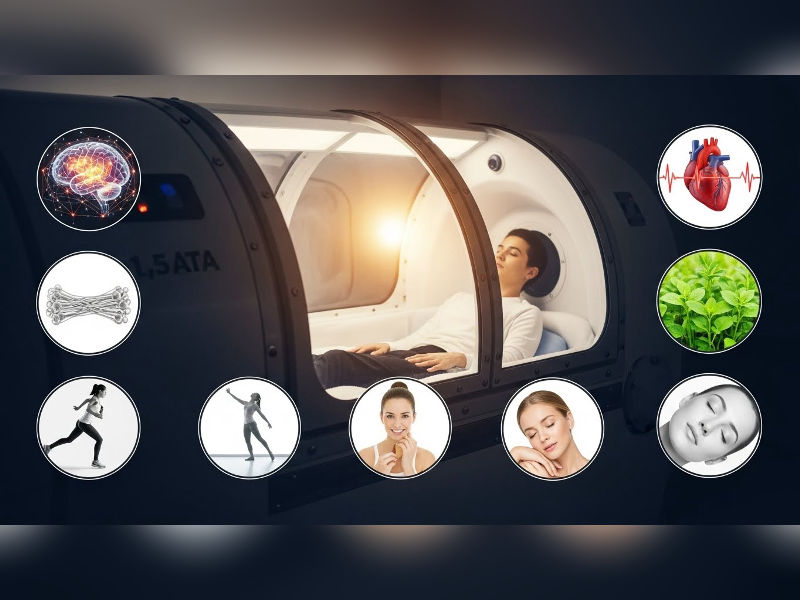
A 1.5 ATA hyperbaric chamber occupies a clinically significant position between soft home chambers (1.3 ATA) and standard clinical HBOT (2.0 ATA). At 1.5 ATA, oxygen crosses two important thresholds: the bacteriostatic threshold. The pressure at which oxygen begins to suppress bacterial and fungal growth. And the pressure at which the strongest mild HBOT research for traumatic brain injury was conducted.1,2
Understanding what 1.5 ATA delivers, which chambers reach it, and what the evidence actually shows helps buyers decide whether this pressure level is the right choice.
What 1.5 ATA Delivers Clinically
At 1.5 ATA with 100% oxygen, the partial pressure of O₂ reaches 1.5 ATA. Crossing the bacteriostatic threshold and entering the range where clinical trial evidence for mTBI begins to accumulate. This is not soft chamber territory (1.3 ATA with air) and it is not standard clinical territory (2.0 ATA). It is a middle zone with a specific evidence profile.
A 2022 systematic review by Harch on HBOT for mild traumatic brain injury (mTBI) and persistent postconcussion syndrome found that 1.5 ATA with 100% oxygen produced four positive randomized controlled trials meeting CEBM Level 1 evidence criteria. This was the strongest evidence level in the review. Stronger than results at 1.3 ATA (mixed) and stronger than results at 2.4 ATA (negative for mTBI specifically).2
Pressure Context: 1.5 ATA in the Spectrum
| Pressure | Key Threshold | Evidence for mTBI | Chamber Type |
|---|---|---|---|
| 1.3 ATA | Below bacteriostatic | Mixed (1 pos, 1 neg) | Soft shell home chambers |
| 1.5 ATA | Bacteriostatic threshold; bacteria/fungi suppressed | Strong (4 RCTs, Level 1) | Hard shell home models; some clinical |
| 2.0 ATA | Standard clinical minimum | Limited data for mTBI | Clinical monoplace standard |
| 2.4 ATA | Standard clinical | Negative for mTBI | Clinical standard for DCI, CO |
The pattern demonstrates that more pressure is not always better. For mTBI specifically, 1.5 ATA outperformed both lower and higher pressures in the best available evidence. The dose-response relationship in HBOT is condition-specific, not linear.2
Chambers That Reach 1.5 ATA
The FDA-cleared brands (OxyHealth, Summit to Sea, Newtowne) all cap at 1.3 ATA. Reaching 1.5 ATA requires stepping outside FDA-cleared territory:
| Model | Brand | Pressure | Type | Price | FDA |
|---|---|---|---|---|---|
| Apex32 / Apex36 | OxyRevo | 1.5 ATA | Soft shell | $8,499–$8,999 | No (CE) |
| Sitting Pod | Dr Hugo / LANNX | 1.5 ATA | Soft shell upright | $6,000–$10,000 | No (CE) |
| Eclipse Elite | Hyperbaric USA | 1.5 ATA | Hard shell | $21,450 | TBD |
| Zeugma Wellness | HPO Tech | 1.5 ATA | Hard shell aluminum | $15,000–$30,000 | No (CE) |
Safety at 1.5 ATA
At 1.5 ATA, adverse events increase slightly compared to 1.3 ATA but remain lower than clinical 2.0+ ATA protocols. A 2023 safety study at 1.45 ATA in 175 patients found adverse events in 7.1% of sessions, all limited to subjective earache with zero objective barotrauma. Significantly lower adverse event rates than at 1.5, 2.0, or higher pressures (p values significant).3
At 1.5 ATA with supplemental oxygen, fire risk increases compared to ambient-air soft chambers. Chambers operating at 1.5 ATA with an O₂ source require appropriate safety protocols. No open flames, no sparks, no synthetic fabrics with high static potential.
Who Is a Good Candidate for HBOT?
1.5 ATA with oxygen is worth considering for users specifically interested in the mTBI/postconcussion evidence base, users who have found 1.3 ATA insufficient, or those who want the bacteriostatic capability not achievable at lower pressures. For all other UHMS-approved conditions requiring 2.0+ ATA, see the 2.0 ATA hyperbaric chamber guide or the hospital hyperbaric chamber guide. For a comparison with 1.3 ATA options, see the mild hyperbaric chamber guide.
FAQs
Is 1.5 ATA considered clinical HBOT?
The UHMS minimum for approved indications is 1.4 ATA, and most protocols use 2.0+ ATA. At 1.5 ATA with 100% O₂, it is above the soft chamber level and crosses clinical thresholds for specific conditions. Particularly mTBI per the Harch 2022 review.
Do any FDA-cleared chambers reach 1.5 ATA?
Not currently. All three FDA-cleared portable brands (OxyHealth, Summit to Sea, Newtowne) are limited to 1.3 ATA. 1.5 ATA options carry CE certification only.
Is 1.5 ATA better than 2.0 ATA for everything?
No. For wound healing, radiation injury, and most UHMS indications, 2.0 ATA is the evidence-based standard. The 1.5 ATA advantage is specific to the mTBI evidence base. Pressure selection should match the condition being addressed.
References
References
- Sack RA et al. Transcutaneous oximetry in chronic ulcer patients at 1.4 vs 2.0 ATA. Undersea Hyperb Med. 2023. PMID: 38615347.
- Harch P. Systematic review and dosage analysis: HBOT in mTBI PCS. Front Neurol. 2022. PMID: 35370898. https://doi.org/10.3389/fneur.2022.815076
- Monge G et al. Safety of HBOT and evaluation of associated clinical parameters. Int J Transl Med Res Public Health. 2023. https://doi.org/10.21106/ijtmrph.430
- Laspro M et al. HBOT regimens, treated conditions, and adverse effect profile: UHMS survey. Undersea Hyperb Med. 2024. PMID: 39821765.
- Burman F. Low-pressure fabric hyperbaric chambers. S Afr Med J. 2019;109(4). PMID: 31084683. https://doi.org/10.7196/SAMJ.2019.v109i4.13934
Medical Disclaimer
The content on BaricBoost.com is for informational purposes only and is not intended as a substitute for professional medical advice, diagnosis, or treatment. Always seek the advice of your physician or other qualified health provider with any questions you may have regarding a medical condition. Never disregard professional medical advice or delay in seeking it because of something you have read on this website.

Author
Seph Fontane Pennock is the founder of BaricBoost.com and Regenerated.com, a clinic directory for regenerative medicine serving 10,000+ providers across the United States. He previously built and sold PositivePsychology.com, which grew to 19 million users and became the largest evidence-based positive psychology resource on the web. Seph brings direct experience as an HBOT patient, having completed protocols at clinics across three continents while navigating mold illness, systemic inflammation, and autoimmune conditions. His treatment journey includes hyperbaric oxygen therapy, peptide protocols, NAD+ therapy, and consultations with specialists from Dubai to Cape Town to Mexico. This combination of entrepreneurial track record and lived patient experience shapes everything published on BaricBoost.com. Every article is grounded in peer-reviewed research, informed by real clinical encounters, and written for patients making high-stakes treatment decisions. Seph's focus is on bringing transparency, scientific rigor, and practical guidance to the hyperbaric oxygen therapy space.
Why Trust Our Evaluations
Our rankings are based on hands-on testing, published clinical data, and verified manufacturer specifications. We apply the same criteria to every product regardless of affiliate status. Editorial Process · Evaluation Methodology