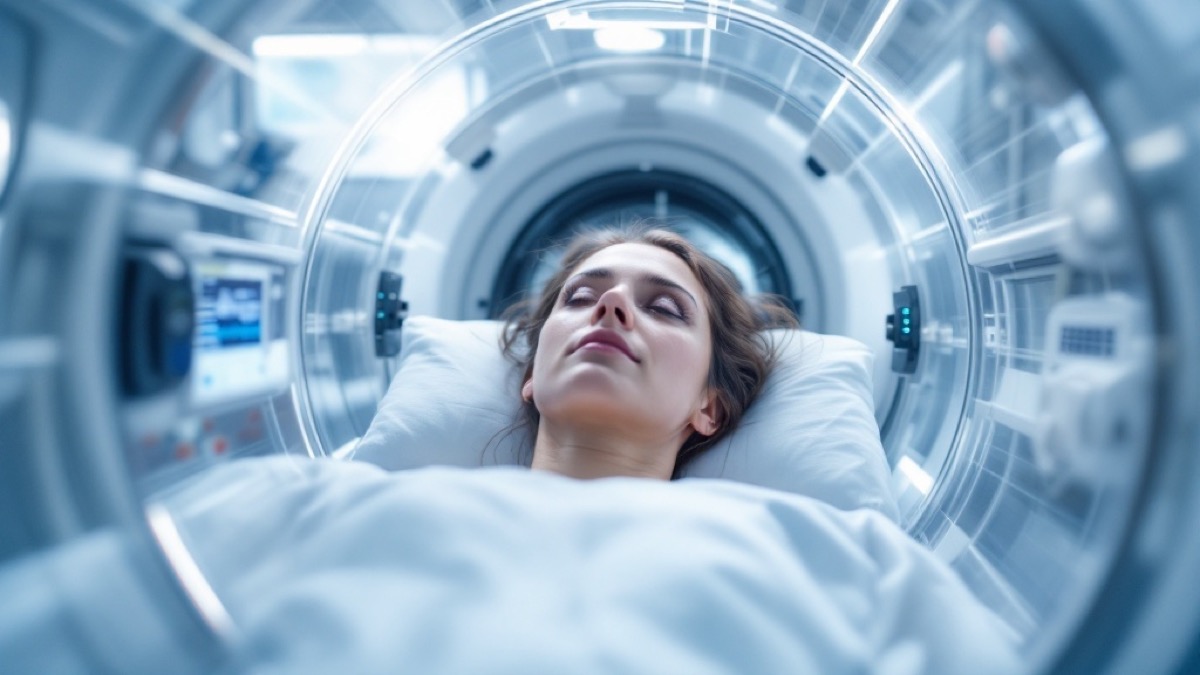
Normobaric oxygen therapy (NBOT) delivers 100% oxygen at normal atmospheric pressure. It sounds simple because it is. You breathe pure oxygen through a mask or nasal cannula without entering a pressurized chamber. No special equipment beyond an oxygen source and delivery system. No pressure changes. No ear equalization. And yet, for certain conditions, the clinical results are surprisingly compelling.
NBOT sits in an interesting space between standard supplemental oxygen and Hyperbaric Oxygen Therapy (HBOT). It delivers far more oxygen than room air (21% O2) but without the pressure component that defines HBOT. Understanding where NBOT works, where it falls short, and how it compares to HBOT helps you determine whether it is the right option for your situation.
Key Takeaways
- NBOT delivers 100% oxygen at 1.0 ATA (atmospheres absolute), meaning normal sea-level pressure with no pressurization.
- Israeli research from Tel Aviv University has shown significant neurological improvements using NBOT protocols for stroke and traumatic brain injury (TBI).
- NBOT is far cheaper and more accessible than HBOT, with no chamber required and minimal side effects.
- HBOT dissolves 10-15x more oxygen into blood plasma than NBOT because of pressure (Henry’s Law), making it superior for conditions requiring tissue-level hyperoxia.
- NBOT is commonly used in emergency medicine, post-stroke care, and as supplemental therapy for respiratory conditions.
What Is Normobaric Oxygen Therapy?
NBOT involves breathing 100% oxygen (or high-concentration oxygen, typically 60-100%) at ambient atmospheric pressure, which is 1.0 ATA at sea level. The delivery methods include:
- Non-rebreather mask: Delivers 60-90% oxygen at flow rates of 10-15 L/min. The most common method in clinical settings.
- High-flow nasal cannula (HFNC): Delivers heated, humidified oxygen at up to 60 L/min. Increasingly used in intensive care and emergency settings.
- Tight-fitting mask with reservoir: Can achieve near-100% oxygen concentration at adequate flow rates.
The key distinction from HBOT: there is no pressurized chamber. At 1.0 ATA, hemoglobin in red blood cells is already approximately 97% saturated with oxygen in healthy individuals. Breathing 100% O2 at ambient pressure pushes that saturation to near 100% and adds a modest amount of dissolved oxygen in plasma. This is meaningful but physically limited compared to what pressure achieves.
How NBOT Differs from HBOT
| Factor | NBOT | HBOT |
|---|---|---|
| Pressure | 1.0 ATA (no pressurization) | 1.3-3.0 ATA |
| Oxygen concentration | 60-100% inhaled | 100% inhaled |
| Dissolved plasma O2 | ~2 mL O2/dL plasma | ~6 mL O2/dL plasma (at 2.4 ATA) |
| Hemoglobin saturation | ~100% | ~100% |
| Equipment needed | Oxygen source + mask/cannula | Pressurized chamber + O2 supply |
| Session duration | 30 min – 24 hours (varies by indication) | 60-90 min per session |
| Cost per session | $0-50 (often covered by insurance) | $150-400 |
| Accessibility | Any hospital, many home care settings | Specialized HBOT centers |
| Side effects | Dry nose/throat, rare oxygen toxicity with prolonged use | Ear barotrauma, temporary myopia, rare seizure |
The physics make the difference clear. Henry’s Law states that the amount of gas dissolved in a liquid is proportional to the pressure of that gas above the liquid. At 1.0 ATA, plasma can dissolve about 2 mL of oxygen per deciliter. At 2.4 ATA, that jumps to roughly 6 mL/dL. For conditions where tissue-level hyperoxia is the therapeutic goal (wound healing, radiation injury, decompression sickness), this pressure difference is everything.
Normobaric oxygen delivers meaningful clinical benefit for acute neurological conditions at a fraction of HBOT’s cost and complexity. But for conditions requiring deep tissue oxygenation, the pressure component of HBOT is not optional.
Evidence for Stroke
The most compelling evidence for NBOT comes from stroke research. Acute ischemic stroke causes brain tissue damage through oxygen deprivation, and restoring oxygen delivery quickly is a logical therapeutic target.
Singhal et al. (2005) conducted a randomized pilot study at Massachusetts General Hospital comparing high-flow normobaric oxygen (45 L/min via face tent for 8 hours) to room air in acute ischemic stroke patients. The oxygen-treated group showed significant improvement on neuroimaging (reduced apparent diffusion coefficient lesion volumes) and clinical improvement at 24 hours, though the study was small (n=16) and the benefit did not reach statistical significance for all endpoints.
A larger body of animal research supports the concept. Wu et al. (2012) demonstrated in a rat stroke model that normobaric hyperoxia initiated within 30 minutes of stroke onset reduced infarct volume and improved neurological outcomes. The proposed mechanisms include:
- Maintaining tissue oxygenation in the ischemic penumbra (the tissue surrounding the core infarct)
- Reducing blood-brain barrier disruption
- Decreasing oxidative stress markers
- Extending the therapeutic window for other interventions
However, timing is critical. NBOT appears most beneficial when initiated very early after stroke onset (within 2-6 hours). Later application shows diminishing returns.
Evidence for Traumatic Brain Injury
Israeli researchers, including several from the Sagol Center at Tel Aviv University who are also known for their HBOT work, have investigated normobaric hyperoxia for TBI.
Tolias et al. (2004) studied normobaric hyperoxia (100% O2 for 24 hours) in severe TBI patients. Brain microdialysis monitoring showed that NBO improved brain tissue oxygenation and reduced markers of metabolic distress, including decreased lactate/pyruvate ratio, a measure of anaerobic metabolism indicating oxygen deprivation.
Subsequent studies have explored normobaric oxygen as a bridge therapy or adjunct to other TBI treatments. The evidence suggests that NBOT can improve cerebral oxygen tension and metabolic parameters, though whether this translates to improved long-term outcomes remains under investigation.
Other Clinical Applications
Beyond stroke and TBI, NBOT is used in several established and emerging applications:
- Carbon monoxide poisoning (mild cases): High-flow normobaric oxygen is the initial treatment for CO poisoning, accelerating the displacement of CO from hemoglobin. Severe cases are escalated to HBOT.
- Cluster headaches: 100% oxygen at 12-15 L/min via non-rebreather mask is an established, evidence-based treatment for acute cluster headache attacks, with response rates of 78% within 15 minutes (Cohen et al., 2009).
- Acute respiratory distress: HFNC oxygen therapy has become a cornerstone of ICU care for respiratory failure.
- Post-surgical recovery: Supplemental oxygen in the immediate post-operative period reduces wound infection rates and improves healing in some surgical contexts.
- Neonatal care: Controlled normobaric oxygen is essential in neonatal intensive care for premature infants with underdeveloped lungs.
The Israeli NBOT Studies: Context and Significance
Researchers at Tel Aviv University and the Shamir Medical Center have been at the forefront of oxygen therapy research for neurological conditions. While their most publicized work involves HBOT (including the Efrati et al., 2020 telomere study published in Aging and the Tel Aviv randomized controlled trial for long COVID by Zilberman-Itskovich et al., 2022, published in Scientific Reports), they have also contributed to understanding normobaric oxygen’s role.
Their research framework treats oxygen therapy as a spectrum: from supplemental oxygen (low flow, normobaric) to normobaric hyperoxia (100% O2, ambient pressure) to mild HBOT (1.3 ATA) to medical HBOT (2.0-2.4 ATA). Each point on this spectrum has different physiological effects and clinical applications. The pressure component is what activates specific gene expression changes and neuroplasticity pathways that NBOT alone cannot trigger.
Cost Comparison with HBOT
| Factor | NBOT | HBOT |
|---|---|---|
| Equipment cost | Oxygen concentrator: $500-2,000; Hospital O2 supply: provided | Soft chamber: $4,000-20,000; Hard chamber: $75,000-250,000+ |
| Per-session cost | $0-50 (often included in hospital stay; minimal cost for home use) | $150-400 per session |
| Course of treatment | Variable (hours to days for acute conditions) | $5,000-15,000 (20-40 sessions) |
| Insurance coverage | Generally covered for approved indications | Covered for 14 FDA-cleared indications; denied for off-label |
| Home use feasibility | Yes, with prescription oxygen | Soft chambers available; hard chambers require clinical setting |
The cost difference is substantial. For conditions where NBOT provides meaningful benefit (cluster headaches, mild CO poisoning, acute stroke support), it delivers value at a fraction of HBOT’s price. For conditions requiring the pressure-driven mechanisms of HBOT (wound healing, radiation injury, chronic neurological conditions), NBOT is not a substitute regardless of cost.
When NBOT Makes Sense and When It Does Not
NBOT is a reasonable option when:
- You need acute oxygen support for a time-sensitive condition (stroke, CO poisoning, cluster headache)
- HBOT is unavailable or impractical due to geography, cost, or medical contraindications (e.g., untreated pneumothorax)
- You are using supplemental oxygen as part of a broader treatment plan under medical supervision
NBOT is not sufficient when:
- The condition specifically requires tissue-level hyperoxia beyond what ambient pressure can deliver
- The therapeutic mechanism depends on pressure-related gene expression changes (angiogenesis, stem cell mobilization)
- HBOT has strong evidence for the condition and NBOT does not (radiation injury, diabetic wounds, decompression sickness)
The Bottom Line
Normobaric oxygen therapy is a straightforward, accessible, and affordable way to increase oxygen delivery to tissues. It has genuine clinical applications, particularly for acute neurological events, cluster headaches, and as a bridge therapy in emergency settings. The Israeli research tradition has shown that oxygen therapy exists on a spectrum, and normobaric hyperoxia occupies a meaningful point on that spectrum. But physics sets a hard limit: without pressure, you cannot dissolve enough oxygen into plasma to match what HBOT achieves. For conditions that need deep tissue oxygenation, NBOT is a starting point, not a destination.
- Singhal AB, et al. A pilot study of normobaric oxygen therapy in acute ischemic stroke. Stroke. 2005;36(4):797-802. doi:10.1161/01.STR.0000158914.66827.CE
- Wu O, et al. Normobaric hyperoxia in acute ischemic stroke: systematic review and meta-analysis. Cerebrovasc Dis. 2012;33(suppl 2):45. doi:10.1159/000340090
- Tolias CM, et al. Normobaric hyperoxia-induced improvement in cerebral metabolism and reduction in intracranial pressure in patients with severe head injury. J Neurosurg. 2004;101(3):435-444. doi:10.3171/jns.2004.101.3.0435
- Cohen AS, et al. High-flow oxygen for treatment of cluster headache: a randomized trial. JAMA. 2009;302(22):2451-2457. doi:10.1001/jama.2009.1855
- Efrati S, et al. Hyperbaric oxygen therapy can diminish fibromyalgia syndrome. PLoS One. 2015;10(5):e0127012. doi:10.1371/journal.pone.0127012
- Zilberman-Itskovich S, et al. Hyperbaric oxygen therapy improves neurocognitive functions and symptoms of post-COVID condition: randomized controlled trial. Sci Rep. 2022;12:11252. doi:10.1038/s41598-022-15565-0
Medical Disclaimer
The content on BaricBoost.com is for informational purposes only and is not intended as a substitute for professional medical advice, diagnosis, or treatment. Always seek the advice of your physician or other qualified health provider with any questions you may have regarding a medical condition. Never disregard professional medical advice or delay in seeking it because of something you have read on this website.

Author
Seph Fontane Pennock is the founder of BaricBoost.com and Regenerated.com, a clinic directory for regenerative medicine serving 10,000+ providers across the United States. He previously built and sold PositivePsychology.com, which grew to 19 million users and became the largest evidence-based positive psychology resource on the web. Seph brings direct experience as an HBOT patient, having completed protocols at clinics across three continents while navigating mold illness, systemic inflammation, and autoimmune conditions. His treatment journey includes hyperbaric oxygen therapy, peptide protocols, NAD+ therapy, and consultations with specialists from Dubai to Cape Town to Mexico. This combination of entrepreneurial track record and lived patient experience shapes everything published on BaricBoost.com. Every article is grounded in peer-reviewed research, informed by real clinical encounters, and written for patients making high-stakes treatment decisions. Seph's focus is on bringing transparency, scientific rigor, and practical guidance to the hyperbaric oxygen therapy space.