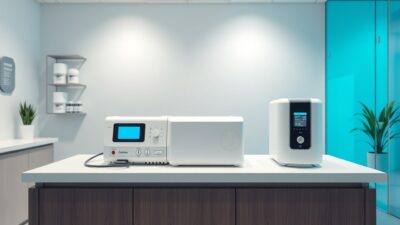
Ear insufflation is one of the simplest and least invasive forms of ozone therapy, and it is increasingly used by integrative practitioners for chronic and recurrent ear infections. The procedure involves directing humidified ozone gas into the ear canal, where it contacts the tympanic membrane and diffuses into the middle ear space. Proponents report that it can reduce infection duration, relieve pain, and decrease reliance on antibiotics for otitis media. The evidence base is small, but the safety profile is favorable and the procedure is straightforward enough that some patients perform it at home.
This guide covers how ear ozone insufflation works, what conditions it targets, the current evidence, pediatric considerations, and when antibiotics remain the better choice.
Key Takeaways
- Ear ozone insufflation delivers humidified ozone gas into the ear canal via a modified stethoscope or ear piece for 5 to 10 minutes per ear
- Ozone’s antimicrobial properties work through direct oxidation of bacterial and viral membranes at the site of infection1
- Clinical evidence is limited to case reports and small observational studies, with no published RCTs
- Practitioners report the best results for chronic serous otitis media and recurrent ear infections in children2
- The procedure has a strong safety record when ozone is properly humidified and delivered at low concentrations (10-20 mcg/mL)
- Antibiotics remain the standard of care for acute bacterial otitis media with fever, severe pain, or signs of complications
How Ear Ozone Insufflation Works
The ear canal provides a direct pathway to the middle ear. The tympanic membrane (eardrum) is semi-permeable, which allows ozone and its breakdown products to diffuse through into the middle ear space where infections typically occur.
A medical-grade ozone generator produces ozone at a low concentration, typically 10 to 20 mcg/mL. The ozone is humidified (critical to prevent drying and irritation of the ear canal) and directed into the ear through a modified stethoscope earpiece or a purpose-built ear insufflation adapter. The gas gently fills the ear canal for 5 to 10 minutes per side.
Ozone acts on ear infections through several mechanisms:
- Direct antimicrobial action: Ozone oxidizes bacterial cell membranes on contact. The most common pathogens in otitis media, including Streptococcus pneumoniae, Haemophilus influenzae, and Moraxella catarrhalis, are all susceptible to oxidative damage1
- Anti-inflammatory effect: Ozone modulates the NF-kB inflammatory pathway, potentially reducing the swelling and fluid accumulation that characterize middle ear infections
- Improved local oxygenation: By delivering reactive oxygen species to a poorly ventilated space (the middle ear behind a blocked Eustachian tube), ozone may improve the local environment for healing
- Biofilm disruption: Chronic ear infections often involve bacterial biofilms on the middle ear mucosa. Ozone has demonstrated biofilm-disrupting properties in vitro3
“The middle ear during chronic infection is a low-oxygen, biofilm-rich environment. Ozone addresses both factors simultaneously: delivering oxygen and disrupting the biofilm matrix that protects persistent bacteria.”
Conditions Treated with Ear Ozone Insufflation
| Condition | Description | Practitioner-Reported Response |
|---|---|---|
| Acute otitis media (AOM) | Acute middle ear infection with pain, fever, redness | May reduce duration and pain; not a replacement for antibiotics when indicated |
| Chronic serous otitis media | Fluid in middle ear without acute infection; common in children | Best-reported outcomes; may help resolve persistent fluid |
| Recurrent otitis media | 3+ infections in 6 months or 4+ in 12 months | Reported reduction in infection frequency |
| Otitis externa | Outer ear canal infection (swimmer’s ear) | Direct antimicrobial contact; reported rapid symptom improvement |
| Chronic sinusitis | Sinus infection (ozone reaches sinuses via Eustachian tube) | Some practitioners use ear insufflation for sinus-related symptoms |
What the Evidence Shows
The clinical evidence for ear ozone insufflation is limited. Most of the published literature consists of case reports, small observational studies, and practitioner reports rather than controlled clinical trials.
Sharma and Shah (2010) reported favorable outcomes in a series of patients with chronic suppurative otitis media treated with ozonated oil applied to the ear canal, noting reduced discharge and improved healing of tympanic membrane perforations.2
The broader ozone literature provides indirect support. Ozone’s antimicrobial properties are well-established against the specific bacteria that cause ear infections. Bocci (2011) documented ozone’s efficacy against gram-positive and gram-negative bacteria at therapeutic concentrations.1 And ozone’s ability to modulate inflammation through the NF-kB pathway has been demonstrated in multiple clinical contexts.
But direct evidence for ear insufflation as a treatment for otitis media remains at the case report level. No randomized controlled trials have been published comparing ear ozone insufflation to antibiotics, watchful waiting, or placebo for any type of ear infection.
Pediatric Considerations
Ear infections are primarily a pediatric condition. Over 80 percent of children will have at least one episode of acute otitis media by age three.4 This makes pediatric safety a critical question for ear ozone insufflation.
What practitioners report: Children generally tolerate ear insufflation well. The procedure is non-invasive, painless, and takes only a few minutes per ear. Some practitioners prefer it specifically for children with recurrent ear infections who face the prospect of repeated antibiotic courses or ear tube surgery (tympanostomy).
What to consider:
- Children cannot always communicate discomfort accurately, requiring careful observation during the procedure
- Ozone concentrations should be kept at the lower end of the therapeutic range (10-15 mcg/mL) for children
- The American Academy of Pediatrics guidelines on otitis media recommend a period of watchful waiting for non-severe cases, which creates a natural window where ozone insufflation could be tried5
- Children with ear tubes (patent tympanostomy tubes) should not receive ear insufflation, as ozone would pass directly into the middle ear without the tympanic membrane’s protective barrier
No published safety studies exist specifically for ear ozone insufflation in children. Practitioners who use it report a low adverse event rate, but this is observational, not systematically studied.
Home Ear Insufflation
Unlike most forms of ozone therapy, ear insufflation is simple enough that some patients perform it at home. Home ozone generators designed for personal use are available, and the ear insufflation setup requires minimal equipment: the generator, an oxygen source, a flow regulator, and a humidifier attachment with an ear piece.
Advantages:
- Eliminates per-session clinic costs after initial equipment investment
- Convenient for children with recurrent infections
- Can be used at the first sign of infection rather than waiting for a clinic appointment
Risks:
- Incorrect ozone concentration (too high can irritate; too low may be ineffective)
- Lack of proper humidification can dry and irritate the ear canal
- No professional assessment to rule out conditions that require medical attention (perforated eardrum, mastoiditis, cholesteatoma)
- Risk of delaying appropriate medical care for serious infections
Home equipment costs range from $800 to $2,500 for a medical-grade ozone generator with ear insufflation accessories. Lower-cost units under $500 exist but may lack precise concentration controls.
When Antibiotics Are Still Needed
Ozone therapy, whether at home or in a clinic, should not replace medical evaluation and antibiotics when they are clearly indicated. The American Academy of Pediatrics recommends antibiotics for:5
- Children under 6 months with acute otitis media
- Children 6 months to 2 years with bilateral AOM
- Any age with severe symptoms (fever above 39°C / 102.2°F, moderate to severe ear pain, symptoms lasting more than 48 hours)
- Any signs of complications (facial nerve involvement, mastoid tenderness, signs of intracranial spread)
For mild, unilateral AOM in children over 2 years, the AAP allows a 48 to 72 hour observation period. This is where ozone insufflation may have its most appropriate role: as a supportive therapy during watchful waiting, potentially reducing the need for antibiotics in cases that would have resolved on their own.
Costs
- In-clinic ear insufflation: $50 to $100 per session
- Typical protocol (6-10 sessions): $300 to $1,000
- Home ozone generator with ear kit: $800 to $2,500 (one-time investment)
- Ozonated ear oil (topical alternative): $15 to $35 per bottle
Insurance does not cover ozone therapy for ear infections.
The Bottom Line
Ear ozone insufflation is a low-risk, non-invasive therapy that targets the specific conditions present in infected middle ears: bacterial overgrowth, biofilm formation, inflammation, and poor oxygenation. Practitioners and patients report positive outcomes, particularly for chronic serous otitis media and recurrent infections in children.
The evidence base is too small to draw firm conclusions about efficacy. No controlled trials have been published, and the available data consists primarily of case reports and practitioner observations. For parents exploring alternatives to repeated antibiotics or ear tube surgery for their children, ear ozone insufflation is worth discussing with an integrative physician, with the understanding that strong clinical proof is still lacking.
References
- Bocci, V. (2011). Ozone: A New Medical Drug. Springer. doi:10.1007/978-90-481-9234-2
- Sharma, P., & Shah, A. (2010). Ozonated oil in chronic suppurative otitis media: A preliminary report. Indian Journal of Otology, 16(2), 87-89.
- Arita, M., et al. (2005). Microbicidal efficacy of ozonated water against biofilm-forming pathogens. Oral Microbiology and Immunology, 20(4), 206-210. doi:10.1111/j.1399-302X.2005.00213.x
- Teele, D.W., et al. (1989). Epidemiology of otitis media during the first seven years of life in children in greater Boston. Journal of Infectious Diseases, 160(1), 83-94. doi:10.1093/infdis/160.1.83
- Lieberthal, A.S., et al. (2013). The diagnosis and management of acute otitis media. Pediatrics, 131(3), e964-e999. doi:10.1542/peds.2012-3488
Medical Disclaimer
The content on BaricBoost.com is for informational purposes only and is not intended as a substitute for professional medical advice, diagnosis, or treatment. Always seek the advice of your physician or other qualified health provider with any questions you may have regarding a medical condition. Never disregard professional medical advice or delay in seeking it because of something you have read on this website.

Author
Seph Fontane Pennock is the founder of BaricBoost.com and Regenerated.com, a clinic directory for regenerative medicine serving 10,000+ providers across the United States. He previously built and sold PositivePsychology.com, which grew to 19 million users and became the largest evidence-based positive psychology resource on the web. Seph brings direct experience as an HBOT patient, having completed protocols at clinics across three continents while navigating mold illness, systemic inflammation, and autoimmune conditions. His treatment journey includes hyperbaric oxygen therapy, peptide protocols, NAD+ therapy, and consultations with specialists from Dubai to Cape Town to Mexico. This combination of entrepreneurial track record and lived patient experience shapes everything published on BaricBoost.com. Every article is grounded in peer-reviewed research, informed by real clinical encounters, and written for patients making high-stakes treatment decisions. Seph's focus is on bringing transparency, scientific rigor, and practical guidance to the hyperbaric oxygen therapy space.