Gum disease affects nearly half of all adults over 30 in the United States. Standard treatment involves scaling and root planing (deep cleaning), sometimes followed by surgery, antibiotics, or antimicrobial rinses. But a growing body of research suggests that ozone therapy can improve outcomes when used alongside these conventional approaches, particularly for reducing bacterial loads in periodontal pockets and supporting tissue healing.
Here is what the evidence actually shows about ozone for periodontal disease, how it is delivered, what it costs, and whether it is worth asking your dentist about.
Key Takeaways
- Ozone therapy reduces periodontal pathogens including Porphyromonas gingivalis and Aggregatibacter actinomycetemcomitans, the primary bacteria driving gum disease.
- A 2020 meta-analysis found ozone as an adjunct to scaling and root planing (SRP) significantly improved clinical attachment level and reduced probing pocket depth compared to SRP alone (Tene et al., 2020).
- Delivery methods include subgingival ozone gas irrigation, ozonated water rinses, and ozonated oil application.
- Ozone does not replace scaling and root planing. It works best as a complement to mechanical debridement.
- Cost ranges from $50-200 per session, typically not covered by insurance.
How Gum Disease Develops
Periodontal disease is a bacterial infection of the tissues surrounding and supporting the teeth. It progresses through stages:
- Gingivitis: Inflammation of the gums caused by bacterial plaque buildup. Reversible with proper hygiene and professional cleaning.
- Mild periodontitis: Bacteria penetrate below the gumline, forming pockets of 4-5 mm. Bone loss begins.
- Moderate to severe periodontitis: Pocket depths exceed 5-7 mm. Significant bone loss, tooth mobility, and potential tooth loss.
The key pathogens are anaerobic bacteria that thrive in the oxygen-poor environment of deep periodontal pockets. This is exactly why ozone is theoretically well-suited: it delivers reactive oxygen directly into an anaerobic environment, killing bacteria that depend on oxygen-free conditions to survive.
How Ozone Is Used for Periodontal Disease
Dentists and periodontists use ozone in three primary ways for gum disease:
1. Subgingival Ozone Gas Irrigation
A fine cannula delivers ozone gas directly into periodontal pockets after scaling and root planing. The gas penetrates the pocket, contacting bacteria on root surfaces, pocket walls, and within the soft tissue. Typical concentrations range from 20-40 mcg/mL with exposure times of 30-60 seconds per site.
2. Ozonated Water Rinse
Ozone dissolved in water (at concentrations of 2-8 mcg/mL) is used as a subgingival irrigant during or after SRP. Ozonated water has a shorter half-life than gaseous ozone but is easier to deliver and less technique-sensitive. Some practitioners also prescribe ozonated water as a home-use rinse for maintenance.
3. Ozonated Oil Application
Ozonated olive oil or sunflower oil is applied topically to the gum tissue after treatment. The ozonides (ozone reaction products) in the oil provide sustained antimicrobial activity for hours after application. This approach is also used between professional visits as part of a maintenance protocol.
What the Research Shows
The evidence for ozone in periodontal treatment has strengthened considerably in recent years:
| Study | Design | Key Finding |
|---|---|---|
| Tene et al., 2020 | Meta-analysis of RCTs | Ozone + SRP significantly improved clinical attachment level (CAL) and reduced probing pocket depth (PPD) vs SRP alone |
| Hayakumo et al., 2013 | RCT, split-mouth design | Subgingival ozonated water irrigation reduced P. gingivalis counts significantly more than saline irrigation after SRP |
| Schmidlin et al., 2009 | In vitro biofilm study | Gaseous ozone (24 sec) reduced periodontal biofilm viability by 64%. Longer exposure (120 sec) achieved greater reduction |
| Inactive et al., 2013 | Clinical comparative study | Ozone therapy + SRP produced greater PPD reduction at 3-month follow-up compared to SRP + chlorhexidine |
| Katti et al., 2020 | RCT | Subgingival ozone application after SRP improved both PPD and CAL at 1 and 3 months vs SRP alone |
Ozone therapy as an adjunct to scaling and root planing consistently outperforms mechanical cleaning alone for reducing pocket depth and improving clinical attachment, according to meta-analysis data. The effect is most pronounced in moderate pockets of 5-7 mm.
Ozone vs Scaling and Root Planing Alone
The research is clear on one point: ozone does not replace scaling and root planing. SRP remains the gold standard first-line treatment for periodontitis. The physical removal of calculus (tarite) and biofilm from root surfaces is something no antimicrobial agent can substitute.
Where ozone adds value is in the disinfection step that follows mechanical debridement:
- Deeper pocket penetration. Ozone gas diffuses into areas that curettes and ultrasonic scalers cannot reach, including root concavities, furcation areas, and deep pockets.
- Broader antimicrobial spectrum. Ozone kills bacteria, viruses, and fungi through oxidative mechanisms. Unlike antibiotics, it does not promote resistance.
- Anti-inflammatory effects. At controlled doses, ozone modulates the inflammatory response, potentially reducing tissue destruction and promoting healing.
- No bacterial resistance. The oxidative killing mechanism means bacteria cannot develop resistance to ozone, unlike antibiotics commonly used in periodontal treatment (doxycycline, metronidazole, amoxicillin).
Ozone vs Chlorhexidine
Chlorhexidine (CHX) is the most widely used antimicrobial rinse in periodontal treatment. How does ozone compare?
| Factor | Ozone | Chlorhexidine |
|---|---|---|
| Antimicrobial spectrum | Broad (bacteria, viruses, fungi) | Primarily bacteria |
| Resistance development | None documented | Possible with prolonged use |
| Side effects | Minimal at clinical doses | Tooth staining, taste alteration, mucosal irritation |
| Duration of action | Immediate but short-lived (gas); sustained (ozonated oil) | Substantivity: binds to oral tissues for 8-12 hours |
| Cost | $50-200 per professional application | $5-15 per bottle (OTC) |
| Home use | Ozonated water/oil available | Widely available OTC |
| Evidence strength | Growing (multiple RCTs, meta-analysis) | Strong (decades of research, gold standard) |
Chlorhexidine has a longer track record and is more accessible. Ozone has a broader antimicrobial spectrum and no resistance concerns. The two are not mutually exclusive, and some practitioners use both in combination.
What to Expect During Treatment
An ozone-assisted periodontal treatment session typically follows this sequence:
- Assessment: Probing pocket depths, bleeding on probing, and radiographic evaluation to determine disease severity.
- Scaling and root planing: Mechanical removal of calculus and biofilm, usually under local anesthesia for deep pockets.
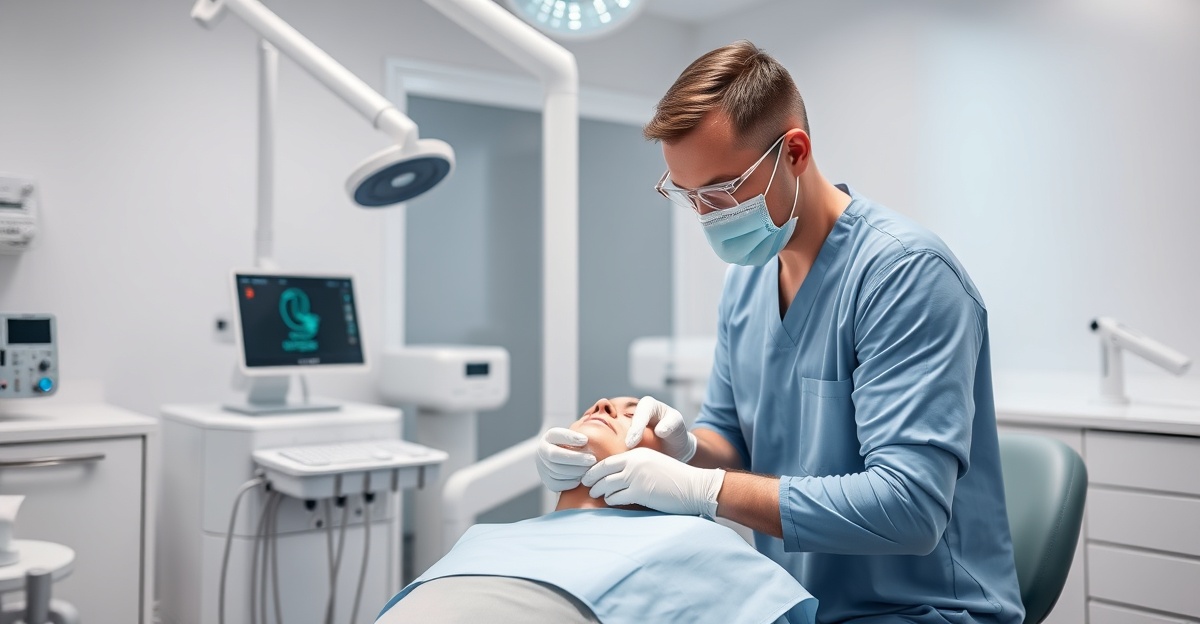
- Ozone application: Subgingival ozone gas or ozonated water irrigation of treated pockets. This step adds 10-15 minutes to the procedure.
- Topical application: Some practitioners apply ozonated oil to the treated areas for sustained antimicrobial effect.
- Follow-up: Re-evaluation at 4-6 weeks to assess healing, pocket depth changes, and whether additional treatment is needed.
Most patients report minimal discomfort from the ozone application itself. The ozone step does not require additional anesthesia beyond what is used for scaling and root planing.
Cost and Insurance
Ozone therapy for periodontal disease is not covered by dental insurance in the US. Out-of-pocket costs vary:
- Per-session cost: $50-200 for ozone application as an adjunct to SRP
- Number of sessions: Typically 1-3 sessions initially, then periodic maintenance every 3-6 months
- Home maintenance: Ozonated oil ($15-30/bottle) or ozonated water units ($100-300) for between-visit use
Compare this to the cost of SRP alone ($150-350 per quadrant) and the cost of periodontal surgery if disease progresses ($1,000-3,000+ per quadrant). If ozone therapy improves healing outcomes and reduces the need for surgical intervention, the upfront cost may pay for itself.
Maintenance Between Visits
Some practitioners recommend home-use ozone products to maintain the antimicrobial effect between professional cleanings:
- Ozonated water rinse: Swish with freshly ozonated water for 30-60 seconds daily. Requires a home ozone water generator (varies widely in quality).
- Ozonated olive oil: Apply a small amount to the gums after brushing. Acts as a sustained-release antimicrobial. Available commercially in dental-grade formulations.
- Oil pulling with ozonated oil: A traditional practice updated with ozone-infused oils. Limited evidence but some practitioners report patient satisfaction.
These home products should supplement, not replace, regular brushing, flossing, and professional maintenance visits.
Finding a Dentist Who Offers Ozone for Gum Disease
Ozone periodontal therapy is most commonly available through:
- Biological and holistic dental practices
- Periodontists who have adopted ozone technology
- Integrative dental clinics
Ask potential providers about their specific training in dental ozone therapy, what equipment they use, and how many periodontal patients they have treated with ozone. A practitioner who has incorporated ozone into their periodontal protocol for years is a different proposition from one who bought a device last month.
The Bottom Line
Ozone therapy is a promising adjunct to conventional periodontal treatment. The meta-analysis data supports its use alongside scaling and root planing for improving clinical attachment and reducing pocket depth. It kills periodontal pathogens without promoting resistance, reaches areas that mechanical instruments cannot, and adds minimal time or discomfort to the procedure. It is not a standalone treatment for gum disease, and it is not yet covered by insurance. But for patients with moderate to severe periodontitis who want to maximize their treatment outcomes, asking your periodontist about ozone is a reasonable step.
- Tene A, et al. Efficacy of ozone therapy as an adjunct to scaling and root planing in the treatment of chronic periodontitis: a meta-analysis. J Periodontal Res. 2020;55(4):467-477. doi:10.1111/jre.12736
- Hayakumo S, et al. Clinical and microbiological effects of ozone nano-bubble water irrigation as an adjunct to mechanical subgingival debridement in periodontitis patients. J Clin Periodontol. 2013;40(8):787-792. doi:10.1111/jcpe.12120
- Schmidlin PR, et al. Effect of gaseous ozone and hydrogen peroxide on Porphyromonas gingivalis. J Periodontal Res. 2009;44(4):488-495. doi:10.1111/j.1600-0765.2008.01145.x
- Katti SS, et al. Effect of subgingival ozone irrigation on clinical parameters and microbiological profile in periodontal pockets. J Indian Soc Periodontol. 2020;24(5):449-454. doi:10.4103/jisp.jisp_597_19
- Nogales CG, et al. Ozone therapy in medicine and dentistry. J Contemp Dent Pract. 2008;9(4):75-84. doi:10.5005/jcdp-9-4-75
- Sgolastra F, et al. Effectiveness of ozone therapy as an adjunctive treatment in chronic periodontitis: a systematic review. J Periodontal Res. 2014;49(4):428-437. doi:10.1111/jre.12128
Medical Disclaimer
The content on BaricBoost.com is for informational purposes only and is not intended as a substitute for professional medical advice, diagnosis, or treatment. Always seek the advice of your physician or other qualified health provider with any questions you may have regarding a medical condition. Never disregard professional medical advice or delay in seeking it because of something you have read on this website.

Author
Seph Fontane Pennock is the founder of BaricBoost.com and Regenerated.com, a clinic directory for regenerative medicine serving 10,000+ providers across the United States. He previously built and sold PositivePsychology.com, which grew to 19 million users and became the largest evidence-based positive psychology resource on the web. Seph brings direct experience as an HBOT patient, having completed protocols at clinics across three continents while navigating mold illness, systemic inflammation, and autoimmune conditions. His treatment journey includes hyperbaric oxygen therapy, peptide protocols, NAD+ therapy, and consultations with specialists from Dubai to Cape Town to Mexico. This combination of entrepreneurial track record and lived patient experience shapes everything published on BaricBoost.com. Every article is grounded in peer-reviewed research, informed by real clinical encounters, and written for patients making high-stakes treatment decisions. Seph's focus is on bringing transparency, scientific rigor, and practical guidance to the hyperbaric oxygen therapy space.