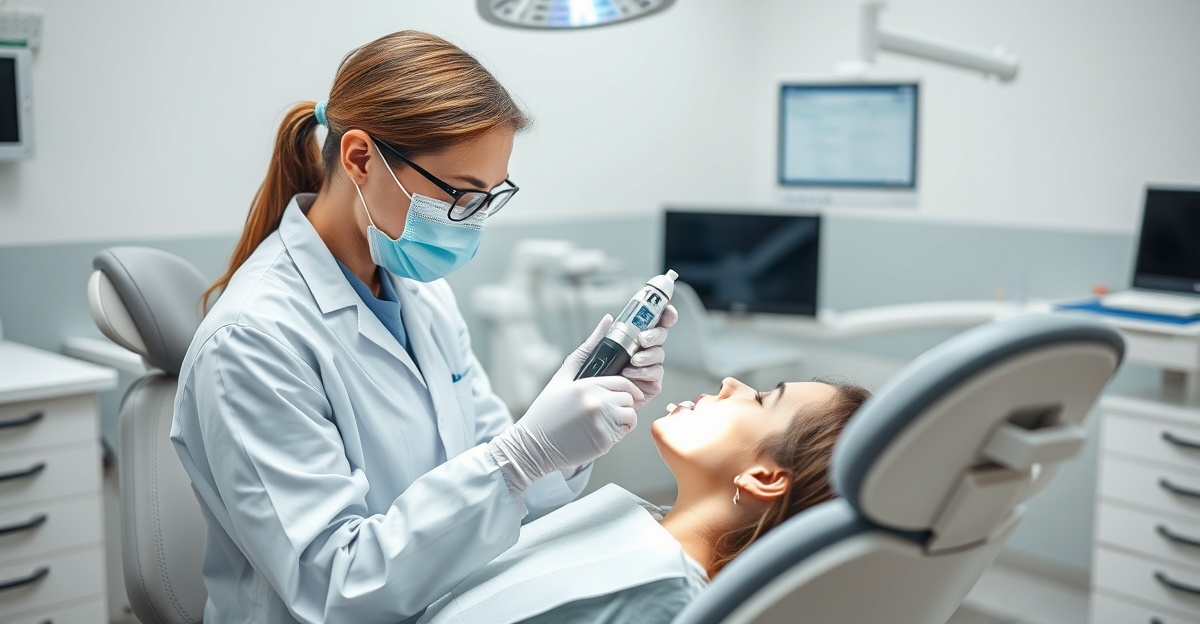
Ozone therapy in dentistry uses concentrated ozone gas (O3) to kill bacteria, promote remineralization, and treat cavities, gum disease, and root canal infections without drilling in many cases. The approach has been used in European dental practices since the 1990s, and a growing body of clinical evidence supports its effectiveness for specific dental applications.
Key Takeaways
- Dental ozone kills 99% of oral bacteria on contact within 10-20 seconds and promotes enamel remineralization
- Applications include early cavities, root canal disinfection, gum disease treatment, implant maintenance, and tooth sensitivity
- The HealOzone device was the first clinically validated system. Several newer devices are now available.
- A 2020 systematic review of 12 RCTs found promising results but called for larger, longer trials
- Cost ranges from $25 to $200 per treatment depending on the application
- Ozone works best for early-stage decay and as an adjunct to standard dental care. It does not replace treatment for advanced cavities.
How Dental Ozone Works
Ozone (O3) is an unstable molecule made of three oxygen atoms. When applied to tooth surfaces, it rapidly oxidizes bacterial cell walls, killing pathogens within seconds. This is not a gentle nudge. Research shows ozone eliminates up to 99.9% of common oral bacteria including Streptococcus mutans, the primary driver of tooth decay.1
Beyond killing bacteria, ozone triggers two additional processes that make it valuable in dentistry. First, it opens dentinal tubules, which allows remineralizing agents like fluoride and calcium phosphate to penetrate deeper into damaged enamel. Second, ozone shifts the local environment from acidic to alkaline, creating conditions that favor mineral deposition over mineral loss.2
Laboratory studies have shown that exposure to ozone for 40-50 seconds enhanced enamel microhardness and produced remineralization rates between 96.8% and 97.4%.3 These are remarkable numbers, though real-world clinical results depend on the severity of the lesion, the patient’s saliva quality, and follow-up care.
Dental Applications of Ozone Therapy
Early Cavities and Tooth Decay
This is where dental ozone has the strongest evidence. For early-stage cavities that haven’t broken through the enamel surface, ozone can sterilize the lesion and promote natural remineralization. The goal is to arrest decay before it reaches the point where drilling becomes necessary.
Baysan and Lynch conducted some of the earliest clinical trials using the HealOzone device on root caries lesions. Their research demonstrated that ozone application followed by a remineralizing solution produced statistically significant reversal of early root decay compared to controls.4
A 2020 systematic review and meta-analysis by Azarpazhooh and Limeback examined 12 randomized controlled trials comparing ozone therapy with other caries treatments. The review found promising results for ozone in managing early carious lesions, though the authors noted that the certainty of evidence was low and called for larger, longer trials.5
When nano-hydroxyapatite gel and ozone were combined in a randomized clinical trial, the highest rate of lesion remineralization reached 69.3% at one-year follow-up.6
Ozone as an Alternative to Root Canal
The idea of ozone replacing root canal therapy gets a lot of attention online, but the reality is more nuanced. Ozone cannot replace a root canal for a tooth with an established infection deep in the pulp. What it can do is disinfect the root canal system more thoroughly during the procedure itself.
A 2020 systematic review in the International Endodontic Journal evaluated ozone’s effectiveness for root canal disinfection. The review found that ozone, particularly in aqueous form delivered with ultrasonic activation, achieved antibacterial efficacy comparable to 5.25% sodium hypochlorite, the gold standard irrigant.7
Ozone gas can also reach areas that liquid irrigants miss: lateral canals, accessory canals, dentinal tubules, and the apical delta. This makes it a useful adjunct during root canal treatment rather than a replacement for it.8
“Exposure to ozone for 40-50 seconds enhanced enamel microhardness and produced remineralization rates between 96.8% and 97.4%.”
Tassery et al., Ozone Management in Primary Dentition, 2024
Ozone for Gum Disease
Periodontal disease affects nearly half of adults over 30. Ozone therapy is used as an adjunct to scaling and root planing (SRP), the standard non-surgical treatment for gum disease.
A 2025 meta-analysis by Liu et al. in BMC Oral Health analyzed studies comparing ozone-assisted SRP with SRP alone. The results showed statistically significant improvements in probing depth and gingival index in the ozone groups. However, no significant differences were found in bleeding on probing, plaque index, or clinical attachment level.9
Ozone can be delivered as gas, ozonated water, or ozonated oil for periodontal applications. Each form has different advantages. Gaseous ozone penetrates periodontal pockets effectively. Ozonated water provides broader surface coverage during irrigation. Ozonated oil offers sustained antimicrobial action when packed into pockets after treatment.
Dental Implants
Peri-implantitis, infection around dental implants, affects up to 22% of implant patients. Ozone shows promise for managing this condition because it can disinfect the implant surface without damaging the titanium. A systematic review found ozone to be a valid adjunctive therapy for peri-implantitis, though more controlled trials are needed.10
Tooth Sensitivity
Ozone application can reduce dentin hypersensitivity by sealing exposed dentinal tubules. The oxidative effect promotes the formation of a protective layer over exposed dentin, reducing fluid movement that triggers pain signals.
Ozone Delivery Systems in Dentistry
| Device | Type | Use Case | Status |
|---|---|---|---|
| HealOzone (KaVo) | Gas with suction cup | Cavities, root caries | Original clinical device, limited availability |
| OzoneDTA | Gas generator | Multiple dental applications | Currently available |
| Prozone (W&H) | Handpiece-based gas | Periodontal, endodontic | Currently available |
| Ozonated Water Systems | Aqueous ozone | Irrigation, periodontal | Multiple manufacturers |
| Ozonated Oils | Topical | Periodontal packing, sensitivity | Widely available |
The HealOzone, developed by Edward Lynch and commercialized by KaVo, was the first device specifically designed and clinically tested for dental ozone therapy. It uses a silicone cup that seals against the tooth surface, delivering a controlled concentration of ozone gas while simultaneously suctioning excess ozone to prevent inhalation.
What a Dental Ozone Session Looks Like
A typical ozone treatment takes 60 seconds to 5 minutes per tooth, depending on the application. Here’s what to expect:
For cavity treatment: The dentist places a small silicone cup over the affected tooth. Ozone gas flows through the cup at a concentration of 2,100 ppm for 40-60 seconds. You won’t feel pain. There’s no drilling, no anesthesia needed. After ozone application, a remineralizing solution is applied to the treated area. The whole process takes about 5 minutes per tooth.
For periodontal treatment: Ozone gas or ozonated water is applied to periodontal pockets during or after scaling and root planing. The dentist may use a syringe to irrigate with ozonated water or direct gas into deeper pockets with a fine cannula.
For root canal: During endodontic treatment, ozone gas or ozonated water is used as an additional disinfection step after standard instrumentation and irrigation. This adds 5-10 minutes to the procedure.
Cost of Dental Ozone Therapy
| Application | Typical Cost | Sessions Needed |
|---|---|---|
| Early cavity treatment | $25 – $75 per tooth | 1-3 sessions, 4-6 weeks apart |
| Periodontal ozone (adjunct to SRP) | $50 – $150 per quadrant | 1-2 sessions per quadrant |
| Root canal ozone disinfection | $50 – $100 add-on | Included in root canal visit |
| Implant maintenance | $50 – $100 | During regular maintenance visits |
| Sensitivity treatment | $25 – $75 | 1-2 sessions |
Most dental insurance plans do not cover ozone therapy. It is considered an elective or complementary treatment. Some dentists include ozone as part of their standard cavity management protocol without additional charge. Others bill it as a separate line item.
Finding an Ozone Dentist
Not every dentist offers ozone therapy. It requires specialized equipment and training. Here’s how to find a provider:
- International Academy of Oral Medicine and Toxicology (IAOMT) maintains a provider directory that includes dentists trained in ozone therapy
- American Academy of Ozone Therapy (AAO) offers a practitioner search tool
- Holistic and biological dentistry practices are more likely to offer ozone as part of their standard toolkit
- Ask specifically whether the practice uses ozone for your particular concern (cavities, gum disease, root canals) since not all ozone dentists offer every application
Limitations and What Ozone Cannot Do
Ozone therapy has real benefits in dentistry, but it also has clear boundaries:
- Advanced cavities: Once decay has created a large hole in the tooth structure, ozone cannot rebuild what’s lost. You still need a filling or crown.
- Deep infections: A tooth with an established pulp infection needs root canal therapy. Ozone alone will not resolve it.
- Structural damage: Cracked, broken, or severely eroded teeth require restorative work. Ozone addresses bacteria and mineral loss, not structural integrity.
- Evidence gaps: Most clinical trials are small (under 100 participants) and short-term (under 12 months). Long-term outcomes data is limited.
- Not FDA-approved for dental use: In the United States, ozone generators are not specifically FDA-cleared for dental applications. Dentists use them under their clinical judgment.
If you’re exploring ozone therapy as part of your dental care, look for a provider who uses it as part of a comprehensive treatment plan rather than as a standalone cure. The strongest evidence supports ozone as a complement to standard dental care, not a replacement for it.
Sources
- Nogales CG, Ferrari PH, Kantorovich EO, Lage-Marques JL. Ozone therapy in medicine and dentistry. J Contemp Dent Pract. 2008;9(4):75-84. doi:10.5005/jcdp-9-4-75
- Tassery H, et al. Ozone Treatment for the Management of Caries in Primary Dentition: A Systematic Review of Clinical Studies. Dentistry Journal. 2024;12(3):69. doi:10.3390/dj12030069
- Aoba T. Solubility properties of human tooth mineral and pathogenesis of dental caries. Oral Diseases. 2004;10(5):249-257. doi:10.1111/j.1601-0825.2004.01030.x
- Baysan A, Lynch E. The use of ozone in dentistry and medicine. Primary Dental Care. 2005;12(2):47-52. doi:10.1308/1355761053695158
- Azarpazhooh A, Limeback H. The application of ozone in dentistry: A systematic review of literature. Journal of Dentistry. 2008;36(2):104-116. doi:10.1016/j.jdent.2007.11.008
- Yilmaz HN, Tuna EB. Effect of nano-hydroxyapatite and ozone on approximal initial caries: a randomized clinical trial. Sci Rep. 2020;10(1):11138. doi:10.1038/s41598-020-67885-8
- Silva EJNL, et al. The effect of ozone therapy in root canal disinfection: a systematic review. Int Endod J. 2020;53(3):317-332. doi:10.1111/iej.13229
- Santhosh Kumar J. Ozone Therapy in Minimal Intervention Dentistry and Endodontics – A Review. J Clin Diagn Res. 2013;7(8):1656-1659. doi:10.7860/JCDR/2013/5288.3237
- Liu J, et al. Effects of ozone therapy as an adjuvant in the treatment of periodontitis: a systematic review and meta-analysis. BMC Oral Health. 2025;25:335. doi:10.1186/s12903-025-05639-6
- The Use of Ozone as an Adjunctive Therapy for Periodontitis and Peri-Implantitis: A Systematic Review. J Pers Med. 2023;13(4):646. doi:10.3390/jpm13040646
Medical Disclaimer
The content on BaricBoost.com is for informational purposes only and is not intended as a substitute for professional medical advice, diagnosis, or treatment. Always seek the advice of your physician or other qualified health provider with any questions you may have regarding a medical condition. Never disregard professional medical advice or delay in seeking it because of something you have read on this website.

Author
Seph Fontane Pennock is the founder of BaricBoost.com and Regenerated.com, a clinic directory for regenerative medicine serving 10,000+ providers across the United States. He previously built and sold PositivePsychology.com, which grew to 19 million users and became the largest evidence-based positive psychology resource on the web. Seph brings direct experience as an HBOT patient, having completed protocols at clinics across three continents while navigating mold illness, systemic inflammation, and autoimmune conditions. His treatment journey includes hyperbaric oxygen therapy, peptide protocols, NAD+ therapy, and consultations with specialists from Dubai to Cape Town to Mexico. This combination of entrepreneurial track record and lived patient experience shapes everything published on BaricBoost.com. Every article is grounded in peer-reviewed research, informed by real clinical encounters, and written for patients making high-stakes treatment decisions. Seph's focus is on bringing transparency, scientific rigor, and practical guidance to the hyperbaric oxygen therapy space.