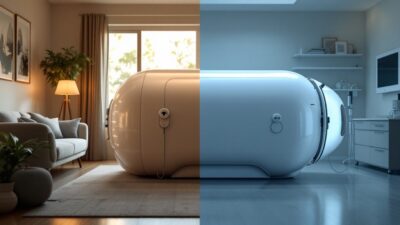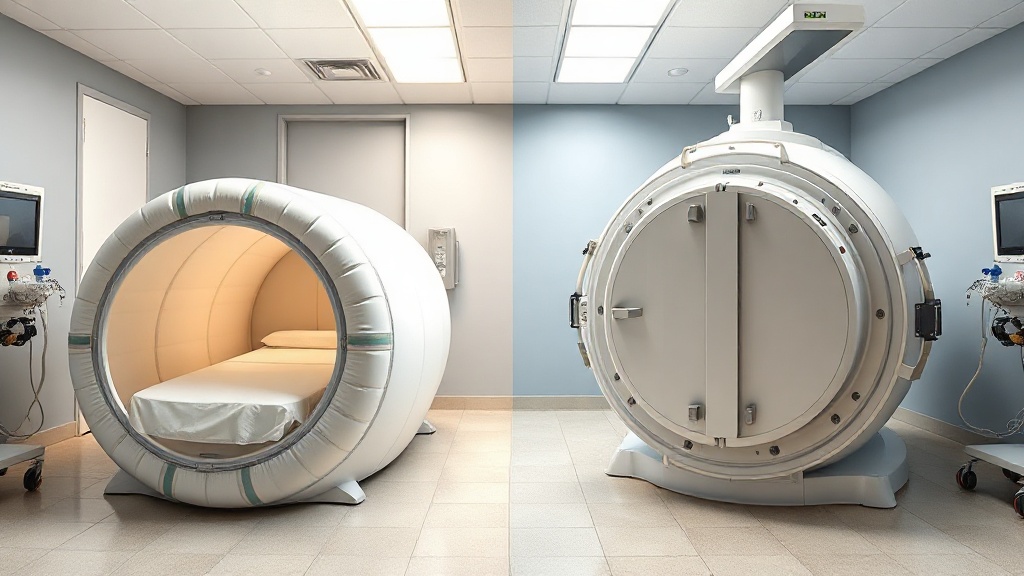
At 1.3 ATA with ambient air, arterial oxygen reaches approximately 230 mmHg. At 2.0 ATA with 100% oxygen, it reaches approximately 1,800 mmHg. That is not a small difference. It is an eightfold difference.1 And yet soft chamber providers routinely market their 1.3 ATA devices for neurological conditions like TBI, long COVID brain fog, and post-stroke recovery, citing studies that used hard chambers at 1.5 to 2.0 ATA. This is a problem.
The Math That Soft Chamber Marketing Ignores
Hyperbaric oxygen therapy works by dissolving oxygen directly into blood plasma under pressure. The amount of dissolved oxygen follows Henry’s Law: the concentration of a gas dissolved in a liquid is proportional to the partial pressure of that gas above the liquid. Here is what that means in practice.1
| Setting | Pressure | Oxygen % | Approx. Arterial pO2 |
|---|---|---|---|
| Normal breathing at sea level | 1.0 ATA | 21% | ~100 mmHg |
| Soft chamber with concentrator | 1.3 ATA | ~24% | ~230 mmHg |
| Soft chamber with O2 mask | 1.3 ATA | ~90% | ~600 mmHg |
| Hard chamber (Harch protocol) | 1.5 ATA | 100% | ~1,100 mmHg |
| Hard chamber (Efrati protocol) | 2.0 ATA | 100% | ~1,800 mmHg |
| Hard chamber (wound care) | 2.4 ATA | 100% | ~2,100 mmHg |
A standard soft chamber at 1.3 ATA with ambient air delivers a partial pressure of oxygen roughly equal to breathing slightly enriched air at sea level. Burman’s 2019 analysis of low-pressure fabric chambers put it plainly: exposure below 2.0 ATA while breathing air does not meet the definition of therapeutic hyperbaric oxygen therapy at all.1 It is better than normal breathing. It is not in the same category as medical HBOT. If you are weighing a purchase, the soft-shell chamber guide covers what these units realistically do.
The Studies Soft Chamber Marketers Cite
When soft chamber providers market their devices for neurological conditions, they typically reference three bodies of research, and every one of them used a hard chamber at pressures a soft chamber cannot reach.
- The Tel Aviv long COVID RCT (Zilberman-Itskovich et al., 2022, published in Scientific Reports). This double-blind, sham-controlled trial of 73 patients used 2.0 ATA with 100% oxygen by mask in a multiplace hard chamber, 40 sessions total. Not 1.3 ATA. Not a soft chamber.2
- The Efrati aging study (Hachmo et al., 2020, published in Aging). This study used 2.0 ATA with 100% oxygen across 60 sessions and reported telomere lengthening and senescent cell reduction. Hard chamber only.8
- Harch’s TBI work. Even the Harch protocol, which uses the lowest pressure of any major HBOT research program, operates at 1.5 ATA with 100% oxygen. That is still meaningfully higher than what a soft chamber achieves even with a concentrator.3
None of the major neurological HBOT studies used 1.3 ATA soft chambers. A 2024 tissue oxygenation study measured transcutaneous oxygen in 130 chronic ulcer patients and found levels at 1.4 ATA (161 mmHg after 10 minutes) were roughly half those at 2.0 ATA (333 mmHg).4 When a soft chamber provider says research shows HBOT helps with brain injuries while selling you a 1.3 ATA device, they are referencing research conducted with fundamentally different equipment at fundamentally different pressures. The soft vs hard chamber clinical data lays the pressures and trials side by side.
The Bacteriostatic Threshold
Oxygen becomes bacteriostatic, meaning it suppresses bacterial and fungal growth, only at the high tissue oxygen tensions that pressures above roughly 1.5 ATA with 100% oxygen produce.5 This is why soft chambers cannot be used to treat wound infections, gas gangrene, or necrotizing soft tissue infections. The UHMS issued a formal consumer warning about soft-sided bag chambers, stating they do not meet clinical HBOT standards and are cleared only for acute mountain sickness.5
Bacterial growth suppression requires the tissue oxygen levels that only pressures above 1.5 ATA with 100% oxygen achieve, a threshold that soft-shell chambers physically cannot reach.
What 1.3 ATA Can and Cannot Do
This is not an argument that soft chambers are useless. It is an argument that they are being sold for things they were not designed and have not been proven to do.
What soft chambers at 1.3 ATA may reasonably help with:
- General wellness and mild recovery
- Subjective improvements in energy and sleep (reported by users, limited controlled data)
- Altitude sickness (the only FDA-cleared indication for soft chambers)
- Light exercise recovery for athletes (anecdotal, minimal controlled evidence)
What soft chambers at 1.3 ATA have NOT been shown to help with:
- Traumatic brain injury recovery
- Long COVID cognitive symptoms
- Post-stroke neuroplasticity
- Telomere lengthening or biological age reversal
- Any of the 14 FDA-cleared indications for medical HBOT
The FDA is explicit about this. Soft-sided chambers are FDA-cleared only for acute mountain sickness. They are not cleared for any of the 14 medical indications that apply to hard chamber HBOT.6 For the low-pressure category as a whole, the mild hyperbaric chamber guide covers where the line sits.
Why This Matters for Patients
A patient with long COVID brain fog who spends $5,000 on 40 soft chamber sessions at 1.3 ATA and sees no improvement may conclude that HBOT does not work. But what they actually received was not the treatment that produced positive results in the clinical trials. They received a lower-pressure, lower-oxygen intervention that has never been tested for their condition in a controlled study.
This is not just a theoretical concern. In HBOT patient communities, one of the most common frustrations is a version of “I tried HBOT and it didn’t help.” When you dig into the details, a significant share of these patients were treated in soft chambers at 1.3 ATA for conditions where only hard chamber protocols have evidence. They did not fail HBOT. They never received HBOT as studied.
The Counterargument: Gene Expression vs Dissolved Oxygen
Proponents of soft chamber therapy argue that the therapeutic mechanism of HBOT is not solely about dissolved oxygen levels. Hadanny and Efrati’s 2020 review of the hyperoxic-hypoxic paradox describes how fluctuations in oxygen concentration, rather than the absolute peak, can trigger the same regenerative gene expression and hypoxia-inducible factor (HIF-1) pathways usually induced by hypoxia.7 The claim is that even mild pressure increases might activate these pathways at pressures below 1.5 ATA.
This argument has some biological plausibility. However, the evidence is not strong enough to support the marketing claims being made. The studies invoking these mechanisms almost all delivered the oxygen swings at 2.0 ATA, not 1.3. The 1.3 ATA outcome studies are mostly small, uncontrolled, and unreplicated, while the robust RCTs with large effect sizes are all at 1.5 ATA or higher with 100% oxygen. Until there are equivalence trials directly comparing 1.3 ATA soft chamber outcomes to 2.0 ATA hard chamber outcomes for neurological conditions, claiming equivalence is misleading.
What Buyers Should Do
- If you are treating a specific neurological condition (TBI, long COVID, stroke, cognitive decline): seek a clinic with a hard chamber capable of reaching the pressure used in the relevant clinical trials. For most neurological conditions, that means 1.5 to 2.0 ATA with 100% oxygen.
- If you are buying a home chamber for general wellness: a soft chamber at 1.3 ATA is a reasonable option, provided you understand and accept its limitations. Do not expect it to replicate the results of hard chamber clinical trials.
- If a clinic or chamber manufacturer cites a study: check what pressure and oxygen concentration the study used. If it was 2.0 ATA in a hard chamber and they are selling you 1.3 ATA in a soft chamber, they are misleading you.
- Match the pressure to the evidence. The single most common way patients get shortchanged is a pressure mismatch: paying for hard chamber outcomes while sitting in a soft chamber that cannot reach the pressure those outcomes required.
Frequently Asked Questions
Are soft hyperbaric chambers a scam?
No. Soft chambers have a legitimate place in general wellness and may provide modest benefits for recovery and energy. The problem is marketing them for conditions where only hard chamber HBOT has evidence. Burman’s 2019 SAMJ analysis notes these units are FDA-cleared for acute mountain sickness only and do not deliver therapeutic HBOT as clinically defined. The device is not a scam. The marketing around it often is.
Why do people feel better after soft chamber sessions?
Several explanations are plausible: placebo effect (which is real and measurable), genuine mild oxygenation benefit, the relaxation of lying still for 60 to 90 minutes, or a real but modest effect that falls short of what a hard chamber would deliver. Subjective improvement is valid. But subjective improvement in an uncontrolled setting does not equal the clinical outcomes reported in controlled trials at higher pressures.
Can a soft chamber with an oxygen concentrator match hard chamber results?
Adding an oxygen concentrator (delivering about 90% O2) to a soft chamber at 1.3 ATA raises the partial pressure of oxygen meaningfully, but still below the level reached at the 1.5 ATA of the Harch protocol. It is a reasonable middle ground for home users, yet it does not replicate hard chamber clinical protocols, and using supplemental oxygen in a soft chamber introduces additional fire safety considerations.
Sources
- Burman F. “Low-pressure fabric hyperbaric chambers.” South African Medical Journal. 2019;109(4):232-233. PMID: 31084683. Link
- Zilberman-Itskovich S, et al. “Hyperbaric oxygen therapy improves neurocognitive functions and symptoms of post-COVID condition: randomized controlled trial.” Scientific Reports. 2022;12:11252. PMID: 35821512. Link
- Harch PG. “Systematic Review and Dosage Analysis: Hyperbaric Oxygen Therapy Efficacy in Mild Traumatic Brain Injury Persistent Postconcussion Syndrome.” Frontiers in Neurology. 2022;13:815056. Link
- Sack RA, et al. “Transcutaneous oximetry values in chronic ulcer patients during hyperbaric treatment at 1.4 ATA compared to 2 ATA.” Undersea and Hyperbaric Medicine. 2024;51(1):9-16. PMID: 38615347. Link
- Undersea and Hyperbaric Medical Society. “Consumer Warning: The Dangers of Soft-Sided Bag Chambers.” Link
- U.S. Food and Drug Administration. “Hyperbaric Oxygen Therapy: Get the Facts.” Link
- Hadanny A, Efrati S. “The Hyperoxic-Hypoxic Paradox.” Biomolecules. 2020;10(6):958. PMID: 32630465. Link
- Hachmo Y, et al. “Hyperbaric oxygen therapy increases telomere length and decreases immunosenescence in isolated blood cells: a prospective trial.” Aging. 2020;12(22):22445-22456. Link
Medical Disclaimer
The content on BaricBoost.com is for informational purposes only and is not intended as a substitute for professional medical advice, diagnosis, or treatment. Always seek the advice of your physician or other qualified health provider with any questions you may have regarding a medical condition. Never disregard professional medical advice or delay in seeking it because of something you have read on this website.

Author
Seph Fontane Pennock is the founder of BaricBoost.com and Regenerated.com, a clinic directory for regenerative medicine serving 10,000+ providers across the United States. He previously built and sold PositivePsychology.com, which grew to 19 million users and became the largest evidence-based positive psychology resource on the web. Seph brings direct experience as an HBOT patient, having completed protocols at clinics across three continents while navigating mold illness, systemic inflammation, and autoimmune conditions. His treatment journey includes hyperbaric oxygen therapy, peptide protocols, NAD+ therapy, and consultations with specialists from Dubai to Cape Town to Mexico. This combination of entrepreneurial track record and lived patient experience shapes everything published on BaricBoost.com. Every article is grounded in peer-reviewed research, informed by real clinical encounters, and written for patients making high-stakes treatment decisions. Seph's focus is on bringing transparency, scientific rigor, and practical guidance to the hyperbaric oxygen therapy space.