HBOT, ozone therapy, and IV NAD+ are three different treatments that share an “oxygen and cellular energy” reputation but work through unrelated mechanisms. HBOT has 14 FDA-cleared indications; ozone therapy and IV NAD+ have zero. In the only head-to-head human trial, HBOT reduced venous leg ulcer area by 69.7% versus 41.3% for ozone (Pasek et al., 2023). This guide sets out how each one works, what the evidence shows, and when each makes sense.
How do HBOT, ozone, and IV NAD+ differ?
All three raise oxygen or cellular-energy activity, but by different routes. HBOT dissolves extra oxygen into blood plasma under pressure. Ozone therapy introduces a reactive oxygen molecule that triggers an antioxidant response. IV NAD+ replenishes a coenzyme used in energy metabolism. They treat different conditions best and are not interchangeable.
- Pressurized O2 dissolves into plasma
- 14 FDA-cleared indications
- 69.7% venous ulcer area reduction (head-to-head)
- $150 to $400 per session
- Reactive O3 triggers antioxidant response
- Not FDA-approved in the US
- 41.3% venous ulcer area reduction (head-to-head)
- Widely practiced in Europe
Hyperbaric oxygen therapy (HBOT)
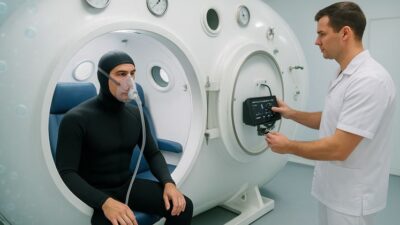
HBOT places you in a pressurized chamber breathing 100% oxygen (in a hard chamber) or concentrated air (in a soft chamber). The elevated pressure dissolves oxygen directly into blood plasma at levels breathing alone cannot reach. At 2.0 to 2.4 ATA (atmospheres absolute) with 100% oxygen, arterial oxygen tension rises to roughly 1,500 mmHg, about 15 times the sea-level value, and plasma-dissolved oxygen increases roughly 10 to 15 fold (Thom, 2011).4
This hyperoxygenation drives several downstream effects: angiogenesis (new blood vessel formation), stem cell mobilization from bone marrow, reduced inflammation through suppression of pro-inflammatory cytokines, enhanced white blood cell bacterial killing, and activation of hypoxia-inducible factor (HIF-1) pathways that regulate tissue-repair genes (Thom, 2011).4
FDA status: HBOT is cleared for 14 specific medical indications and used off-label for many others. In the only head-to-head human trial against ozone therapy (Pasek et al., 2023), topical HBOT reduced venous ulcer area by 69.7% versus 41.3% for local ozone, while ozone produced greater pain relief.1
Ozone therapy
Ozone therapy introduces ozone (O3), a reactive form of oxygen, into the body through several routes: major autohemotherapy (withdrawing blood, mixing it with ozone, and reinfusing it), rectal or vaginal insufflation, or injection into joints or tissues.
The mechanism differs fundamentally from HBOT. Ozone does not raise tissue oxygenation through pressure. Instead it creates a controlled oxidative stress that upregulates the body’s antioxidant defenses (superoxide dismutase, catalase, glutathione peroxidase), modulates the immune system, and has antimicrobial effects. A 2018 systematic review of 9 RCTs (n=453) found ozone significantly improved chronic wound closure, though the authors reported “no conclusive evidence” of superiority over standard care (Fitzpatrick et al., 2018).2 Animal studies comparing the two therapies directly, in models of colitis and acute pancreatitis, found both reduced tissue injury with broadly similar effect (Altinel et al., 2011; Uysal et al., 2010).56
FDA status: The FDA has not approved ozone as a medical treatment in the United States, and under 21 CFR 801.415 ozone is described as having no known useful medical application in concentrations high enough to be effective as a germicide.7 Ozone therapy is practiced in the US under physician discretion and is more widely used in Europe and Latin America.
IV NAD+ therapy
Nicotinamide adenine dinucleotide (NAD+) is a coenzyme present in every cell. It is central to mitochondrial energy production, DNA repair, and sirtuin activation (linked to longevity pathways). NAD+ levels decline with age, chronic illness, and metabolic stress.
IV NAD+ therapy delivers the coenzyme directly into the bloodstream, bypassing digestion for higher bioavailability than oral supplements. Typical infusions run 250 to 1,000 mg over 2 to 6 hours. Proposed mechanisms include restoring mitochondrial function, supporting DNA repair, and reducing neuroinflammation.
FDA status: NAD+ is not FDA-approved for any specific condition. It is given as a nutritional supplement or compounded preparation under physician supervision. A 2024 placebo-controlled pilot RCT found that IV nicotinamide riboside (NR) raised blood NAD+ levels more than IV NAD+ at 3 hours, with shorter infusion times and fewer side effects (Hawkins et al., 2024).3
Head-to-head comparison
| Factor | HBOT | Ozone Therapy | IV NAD+ |
|---|---|---|---|
| Mechanism | Pressure-driven plasma hyperoxygenation (roughly 10 to 15x dissolved O2) | Controlled oxidative stress upregulates antioxidant pathways; modulates cytokines | Coenzyme replenishment supporting sirtuin activation, DNA repair, mitochondrial ATP |
| Evidence level | Strong. 14 FDA-cleared indications, multiple Cochrane reviews | Emerging. Systematic reviews exist but are small and at high risk of bias; no FDA approval | Limited. Mostly small pilots; a 2024 RCT questions IV NAD+ versus IV NR |
| Typical protocol | 60 to 90 min sessions, 20 to 60 sessions, 5x/week at 2.0 to 2.4 ATA | 30 to 60 min sessions, 10 to 20 sessions; no standardized dosing | 2 to 4 hour IV drip; 5 to 10 sessions; 250 to 500 mg per infusion |
| Cost range | $150 to $400/session; full course $5,000 to $15,000; Medicare covers approved uses | $100 to $300/session; 10 to 20 sessions: $2,000 to $5,000; rarely insured | $500 to $1,000/session; 5 to 10 sessions: $5,000 to $10,000+; never insured |
| FDA status | Cleared for 14 conditions | Not FDA-approved; restricted in some US states | Not FDA-approved as therapy; sold as a wellness service or compounded preparation |
| Side effects | Ear barotrauma (common, mild); O2 toxicity seizures (rare); claustrophobia; temporary myopia | Air embolism risk (IV route); oxidative damage if overdosed; respiratory irritation | Nausea, chest pressure, GI symptoms, raised heart rate during infusion |
| Best-supported conditions | Diabetic wounds, radiation injury, decompression sickness, CO poisoning, sudden hearing loss | Chronic wounds (weak evidence); dental infections (emerging); joint pain (emerging) | Fatigue and addiction withdrawal (very small studies) |
| Best first choice for | A condition with published HBOT evidence or an FDA-cleared indication | Chronic infection or immune modulation, as an adjunct | Suspected mitochondrial fatigue, as a short adjunct |
When should you choose each therapy?
Choose HBOT when:
- You have a condition with published HBOT evidence (long COVID, TBI, stroke recovery, diabetic wounds, radiation injury)
- You need tissue-level repair, not just systemic modulation
- Your condition involves poor blood flow or oxygen delivery to specific tissues
- You want the therapy with the strongest regulatory and evidence base (see the HBOT alternatives comparison)
Choose ozone therapy when:
- You are dealing with chronic infection where immune modulation is the priority
- You want to support antioxidant capacity as an adjunct
- You have joint conditions where direct ozone injection may help
- You are already doing HBOT and want a therapy that works through a different mechanism. Review 10-pass ozone therapy cost before committing to a course
Choose IV NAD+ when:
- Fatigue, brain fog, or low energy are your primary complaints and you suspect mitochondrial dysfunction
- You are in addiction recovery, where NAD+ has been used in detox protocols
- You want a shorter-term intervention that can complement a longer HBOT course
Can you stack these therapies?
Yes, and many integrative practitioners do, though no published trial has tested the combinations directly. Because the three target different systems, the rationale is mechanistic rather than trial-based:
- HBOT plus IV NAD+: used for TBI and long COVID. HBOT drives tissue repair; NAD+ supports the mitochondrial energy those repair processes require.
- HBOT plus ozone therapy: used in chronic-infection protocols. HBOT raises tissue oxygen; ozone modulates the immune response.
- All three: some longevity clinics offer the full stack, targeting tissue oxygenation (HBOT), immune function (ozone), and cellular energy (NAD+).
No published study has examined these combinations head-to-head. The stacking approach rests on mechanistic reasoning and clinical observation, not randomized trial data.
Frequently asked questions
Is HBOT better than ozone therapy?
They are not directly comparable because they work through different mechanisms. HBOT has a stronger evidence base and FDA clearance for 14 conditions. Ozone therapy has a longer history in European medicine and may suit immune modulation. The one head-to-head human trial (Pasek et al., 2023) found HBOT superior for venous ulcer closure (69.7% versus 41.3% area reduction), while ozone gave better pain relief.1
Is IV NAD+ worth the cost?
At $500 to $1,000 per infusion, IV NAD+ is expensive relative to its evidence base. A 2024 placebo-controlled pilot RCT found IV nicotinamide riboside raised blood NAD+ levels more than IV NAD+ with fewer side effects (Hawkins et al., 2024).3 If fatigue and brain fog are your main issues, discuss IV NR with your provider too. For conditions with stronger HBOT evidence, start with HBOT and consider NAD+ as an adjunct.
Can I do ozone therapy at home?
Some patients do rectal ozone insufflation at home with purchased equipment, which is less regulated than clinic-based autohemotherapy. Home ozone carries added safety risk because ozone is a respiratory irritant and must not be inhaled. If you pursue it, work with a practitioner who can supervise your protocol and confirm you are using medical-grade equipment.
Which therapy should I try first?
Start with the therapy that has the strongest evidence for your specific condition. For most conditions BaricBoost covers (long COVID, TBI, stroke, wound healing), that is HBOT. If your primary issue is chronic infection or immune dysfunction, ask an integrative practitioner about ozone. If fatigue and mitochondrial function are your main concern, IV NAD+ or IV NR may be a reasonable starting point.
Sources
- Pasek J, Szajkowski S, Cieslar G. Topical hyperbaric oxygen therapy versus local ozone therapy in healing of venous leg ulcers. Int J Environ Res Public Health. 2023;20(3):1967. DOI: 10.3390/ijerph20031967
- Fitzpatrick E, Holland O, Vanderlelie J. Ozone therapy for the treatment of chronic wounds: a systematic review. Int Wound J. 2018;15(4):633-644. DOI: 10.1111/iwj.12907
- Hawkins J et al. Randomized, placebo-controlled pilot clinical study evaluating acute intravenous NR and NAD+ in healthy adults. medRxiv. 2024. DOI: 10.1101/2024.06.06.24308565
- Thom SR. Hyperbaric oxygen: its mechanisms and efficacy. Plast Reconstr Surg. 2011;127(Suppl 1):131S-141S. DOI: 10.1097/PRS.0b013e3181fbe2bf
- Altinel O et al. Comparison of hyperbaric oxygen and medical ozone therapies in a rat model of experimental distal colitis. Scand J Clin Lab Invest. 2011;71(3):185-192. DOI: 10.3109/00365513.2010.548875
- Uysal B et al. Efficacy of hyperbaric oxygen therapy and medical ozone therapy in experimental acute necrotizing pancreatitis. Pancreas. 2010;39(1):9-15. DOI: 10.1097/MPA.0b013e3181bb5ae3
- U.S. Food and Drug Administration. Maximum acceptable level of ozone, 21 CFR 801.415. accessdata.fda.gov
- Undersea and Hyperbaric Medical Society. Approved indications for hyperbaric oxygen therapy. uhms.org
Medical Disclaimer
The content on BaricBoost.com is for informational purposes only and is not intended as a substitute for professional medical advice, diagnosis, or treatment. Always seek the advice of your physician or other qualified health provider with any questions you may have regarding a medical condition. Never disregard professional medical advice or delay in seeking it because of something you have read on this website.

Author
Seph Fontane Pennock is the founder of BaricBoost.com and Regenerated.com, a clinic directory for regenerative medicine serving 10,000+ providers across the United States. He previously built and sold PositivePsychology.com, which grew to 19 million users and became the largest evidence-based positive psychology resource on the web. Seph brings direct experience as an HBOT patient, having completed protocols at clinics across three continents while navigating mold illness, systemic inflammation, and autoimmune conditions. His treatment journey includes hyperbaric oxygen therapy, peptide protocols, NAD+ therapy, and consultations with specialists from Dubai to Cape Town to Mexico. This combination of entrepreneurial track record and lived patient experience shapes everything published on BaricBoost.com. Every article is grounded in peer-reviewed research, informed by real clinical encounters, and written for patients making high-stakes treatment decisions. Seph's focus is on bringing transparency, scientific rigor, and practical guidance to the hyperbaric oxygen therapy space.