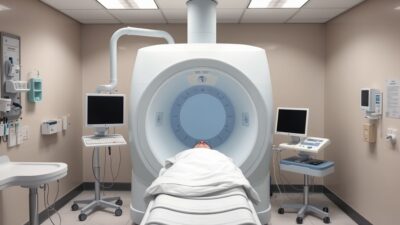
Hyperbaric oxygen therapy does not cure cancer and there is no evidence it promotes tumor growth. Its real, evidence-based role in cancer care is narrow: treating the delayed radiation injuries that surface months or years after treatment (osteoradionecrosis, radiation cystitis, and proctitis), which is an FDA-cleared use typically delivered over 30 to 60 sessions. A separate older body of work tested HBOT as a radiosensitizer during radiation and found a survival signal only in head and neck cancer. This page explains what the evidence supports and, just as importantly, what it does not.
Does HBOT Feed Cancer?
This is the most common worry cancer patients raise, and decades of research have answered it. The concern is intuitive: HBOT promotes healing and new blood vessel growth, so could it also feed a tumor? The evidence says no. A 2012 review in Targeted Oncology by Moen and Stuhr analyzed the available studies and concluded there is no evidence HBOT acts as a stimulator of tumor growth or an enhancer of recurrence, and that it may even have tumor-inhibitory effects in certain cancer subtypes.4
“There is no evidence indicating that hyperbaric oxygen acts as a stimulator of tumor growth or an enhancer of recurrence. Evidence implies HBO may have tumor-inhibitory effects in certain cancer subtypes.”
Moen & Stuhr, 2012, Targeted Oncology
The most recent clinical data comes from a 2025 retrospective study of 45 solid-tumor patients, 18.6% of whom had active cancer when HBOT began.5 Over a median follow-up of 783 days, the authors found no significant relationship between the number of HBOT sessions and metastasis (p=0.213) or mortality (p=0.881), and no HBOT-related complications.
The mechanism helps explain why. Tumor angiogenesis is driven by VEGF released in response to hypoxia. By raising tissue oxygenation, HBOT may reduce the hypoxia-driven signals that fuel aggressive tumor behavior. An earlier Feldmeier review reached the same practical conclusion, stating that a history of malignancy should not be considered a contraindication to hyperbaric oxygen.6
Can HBOT Treat Cancer Directly?
No. HBOT is not a treatment for cancer itself, and no clinical guideline recommends it to shrink or eliminate tumors. The only mechanism by which oxygen relates to killing cancer is indirect: radiation therapy needs oxygen to generate the reactive oxygen species that damage tumor DNA. Because tumors are often hypoxic at their core, that hypoxia makes them more resistant to radiation. This is the oxygen enhancement effect, and it is the rationale that led researchers to test HBOT as a radiosensitizer given immediately before or during radiation.
A 2018 Cochrane review by Bennett and colleagues analyzed 19 randomized trials involving 2,286 patients.1 The findings were strongly site-specific. In head and neck cancer, HBOT plus radiation reduced 5-year mortality by 18% (RR 0.82, 95% CI 0.69-0.98) and cut 1-year local recurrence by 34% (RR 0.66, 95% CI 0.56-0.78), with a number needed to treat of 11 for the mortality benefit. For cervical and bladder cancer, there was no clear benefit.
“HBOT combined with radiation therapy reduced 5-year mortality in head and neck cancer by 18% (RR 0.82) and decreased local tumor recurrence by 34% at one year, with no clear benefit for cervical or bladder cancer.”
Bennett et al., 2018, Cochrane Database of Systematic Reviews
Two cautions keep this out of routine practice. First, severe radiation reactions increased 2.6-fold (RR 2.64) and seizure risk rose sharply with HBOT.1 Second, these trials were mostly run between the 1960s and 1990s, and modern radiosensitizers and fractionation techniques have since overtaken the approach. The head and neck signal is real, but it has not translated into current standard-of-care guidelines.
What Does Research Show HBOT Does in Cancer Care?
The table below is the single summary of where HBOT stands across cancer-related uses. The rest of this page expands the established role, treating radiation injury, in plain terms.
HBOT in Cancer Care: Application by Evidence Level
| Application | Evidence Base | Verdict | FDA Status |
|---|---|---|---|
| Radiosensitizer (head & neck cancer) | Cochrane, 19 RCTs | Moderate benefit, not standard care | Off-label |
| Radiosensitizer (cervical / bladder cancer) | Cochrane | No clear benefit | Off-label |
| Osteoradionecrosis (late radiation injury) | Cochrane, registry | Moderate | FDA-cleared |
| Radiation proctitis | Cochrane | Moderate | FDA-cleared |
| Radiation cystitis | Cochrane, systematic review | Weak to moderate | FDA-cleared |
| Neural tissue radiation injury | Cochrane | No benefit | FDA-cleared |
| Direct anti-cancer therapy | Preclinical only | Insufficient | Not established |
| Safety alongside cancer treatment | Reviews, registry | No tumor promotion | N/A |
How Does HBOT Treat Radiation Injury?
Radiation damages the small blood vessels of treated tissue, causing progressive hypoxia that can kill tissue months or years later through obliterative endarteritis. HBOT promotes new blood vessel growth in these chronically hypoxic zones, restoring oxygen delivery and enabling healing that the radiation damage had blocked. This is the FDA-cleared use and the most common reason cancer survivors are referred for HBOT.
A 2023 Cochrane review by Lin and colleagues (18 RCTs, 1,071 participants) found HBOT was 39% more likely to produce complete resolution or significant improvement of late radiation tissue injury compared with controls (RR 1.39, 95% CI 1.02-1.89).2 Specific findings included:
- Osteoradionecrosis: improved mucosal coverage (RR 1.3, NNT 5)
- Radiation proctitis: improvement or cure (RR 1.72, NNT 5)
- Reduced wound breakdown after head and neck surgery by 76% (RR 0.24) in irradiated patients
- No benefit for neural tissue radiation injury
A registry of 2,538 patients with radiation injuries found symptoms improved or resolved in the majority of cases, with osteoradionecrosis responding best.3 The five most commonly treated injuries were osteoradionecrosis (33.4%), soft tissue radionecrosis (27.5%), radiation cystitis (18.6%), radiation proctitis (9.2%), and laryngeal radionecrosis (4.8%). For the detailed clinical numbers, see the radiation injury outcomes data, and for the broader research base see the HBOT research hub. Treatment typically runs 30 to 60 sessions at 2.0 to 2.4 ATA in a hard chamber.
Which Cancers Does the Evidence Cover?
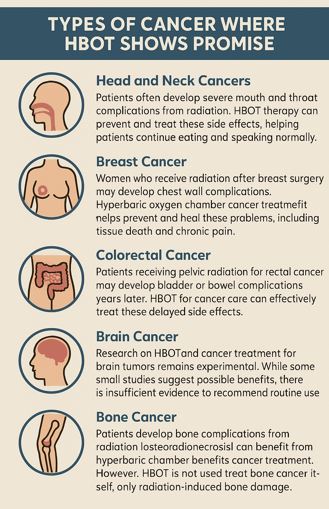
Head and neck cancers are the most evidence-backed application, both for the radiosensitizer survival signal noted above and, after treatment, for osteoradionecrosis of the jaw, one of the most debilitating late effects in this group. HBOT combined with surgery improves healing of exposed, irradiated jawbone and is used at most major cancer centers.
Breast cancer survivors who develop chest wall complications after radiation may benefit for symptom relief. In a case series of 67 women (Spruijt and van den Berg, 2020), 85% reported at least one-point improvement in composite symptom scores after a mean of 44 sessions, with pain and fibrosis gains sustained at 12 months.7 Evidence remains limited and uncontrolled.
Colorectal and pelvic cancers treated with pelvic radiation can lead to radiation cystitis or proctitis years later. HBOT treats these delayed effects, covered in detail in our articles on radiation cystitis and radiation damage.
Brain tumors remain experimental territory for HBOT. Some small studies suggest possible benefit, but the evidence is insufficient to recommend routine use.
What Are the Risks and Limits?
It is not a cancer treatment. HBOT does not cure cancer or stop tumor growth. It treats specific radiation complications and, historically, enhanced radiation as a sensitizer in one cancer type. Claims that HBOT fights cancer directly are not supported by evidence.
The benefit is narrow. The radiosensitizer signal appeared only in head and neck cancer, with no clear benefit for cervical or bladder cancer in the same Cochrane review.1 Extrapolating to other cancer types is not supported.
Medical risks apply. Extended high-oxygen exposure can cause temporary vision changes, and rarely oxygen-toxicity seizures; pressure changes can injure the ears and sinuses. The Lin 2023 Cochrane review found ear barotrauma was substantially more common without gradual pressurization (RR 9.08).2 Review the full hyperbaric chamber side effects before starting.
Contraindications matter. Absolute contraindications include untreated pneumothorax and certain chemotherapy drugs (bleomycin, doxorubicin, cisplatin). Clear oncology sign-off is required before any cancer patient begins HBOT.
How Do You Access HBOT as a Cancer Patient?
Start the conversation with your oncologist. HBOT for approved radiation-injury indications is most commonly available through hospital-based hyperbaric programs, and many comprehensive cancer centers have dedicated units. Look for programs accredited by the Undersea and Hyperbaric Medical Society and staffed by physicians formally trained in hyperbaric medicine. For approved indications, HBOT is often covered by Medicare and many private insurers when properly documented; see our hyperbaric chamber cost and insurance coverage guides. Radiation injury can also become a long-term issue, which the guide on HBOT for chronic conditions addresses.
Sources
- Bennett MH, Feldmeier J, Smee R, Milross C. Hyperbaric oxygenation for tumour sensitisation to radiotherapy. Cochrane Database of Systematic Reviews. 2018;4:CD005007. DOI: 10.1002/14651858.CD005007.pub4
- Lin ZC, Bennett MH, Hawkins GC, et al. Hyperbaric oxygen therapy for late radiation tissue injury. Cochrane Database of Systematic Reviews. 2023;8:CD005005. DOI: 10.1002/14651858.CD005005.pub5
- Niezgoda JA, Serena T, Carter M. Outcomes of radiation injuries using hyperbaric oxygen therapy: an observational cohort study. Advances in Skin & Wound Care. 2016;29(1). DOI: 10.1097/01.ASW.0000473679.29537.c0
- Moen I, Stuhr LEB. Hyperbaric oxygen therapy and cancer: a review. Targeted Oncology. 2012;7(4):233-242. DOI: 10.1007/s11523-012-0233-x
- Canarslan Demir K, et al. Hyperbaric oxygen therapy for managing cancer treatment complications: a safety evaluation. Medicina (Kaunas). 2025;61(3):385. DOI: 10.3390/medicina61030385
- Feldmeier J, Carl U, Hartmann K, Sminia P. Hyperbaric oxygen: does it promote growth or recurrence of malignancy? Undersea & Hyperbaric Medicine. 2003;30(1):1-18. PMID: 12841604
- Spruijt NE, van den Berg R. The effect of hyperbaric oxygen treatment on late radiation tissue injury after breast cancer: a case series of 67 patients. Diving and Hyperbaric Medicine. 2020;50(3):206-213. DOI: 10.28920/dhm50.3.206-213
- Dejonckheere CS, et al. Hyperbaric oxygen therapy for chronic radiotherapy-related adverse effects: a clinically focused review. CA: A Cancer Journal for Clinicians. 2025. DOI: 10.3322/caac.70058
Medical Disclaimer
The content on BaricBoost.com is for informational purposes only and is not intended as a substitute for professional medical advice, diagnosis, or treatment. Always seek the advice of your physician or other qualified health provider with any questions you may have regarding a medical condition. Never disregard professional medical advice or delay in seeking it because of something you have read on this website.

Author
Seph Fontane Pennock is the founder of BaricBoost.com and Regenerated.com, a clinic directory for regenerative medicine serving 10,000+ providers across the United States. He previously built and sold PositivePsychology.com, which grew to 19 million users and became the largest evidence-based positive psychology resource on the web. Seph brings direct experience as an HBOT patient, having completed protocols at clinics across three continents while navigating mold illness, systemic inflammation, and autoimmune conditions. His treatment journey includes hyperbaric oxygen therapy, peptide protocols, NAD+ therapy, and consultations with specialists from Dubai to Cape Town to Mexico. This combination of entrepreneurial track record and lived patient experience shapes everything published on BaricBoost.com. Every article is grounded in peer-reviewed research, informed by real clinical encounters, and written for patients making high-stakes treatment decisions. Seph's focus is on bringing transparency, scientific rigor, and practical guidance to the hyperbaric oxygen therapy space.