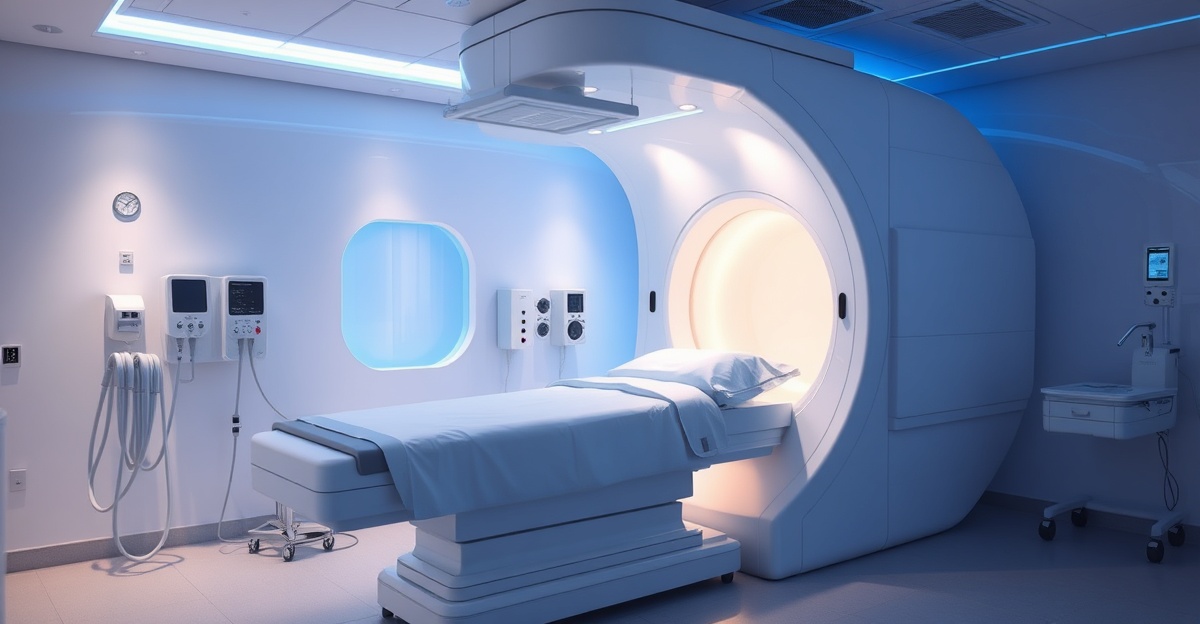
HBOT resolves or improves radiation cystitis symptoms in roughly 87% of patients across 815 cases, with complete resolution of bleeding in about two-thirds.2 It is an FDA-cleared indication covered by Medicare, and outcomes are better when treatment starts within six months of symptom onset. This is one of the most evidence-backed uses of hyperbaric oxygen for radiation injury, and one of several post-cancer applications of HBOT.
What Is Radiation Cystitis?
Radiation cystitis develops when the bladder sustains cumulative damage from ionizing radiation used to treat nearby cancers: prostate, cervical, rectal, bladder, and other pelvic malignancies. The damage is not immediate. Radiation progressively obliterates small blood vessels, reducing oxygen delivery to bladder tissue over time. The result is mucosal breakdown, fibrosis, and fragile blood vessels called telangiectasias that bleed easily.
Symptoms range from mild irritation and urinary frequency to severe hemorrhagic cystitis, where bleeding is heavy enough to cause clots, obstruction, and hospitalization. Conservative treatments (hydration, bladder irrigation, fulguration) often provide temporary relief but do not address the underlying vascular damage.
How Does HBOT Work for Radiation Cystitis?
The core problem is hypoxia in damaged tissue. Blood vessels scarred by radiation cannot deliver enough oxygen for tissue to heal. HBOT counteracts this by dissolving high concentrations of oxygen into plasma, reaching tissue that normal circulation cannot supply. Beyond acute oxygenation, repeated sessions trigger angiogenesis, the growth of new blood vessels into ischemic tissue, which produces lasting improvement rather than temporary relief. Our HBOT research overview covers the underlying biology.
How Effective Is HBOT for Radiation Cystitis?
Radiation cystitis has more clinical evidence supporting HBOT than almost any other non-standard application. The largest systematic review, covering 815 patients, found a weighted average overall response rate of 87.3% and complete symptom resolution in 65.3%.2 Other meta-analyses land in the same range.
HBOT Response Rates Across Major Reviews
| Review | Patients | Overall response | Complete response |
|---|---|---|---|
| Villeirs et al., 2019 | 815 | 87.3% | 65.3% |
| Yang et al., 2024 | 556 | ~90% | 55% |
| Cardinal et al., 2018 | 602 | 84% | – |
The 2024 review of 14 studies and 556 patients found nearly 90% experienced symptom improvement, with 55% achieving complete remission of hematuria (95% CI 51-59%).1 The 2018 meta-analysis of 13 studies and 602 patients found 84% achieved partial or complete resolution, with at least a one-grade hematuria improvement in 75% and a 14% recurrence rate.3
Weighted average overall response rate across 815 radiation cystitis patients treated with HBOT.
Villeirs et al., 2019
Is HBOT an FDA-Approved Treatment for Radiation Cystitis?
Yes. The FDA has cleared HBOT for radiation tissue damage, which includes radiation cystitis, placing it in a different category from experimental uses. The Undersea and Hyperbaric Medical Society (UHMS) formally recognizes delayed radiation injury of soft tissue and bone as an approved indication. That approval is what makes insurance coverage realistic here.
How Durable Is the Response?
One concern with any treatment for chronic radiation damage is whether improvements last. The RICH-ART trial, with 5-year follow-up published in 2025, found that 68.6% of responders maintained their gains, with a mean improvement of 22.9 points on patient-reported urinary symptom scores sustained long term.9 Recurrence across studies is roughly 14%, and repeat HBOT courses have been effective for those who do recur.
Of responders maintained their improvement at 5 years in the RICH-ART trial follow-up.
RICH-ART 5-year follow-up, 2025
Does Early Treatment Matter?
Yes. Research consistently shows earlier intervention leads to better outcomes. Patients who began HBOT within 6 months of developing hematuria had significantly better results than those who waited.6 Among non-responders in one major study, most had either started treatment late or completed fewer than the recommended number of sessions.5 Starting HBOT before damage becomes entrenched gives angiogenesis more to work with.
Who Is a Candidate?
Best candidates have documented radiation-induced bladder injury, have completed cancer treatment with no active malignancy in the bladder, have not responded to conservative measures, and are medically stable enough for a pressurized environment. Cystoscopy confirming telangiectasias or mucosal damage is typically required before referral. Active bladder cancer is generally a contraindication, as are severe untreated emphysema, certain medications (bleomycin, doxorubicin, cisplatin), active ear or sinus disease, and severe claustrophobia. Our side effect and contraindication guide covers what to review with your physician.
How Many HBOT Sessions Are Needed?
The standard protocol involves 30 to 40 sessions at 2.0 to 2.4 ATA. Each session runs about 90 minutes, breathing 100% oxygen through a mask or hood inside a hard-shell chamber, typically five days per week, making a full course six to eight weeks. Severe hemorrhagic cystitis may require more. Some centers use 20 sessions as an initial course and assess response, but current evidence suggests a minimum of 30 to 40 for optimal results. Our session guide explains what each visit involves.
Does Insurance Cover HBOT for Radiation Cystitis?
Because radiation cystitis is an approved indication, coverage is far more accessible than for off-label uses. Medicare covers HBOT for delayed radiation injury, and most major commercial insurers follow Medicare’s policies for approved indications. Prior authorization is almost always required, and documentation from the treating oncologist or urologist is essential. Our HBOT insurance coverage guide walks through prior authorization.
What Should You Expect During Treatment?
Most patients do not notice dramatic improvement in the first one to two weeks, because the angiogenic response takes time to build. Many report that bleeding frequency and severity begin to decrease around weeks three to four, with continued improvement through the end of the course and for several months afterward as new vessels mature. In a prospective study of 33 patients published in 2026, 81.8% achieved complete response and 9.1% partial response (combined 90.9%) at a mean of 29.2 sessions, with all patients completing treatment without complications.4
Radiation Cystitis and Other Radiation Injuries
Radiation damage is rarely isolated to the bladder. Patients treated for pelvic cancers often have concurrent radiation proctitis, vaginal or erectile tissue damage, or pelvic bone changes. HBOT’s mechanism is the same across all of these: promoting angiogenesis in ischemic, radiation-damaged tissue, so other symptoms often improve during treatment. Our broader guide to radiation damage and HBOT covers the full spectrum, and radiation injury outcomes details response by tissue type.
What Happens If HBOT Partially Works
Not every patient achieves complete resolution after one course. Partial responders may benefit from additional sessions or a repeat course after clinical evaluation. Some centers offer booster protocols of 10 to 20 additional sessions. The angiogenic mechanism has no strict ceiling on stimulation, and tissue vascularity can continue to improve with further treatment. Treatment should be delivered in a hospital-based or accredited outpatient hyperbaric facility, not a wellness spa or mild HBOT center, because the therapeutic pressures (2.0 ATA and above) require hard-shell chambers certified for medical use.
Frequently Asked Questions
How many HBOT sessions does radiation cystitis typically require?
Most protocols involve 30 to 40 sessions at 2.0 to 2.4 ATA (Villeirs et al., 2019). Some patients show adequate response after 20 sessions; others with severe or long-standing damage may need up to 60. Your hyperbaric physician will assess response during treatment and adjust the course accordingly. Current evidence favors a minimum of 30 to 40 sessions for the best chance of complete resolution.
How long after radiation therapy can HBOT still help?
HBOT can help even when radiation cystitis develops years after treatment. The mechanism, promoting angiogenesis in chronically ischemic tissue, is not time-limited, and studies include patients treated a decade or more after their radiation therapy. That said, starting sooner after hematuria begins is associated with better outcomes (Chong & Hampson, 2005), so early referral is preferable when symptoms appear.
Will HBOT cure radiation cystitis completely?
Many patients achieve complete resolution of bleeding and significant symptom improvement, and complete response rates across meta-analyses range from 55 to 65% (Villeirs 2019; Yang 2024). A proportion experience partial improvement, and a minority do not respond. Realistic expectations should be set before starting based on the severity and chronicity of symptoms. Repeat courses remain an option for partial responders or recurrence.
Is HBOT safe if my cancer is not fully in remission?
Active cancer in the treatment area is generally a contraindication, as oxygen may theoretically support tumor growth. A recent clear scan and oncologist sign-off are standard requirements before starting treatment for radiation injuries. Your hyperbaric team will coordinate with your oncologist to confirm there is no active malignancy in the bladder before beginning a course.
Sources
- Yang TK, et al. “Efficacy and Safety of Hyperbaric Oxygen Therapy for Radiation-Induced Hemorrhagic Cystitis: A Systematic Review and Meta-Analysis.” J Clin Med, 2024;13(16):4724. 10.3390/jcm13164724
- Villeirs L, et al. “Hyperbaric oxygen therapy for radiation cystitis after pelvic radiotherapy: Systematic review of the recent literature.” Int J Urol, 2019;26(12):1145-1156. 10.1111/iju.14130
- Cardinal J, et al. “Scoping Review and Meta-analysis of Hyperbaric Oxygen Therapy for Radiation-Induced Hemorrhagic Cystitis.” Curr Urol Rep, 2018;19(9):79. 10.1007/s11934-018-0790-3
- Chairetakis G, et al. “Hyperbaric oxygen therapy in the management of radiation-induced hemorrhagic cystitis: a prospective study.” Hellenic Urology, 2026. 10.23736/s2241-9136.25.00103-3
- Corman JM, et al. “Treatment of radiation induced hemorrhagic cystitis with hyperbaric oxygen.” J Urol, 2003;169(6):2200-2202. 10.1097/01.JU.0000063640.41307.C9
- Chong KT, Hampson NB, Corman JM. “Early hyperbaric oxygen therapy improves outcome for radiation-induced hemorrhagic cystitis.” Urology, 2005;65(4):649-653. 10.1016/j.urology.2004.10.050
- Shilo Y, et al. “Hyperbaric oxygen for hemorrhagic radiation cystitis.” Isr Med Assoc J, 2013;15(2):75-78. PMID 23516766
- Lin KH, et al. “Hyperbaric oxygen therapy for hemorrhagic radiation cystitis.” Formosan J Surg, 2017;50(3):104-109. 10.4103/fjs.fjs_19_17
- Oscarsson N, Rosén A, Müller B, et al. “Radiation-induced cystitis treated with hyperbaric oxygen therapy (RICH-ART): long-term follow-up of a randomised controlled trial.” EClinicalMedicine, 2025. PMC12033922
- Oliai C, et al. “Hyperbaric oxygen therapy for radiation-induced cystitis and proctitis.” Int J Radiat Oncol Biol Phys, 2012;83(3):e475-9. 10.1016/j.ijrobp.2011.12.056
Medical Disclaimer
The content on BaricBoost.com is for informational purposes only and is not intended as a substitute for professional medical advice, diagnosis, or treatment. Always seek the advice of your physician or other qualified health provider with any questions you may have regarding a medical condition. Never disregard professional medical advice or delay in seeking it because of something you have read on this website.

Author
Seph Fontane Pennock is the founder of BaricBoost.com and Regenerated.com, a clinic directory for regenerative medicine serving 10,000+ providers across the United States. He previously built and sold PositivePsychology.com, which grew to 19 million users and became the largest evidence-based positive psychology resource on the web. Seph brings direct experience as an HBOT patient, having completed protocols at clinics across three continents while navigating mold illness, systemic inflammation, and autoimmune conditions. His treatment journey includes hyperbaric oxygen therapy, peptide protocols, NAD+ therapy, and consultations with specialists from Dubai to Cape Town to Mexico. This combination of entrepreneurial track record and lived patient experience shapes everything published on BaricBoost.com. Every article is grounded in peer-reviewed research, informed by real clinical encounters, and written for patients making high-stakes treatment decisions. Seph's focus is on bringing transparency, scientific rigor, and practical guidance to the hyperbaric oxygen therapy space.