Every clinical trial that found positive results for Hyperbaric Oxygen Therapy (HBOT) in long COVID used a hard chamber at 2.0 atmospheres absolute (ATA) or higher with 100% medical-grade oxygen. No published study has tested soft chambers (1.3 ATA, ambient air) for long COVID. The arterial oxygen difference between the two chamber types is approximately 8x: ~230 mmHg in a soft chamber versus ~1,824 mmHg in a hard chamber at 2.4 ATA. For long COVID specifically, the evidence supports hard chambers only.
What the Long COVID Trials Actually Used
This is the most important starting point for anyone considering chamber options. The positive trial results that make HBOT a credible option for long COVID were generated under very specific conditions. Changing those conditions means stepping outside the evidence.
The Tel Aviv RCT (Zilberman-Itskovich et al., 2022): 40 sessions, 2.0 ATA, 100% oxygen, 90-minute sessions in a hard chamber. Sham-controlled and double-blind. This is the gold standard trial that showed brain perfusion improvements on MRI1.
The Bhaiyat case report (2022): 60 sessions, 2.0 ATA, 100% oxygen, hard chamber. Showed 34% VO2max increase and white matter improvements on DTI2.
The Vietnamese study (Ha Nguyen Thi Hai et al., 2026): 14 sessions, 2.2 ATA, hard chamber. Quality of life improved from 0.749 to 0.942 on EQ-5D-5L. Cerebral blood flow normalized in a significant proportion of patients3.
The 232-patient registry (van Berkel et al., 2025): Hard chambers, clinical HBOT protocols. 56-63% achieved clinically meaningful improvement4.
The two negative RCTs that found no benefit also used hard chambers, but with only 10 sessions. The failure was in session count, not chamber type.
Not a single long COVID study used a soft chamber. This is not an oversight or a bias against soft chambers. It reflects the fundamental physics: soft chambers cannot deliver the oxygen dose that the evidence suggests is necessary for the biological changes documented in these trials.
The Oxygen Delivery Gap
The difference between soft and hard chambers is not marginal or subtle. It is an order-of-magnitude difference in oxygen delivery to tissues.
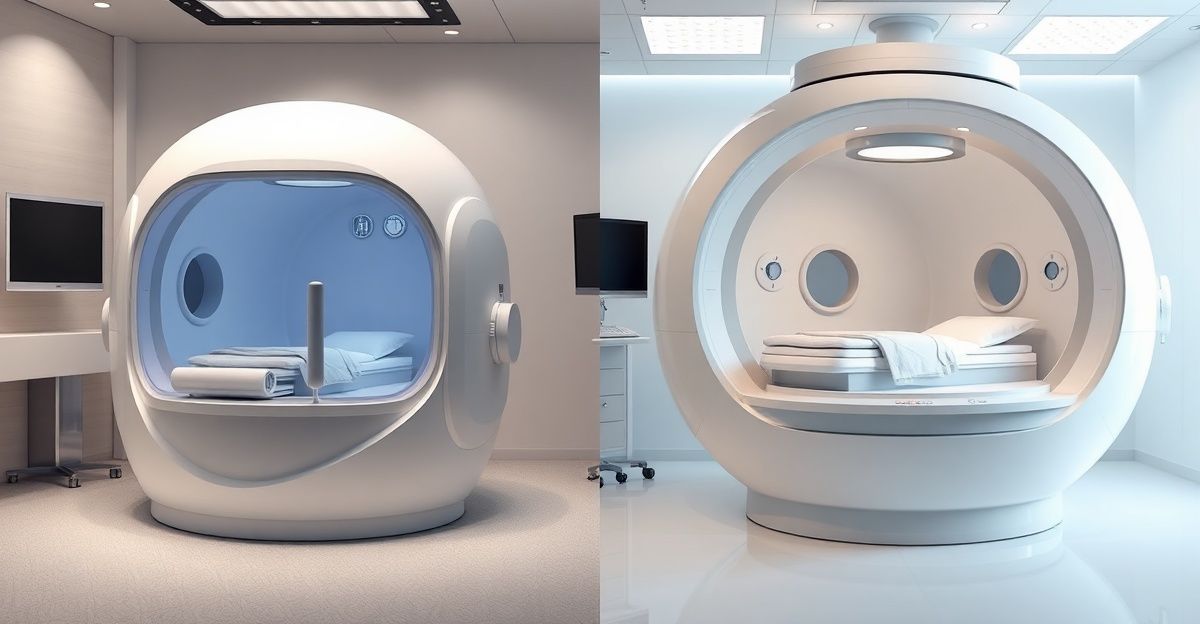
Soft chamber (1.3 ATA, ambient air): Delivers approximately 21% oxygen (room air) at slightly elevated pressure. Even with an oxygen concentrator providing 90-95% O2 via mask inside the chamber, arterial oxygen reaches roughly 230 mmHg. The pressure is too low to drive significant oxygen dissolution into plasma. Most oxygen is still carried by hemoglobin, which is already nearly saturated at sea level. The marginal increase from 1.3 ATA is modest5.
Hard chamber (2.0 ATA, 100% oxygen): Delivers 100% medical-grade oxygen at double atmospheric pressure. Arterial oxygen reaches approximately 1,824 mmHg at 2.4 ATA. At these pressures, oxygen dissolves directly into blood plasma in large quantities, independent of hemoglobin. This plasma-dissolved oxygen can reach tissues that hemoglobin-bound oxygen cannot, including areas with microclotting, damaged blood vessels, and impaired circulation.
The arterial oxygen comparison: hard chambers deliver roughly 8 times the oxygen dose of soft chambers. This is not a small difference. It is the difference between a cup of coffee and an espresso machine.
Why this matters for long COVID specifically:
The mechanisms by which HBOT helps long COVID are dose-dependent processes. Each one requires substantial oxygen delivery to trigger:
- Angiogenesis (new blood vessel growth): Requires repeated episodes of significant hyperoxia to activate HIF-1 (hypoxia-inducible factor) and VEGF (vascular endothelial growth factor) pathways. The hyperoxic-hypoxic paradox that drives angiogenesis depends on the contrast between treatment-level oxygen and normal oxygen. A modest increase from 1.3 ATA does not create sufficient contrast.
- Neuroplasticity: The brain MRI changes documented in the Tel Aviv trial (increased perfusion, white matter microstructural improvements) occurred at 2.0 ATA. Whether 1.3 ATA can produce these same structural brain changes has not been tested, and the physics suggests the stimulus would be insufficient.
- Anti-inflammatory cytokine modulation: The inflammatory biomarker shifts (IL-6 down, IL-10 up) documented in the Vietnamese study occurred at 2.2 ATA. The inflammatory cascade is influenced by oxygen partial pressure, and the threshold for meaningful modulation appears to require pressures above 1.5 ATA.
- Mitochondrial biogenesis: New mitochondria grow in response to the oxidative stress signal created by high-dose oxygen. At 1.3 ATA with ambient air, the oxidative stress signal is minimal.
The 1.5 ATA Threshold Problem
A key physiological boundary exists at approximately 1.5 ATA. Above this pressure, oxygen begins to have pharmacological effects that are qualitatively different from simply breathing supplemental oxygen. Below it, the physiological effects are modest and may not exceed what can be achieved with a simple nasal cannula at sea level5.
The South African Undersea and Hyperbaric Medical Association (SAUHMA) stated it plainly: “Mild hyperbaric exposures with air deliver no more oxygen to the body than breathing oxygen by mask at sea level pressure”5. This is a direct challenge to the marketing claims made by soft chamber manufacturers.
Soft chambers max out at 1.3 ATA. They structurally cannot reach the 1.5 ATA threshold because they are inflatable fabric chambers that would rupture at higher pressures. This is not a limitation that can be overcome with a better concentrator or longer sessions. It is a fundamental physical constraint of the chamber design.
The Undersea and Hyperbaric Medical Society (UHMS) has issued a formal consumer warning about soft chambers, stating they are cleared by the FDA only for acute mountain sickness and do not meet clinical HBOT standards6. The FDA has specifically warned consumers against promotional claims for soft chambers treating conditions like cancer, autism, and diabetes.
Can a Soft Chamber Help at All?
The honest answer: possibly, for some symptoms, in some patients. But the evidence is extremely limited and not specific to long COVID.
What small studies show:
- Kim et al. (2011) found that 15 healthy volunteers at 1.3 ATA for 40 minutes had reduced fatigue scores and decreased reactive oxygen metabolites. No control group. Very small sample. Not long COVID patients7.
- Ke et al. (2018) found that 10 participants in a soft chamber achieved their highest oxygen saturation at 1.3 ATA with supplemental oxygen. Very small, no control, measured oxygen saturation only (not clinical outcomes)8.
- Some mild TBI/concussion studies have used 1.3 ATA as a “sham” control, and some patients in these sham groups reported improvements. This has led to debate about whether 1.3 ATA has a real (but smaller) therapeutic effect, or whether the improvements were placebo responses.
What these studies do NOT show:
- That soft chambers work for long COVID (not studied in any publication)
- That soft chambers produce brain perfusion changes (not studied at 1.3 ATA with perfusion MRI)
- That soft chambers modulate inflammatory cytokines in long COVID patients (not studied)
- That soft chambers produce equivalent results to hard chambers at 2.0 ATA (no head-to-head comparison exists for any condition)
- That soft chambers produce durable neuroplasticity changes (no DTI or follow-up imaging at 1.3 ATA)
Cost Comparison: The Soft Chamber Temptation
The financial appeal of soft chambers is obvious and understandable for patients facing $6,000-$16,000 in out-of-pocket costs.
Buying a soft chamber: $3,500-$15,000 one-time purchase. No ongoing facility costs. Unlimited sessions at home. No travel time. Can be used at personal convenience.
Hard chamber clinic sessions: $150-$400 per session. 40 sessions = $6,000-$16,000. Plus transportation costs. Plus time away from work. The total financial and logistical burden is substantial.
A soft chamber purchase price is comparable to the cost of a single hard chamber protocol. The temptation is to buy a soft chamber and do unlimited sessions at home instead of paying for 40 clinic visits.
The problem: You are comparing a device that has not been studied for your condition against a protocol that has been studied and shown to work. The $10,000 you “save” by buying a soft chamber instead of completing a clinical protocol is not a savings if the soft chamber does not produce the same biological effects. Spending $5,000 on something unproven is more expensive than spending $10,000 on something that has a 56-63% chance of meaningful improvement.
The calculation to make: Would you rather spend $10,000 on a treatment with 10 RCTs of evidence and a 56-63% success rate, or $5,000 on a device with zero long COVID studies and an unknown success rate? The answer depends on your risk tolerance and financial situation, but the evidence clearly favors the hard chamber protocol.
Where Soft Chambers May Have a Role
There is one scenario where a soft chamber may be reasonable for long COVID patients.
Post-protocol maintenance. After completing a full 40-session hard chamber protocol that produced measurable improvement, some patients use home soft chambers for ongoing sessions. The theory: periodic mild pressurization may help maintain the gains achieved during the clinical protocol by providing continued (if modest) oxygen stimulus to the newly formed blood vessels and neural connections.
This is based on clinical anecdote, not trial data. No study has tested whether soft chamber maintenance sessions preserve the benefits of a hard chamber protocol. However, the logic is more defensible than using a soft chamber as a primary treatment because the hard work (angiogenesis, neuroplasticity, inflammatory modulation) has already been done by the clinical protocol. The soft chamber may simply provide a maintenance stimulus to structures that already exist.
Some practitioners who have reviewed both chamber types acknowledge this limited role. A soft chamber for maintenance after a hard chamber protocol is a fundamentally different proposition than a soft chamber as the primary treatment. It is the difference between maintaining a garden and trying to grow one without seeds.
A reasonable combined approach might look like: 40 sessions in a hard chamber at a clinic ($6,000-$16,000), followed by purchase of a home soft chamber ($5,000-$10,000) for 2-3 maintenance sessions per week indefinitely. Total investment: $11,000-$26,000, but with the clinical protocol providing the evidence-based treatment and the home chamber providing ongoing low-cost maintenance.
How to Find a Hard Chamber for Long COVID
If the evidence points to hard chambers, here is how to access one.
HBOT clinics and wellness centers. Many independent clinics offer hard chamber sessions on a cash-pay basis. Look for facilities that specify they operate at 2.0 ATA or higher with 100% medical-grade oxygen. Ask about chamber type (monoplace vs multiplace) and pressure capability. Monoplace chambers treat one person in a 100% oxygen environment. Multiplace chambers treat several people in an air-pressurized room with oxygen delivered via mask.
Hospital-based programs. Hospital HBOT departments have the highest-grade hard chambers but typically only treat the 15 FDA-cleared conditions. Some will accept off-label patients on a cash-pay basis. Call the hyperbaric medicine department directly (not the main hospital number) and ask.
Clinical trials. Enrolling in a trial provides access to hard chamber HBOT at no cost, with the caveat that you may be randomized to the sham group. Search ClinicalTrials.gov for “hyperbaric oxygen long COVID” and filter by recruiting status and your geographic area.
Questions to ask any clinic:
- What is your maximum chamber pressure capability? (Must be 2.0 ATA or higher for long COVID)
- Do you use 100% medical-grade oxygen? (Must be yes, not concentrator oxygen)
- Is this a hard chamber or soft chamber? (Must be hard for long COVID treatment)
- What is your standard long COVID protocol? (Should be 40 sessions, 5x/week, 90 minutes with air breaks)
- What is the per-session price and do you offer package pricing for 40 sessions?
- Do you have a physician overseeing the treatment program?
- What outcome measures do you use to track progress?
The Bottom Line
For long COVID treatment, the evidence is unambiguous: hard chambers at 2.0 ATA with 100% oxygen are what the clinical trials used and what produced results. Soft chambers at 1.3 ATA with ambient air have not been studied for long COVID and deliver approximately one-eighth the oxygen dose. The UHMS and SAUHMA have both issued statements that soft chambers at 1.3 ATA do not constitute clinical HBOT. Buying a soft chamber because it is cheaper than a hard chamber protocol means choosing a lower-dose, unproven approach over the protocol that actually has evidence behind it. The only defensible role for a soft chamber in a long COVID treatment plan is as a maintenance tool after completing a full hard chamber protocol.
Sources
- Zilberman-Itskovich S, Catalogna M, Sasson E, et al. “Hyperbaric oxygen therapy improves neurocognitive functions and symptoms of post-COVID condition.” Scientific Reports, 2022;12:11252. DOI: 10.1038/s41598-022-15565-0
- Bhaiyat A, Sasson E, Wang Z, et al. “Hyperbaric oxygen treatment for long coronavirus disease-19: a case report.” Journal of Medical Case Reports, 2022;16:80. DOI: 10.1186/s13256-022-03287-w
- Ha Nguyen Thi Hai et al. “Behavioral and Mental Disorders in Patients after COVID-19 and Results of HBOT.” Journal of Marine Medical Society, 2026. DOI: 10.4103/jmms.jmms_59_25
- van Berkel J, et al. “Hyperbaric oxygen therapy for long COVID.” Scientific Reports, 2025. DOI: 10.1038/s41598-025-11539-0
- Burman F. “Low-pressure fabric hyperbaric chambers.” South African Medical Journal, 2019;109(4). PMID: 31084683.
- UHMS Consumer Warning. “The Dangers of Soft-Sided Bag Chambers.” uhms.org.
- Kim S et al. “The effect of mild-pressure hyperbaric therapy on fatigue and oxidative stress.” Health, 2011;3(7). DOI: 10.4236/HEALTH.2011.37071
- Ke G et al. “Assessment of oxygen saturation levels during a mild hyperbaric chamber treatment.” 2018. DOI: 10.15761/jcis.1000108
Medical Disclaimer
The content on BaricBoost.com is for informational purposes only and is not intended as a substitute for professional medical advice, diagnosis, or treatment. Always seek the advice of your physician or other qualified health provider with any questions you may have regarding a medical condition. Never disregard professional medical advice or delay in seeking it because of something you have read on this website.

Author
Seph Fontane Pennock is the founder of BaricBoost.com and Regenerated.com, a clinic directory for regenerative medicine serving 10,000+ providers across the United States. He previously built and sold PositivePsychology.com, which grew to 19 million users and became the largest evidence-based positive psychology resource on the web. Seph brings direct experience as an HBOT patient, having completed protocols at clinics across three continents while navigating mold illness, systemic inflammation, and autoimmune conditions. His treatment journey includes hyperbaric oxygen therapy, peptide protocols, NAD+ therapy, and consultations with specialists from Dubai to Cape Town to Mexico. This combination of entrepreneurial track record and lived patient experience shapes everything published on BaricBoost.com. Every article is grounded in peer-reviewed research, informed by real clinical encounters, and written for patients making high-stakes treatment decisions. Seph's focus is on bringing transparency, scientific rigor, and practical guidance to the hyperbaric oxygen therapy space.