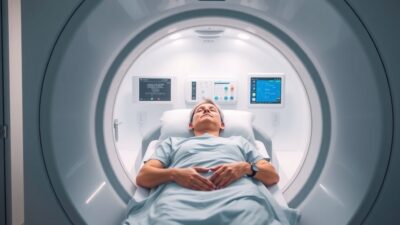
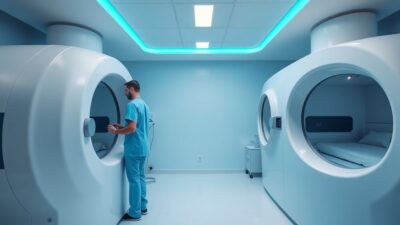
Hyperbaric chambers in diving serve one critical function: treating decompression sickness (DCS) and arterial gas embolism. When a diver ascends too fast, dissolved nitrogen forms bubbles in blood and tissue, causing joint pain, neurological injury, or in severe cases paralysis and death. A recompression chamber re-pressurizes the diver to shrink those bubbles and let the body off-gas safely. The standard protocol is U.S. Navy Treatment Table 6, about 4 hours 45 minutes at 2.8 ATA.
Editor’s note: Recompression for dive injuries is one of the original and most well-established uses of hyperbaric medicine. This guide covers the emergency protocol, the chamber types involved, and what recreational divers should know about access and prevention.
How Does a Hyperbaric Chamber Treat Decompression Sickness?
The definitive treatment for DCS is recompression with 100% oxygen at pressure well above sea level. A hyperbaric chamber after diving re-dissolves the nitrogen bubbles, restores circulation, and delivers oxygen to injured tissue. Decompression sickness is one of the original entries on the list of FDA-cleared indications for HBOT, which is why dive medicine has relied on it for decades.
During a dive, the body absorbs nitrogen from compressed breathing gas. Ascend too quickly and that nitrogen comes out of solution as bubbles that block vessels and injure tissue, producing symptoms from joint pain to paralysis. Recompression works in a few ways at once:
- Bubble compression: higher pressure physically shrinks nitrogen bubbles
- Faster elimination: the pressure gradient drives bubbles back into solution for removal
- Tissue oxygenation: 100% oxygen supports damaged tissue and reduces inflammation
- Symptom reversal: many DCS symptoms improve or resolve with prompt treatment
The most common protocol is Treatment Table 6: 100% oxygen at 2.8 ATA (2.82 atmospheres absolute), cycled with air breaks across a total chamber time of roughly 285 minutes (Moon, 2019). The same recompression approach treats arterial gas embolism, where gas enters the arterial circulation and can cause stroke-like symptoms (Moon, 2019).
How Fast Must a Diver Get to a Chamber After DCS Symptoms?
The sooner recompression begins, the better the outcome, so treat suspected DCS as a medical emergency. Early treatment gives the best chance of full recovery, and delay allows bubble-related injury to progress. Delayed presentations beyond 48 hours can still benefit from recompression, but the response is less predictable, which is why immediate action is the priority (Vann et al., 2011).
While arranging transport, the single most useful first aid is high-flow 100% oxygen, which speeds nitrogen washout even before the diver reaches a chamber. Keep the diver lying flat and hydrated with water, and do not let them fly, because altitude lowers ambient pressure and worsens symptoms.
What Types of Hyperbaric Chambers Are Used for Diving Injuries?
Different diving situations use different chambers, from single-person emergency units to large multi-compartment systems on dive vessels. The core distinction is occupancy and whether medical staff can attend the patient at pressure.
Chamber Types in Diving Medicine
| Chamber type | Pressure | Occupancy | Primary use |
|---|---|---|---|
| Monoplace | Up to ~3.0 ATA | Single patient | Emergency DCS treatment where access is limited |
| Multiplace | Up to ~6.0 ATA | Patient plus attending staff | Complex cases, staff intervention at pressure |
| Deck decompression chamber (DDC) | Matches storage depth | Multiple divers | Saturation diving support on vessels and platforms |
| Portable or mobile | Limited | Single diver | Remote-site emergency response and transport |
Monoplace chambers are simpler and lower cost but limit medical access during treatment, so they are common in smaller diving communities. Multiplace chambers let clinicians manage complex or multiple casualties directly and are standard at major dive medicine centers, as covered in our page on multiplace hyperbaric chambers. Some remote operations rely on portable hyperbaric chambers for first response before transport to a fixed facility.

How Do Commercial Divers Use Hyperbaric Chambers?
Commercial and saturation diving uses chambers not just for treatment but as living and decompression space. In saturation diving, crews live under pressure in deck decompression chambers for days or weeks and decompress once at the end, because the general rule of thumb for saturation decompression is roughly 24 hours for each 100 feet of storage depth. This shapes how offshore energy, salvage, and construction operations are staffed and equipped.
Working depths of 300 to 1,000 feet and longer are routine in offshore oil and gas work, which is why these operations run complex multi-compartment chamber systems with trained hyperbaric and diving medical staff on hand. Military and scientific diving use the same equipment for deep salvage, underwater construction, research, and training.
What Should Recreational Divers Know About DCS Risk and Prevention?
Recreational divers need chambers far less often than commercial divers, but the risk is real and the best chamber is the one you never need. DCS risk rises with rapid or emergency ascents, repetitive diving without adequate surface intervals, flying too soon after diving, dehydration or fatigue, and pushing no-decompression limits.
Prevention is straightforward: keep conservative profiles with safety stops, ascend no faster than 30 feet per minute, allow adequate surface intervals, stay hydrated and fit, and avoid alcohol around diving (U.S. Navy Diving Manual, Rev 7). Carbon monoxide contamination of breathing gas is a separate hazard that also responds to hyperbaric oxygen, covered in our page on oxygen therapy for carbon monoxide poisoning. Note that severe cases such as arterial gas embolism or long-delayed treatment respond less completely to recompression, which is another reason prevention comes first. A related emergency use of hyperbaric oxygen after immersion incidents is discussed in our page on HBOT after drowning.
How Do You Recognize Decompression Sickness?
Early recognition is what makes treatment effective. Symptoms usually appear within minutes to hours of surfacing and fall into two patterns.
Type I DCS (musculoskeletal and skin):
- Joint pain, especially in shoulders and elbows
- Skin rash, mottling, or itching
- Unusual fatigue and malaise
Type II DCS (neurological):
- Numbness, tingling, or weakness
- Paralysis
- Difficulty speaking or thinking clearly
- Vision or hearing problems
- Loss of consciousness
What Should You Do in a Diving Emergency?
Decompression sickness is a medical emergency that needs recompression. Knowing the steps before a dive can save a life.
Divers Alert Network (DAN) emergency line
The Divers Alert Network (DAN) runs a 24/7 emergency hotline for diving injuries at +1-919-684-9111. DAN medical staff can assess symptom severity, advise on first aid, and locate the nearest recompression chamber. Save this number before you get in the water.
If you suspect DCS
- Call emergency services (911 in the US) and state that you suspect decompression sickness.
- Call DAN at +1-919-684-9111 for guidance on urgency and the nearest chamber.
- Give 100% oxygen if available. High-flow oxygen is the most important first aid for DCS.
- Keep the diver lying flat and hydrated with water, not alcohol.
- Do not attempt in-water recompression unless trained and equipped for it. Improvised in-water recompression is dangerous.
- Do not fly until cleared by a diving medicine physician, because altitude worsens DCS.
DAN maintains a global database of recompression chambers and can direct you to the nearest one. The Undersea and Hyperbaric Medical Society also lists accredited hyperbaric facilities for non-emergency inquiries.
The single most important action after a suspected dive injury is simple: call DAN, get high-flow oxygen started, and move the diver to a recompression chamber as fast as possible, where Treatment Table 6 delivers 100% oxygen at 2.8 ATA.
Sources
- Moon RE. “Hyperbaric treatment for decompression sickness: current recommendations.” Undersea and Hyperbaric Medicine, 2019;46(5):685-693. PMID 31683368
- Moon RE. “Hyperbaric treatment of air or gas embolism: current recommendations.” Undersea and Hyperbaric Medicine, 2019;46(5):673-683. PMID 31683367
- Vann RD, Butler FK, Mitchell SJ, Moon RE. “Decompression illness.” The Lancet, 2011;377(9760):153-164. doi:10.1016/S0140-6736(10)61085-9
- Undersea and Hyperbaric Medical Society. “Hyperbaric Oxygen Therapy Indications, 14th Edition.” UHMS, 2019. uhms.org
- U.S. Navy. U.S. Navy Diving Manual, Revision 7. Naval Sea Systems Command, 2016. (Treatment Table 6, ascent rate and recompression protocols)
Medical Disclaimer
The content on BaricBoost.com is for informational purposes only and is not intended as a substitute for professional medical advice, diagnosis, or treatment. Always seek the advice of your physician or other qualified health provider with any questions you may have regarding a medical condition. Never disregard professional medical advice or delay in seeking it because of something you have read on this website.

Author
Seph Fontane Pennock is the founder of BaricBoost.com and Regenerated.com, a clinic directory for regenerative medicine serving 10,000+ providers across the United States. He previously built and sold PositivePsychology.com, which grew to 19 million users and became the largest evidence-based positive psychology resource on the web. Seph brings direct experience as an HBOT patient, having completed protocols at clinics across three continents while navigating mold illness, systemic inflammation, and autoimmune conditions. His treatment journey includes hyperbaric oxygen therapy, peptide protocols, NAD+ therapy, and consultations with specialists from Dubai to Cape Town to Mexico. This combination of entrepreneurial track record and lived patient experience shapes everything published on BaricBoost.com. Every article is grounded in peer-reviewed research, informed by real clinical encounters, and written for patients making high-stakes treatment decisions. Seph's focus is on bringing transparency, scientific rigor, and practical guidance to the hyperbaric oxygen therapy space.