Hyperbaric chamber certification requires a minimum 40 hours of NBDHMT-approved training, documented supervised clinical hours, and a national board exam. The CHT (Certified Hyperbaric Technologist) credential is the industry standard, administered by the NBDHMT and recognized across more than 267 UHMS-accredited facilities. CHT recertification runs every 2 years and requires 24 continuing-education hours plus 100 documented clinical hours.
What certifications do you need to operate a hyperbaric chamber?
You need a board certification from the National Board of Diving and Hyperbaric Medical Technology (NBDHMT) or an equivalent nursing credential. Several pathways exist, and they are not all equal. CHT is the standard for technicians, while nurses pursue the CHRN. Both require a qualifying healthcare credential before you begin.
Eligible credentials for CHT include Respiratory Therapist, Physician Assistant, Active Duty Military Corpsman, EMT or Paramedic, Registered Nurse or Licensed Practical Nurse, Nurse Practitioner, and Physician. Candidates without a qualifying credential typically obtain EMT certification first. Approved programs run through hospitals with hyperbaric facilities, specialized training centers, and some equipment manufacturers.
Hyperbaric certifications compared
| Credential | Prerequisite | Training hours | Exam | Recert cycle | Recert requirement |
|---|---|---|---|---|---|
| CHT (Certified Hyperbaric Technologist) | RT, EMT/paramedic, PA, RN/LPN, corpsman, or physician | 40-hour minimum + clinical hours | NBDHMT national exam | Every 2 years | 24 CE hours (12+ Category A) + 100 clinical hours |
| CHRN (Certified Hyperbaric Registered Nurse) | RN, LPN, or NP | 40-hour minimum + clinical hours | NBDHMT national exam | Every 4 years | 60 CE hours (30 Category A) |
| CHS (Certified Hyperbaric Specialist) | Advanced techs and nurses | Program-dependent | ABWH exam | Varies | Set by ABWH |
| DMT (Diver Medic Technologist) | Remote-duty and commercial-dive medics | Structured DMT course | NBDHMT national exam | Every 2 years | NBDHMT-defined CE |
How long does it take to get certified?
The full process typically takes 3 to 18 months. The 40-hour introductory course can be compressed into about one intensive week or spread across months for working professionals, and supervised clinical hours follow. The UHMS recommends that new staff achieve certification within 18 months of starting hyperbaric work.
Some theoretical components can be completed online through NBDHMT-approved providers, but hands-on training with actual chamber equipment is mandatory. Hybrid programs pair online coursework with in-person lab sessions for the required practical training. Accreditation matters: a program without UHMS or NBDHMT recognition should raise concern before you enroll.
How much does hyperbaric chamber training cost?
Training runs roughly $500 to $2,000 for the 40-hour course, plus the NBDHMT exam fee of around $100. Some healthcare employers cover these costs, so ask before enrolling.
What does hyperbaric chamber training actually cover?
Certification training covers safety protocols, patient monitoring, emergency procedures, and chamber mechanics, which blend together in real scenarios. You spend time on pressure physics and how the body responds at different atmospheric levels. Gas laws are not theoretical here: Boyle’s Law, Henry’s Law, and Dalton’s Law guide every decision inside the chamber.
Technical knowledge alone is not enough. As the technologist, you are the link between the patient and the medical team, and many patients feel anxious during early sessions. The role requires dual awareness: understanding the equipment and understanding the patient. Every session demands continuous monitoring of vital signs and readiness to respond if complications arise.
Safety drives everything. Fire prevention tops the priority list because pure-oxygen environments are highly reactive. Strict rules govern what enters the chamber: no petroleum-based products, no unapproved electronics, and no synthetic fabrics that generate static. Trainees learn to inspect patients before every session, following NFPA 99 Chapter 14 requirements for hyperbaric facility safety. Emergency decompression procedures are a separate critical component: if a fire, medical emergency, or equipment failure occurs, you must return patients to normal pressure safely without causing decompression illness.
What equipment and monitoring skills do technicians learn?
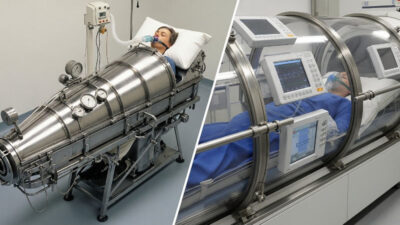
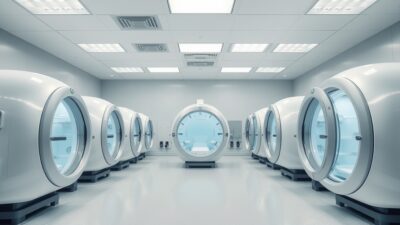
Operating the chamber requires substantial technical knowledge across multiple integrated systems. You learn the distinct procedures for monoplace chambers (single patient) and multiplace chambers (patients and staff together), each with unique safety concerns, and portable hyperbaric chamber systems add further operational requirements.
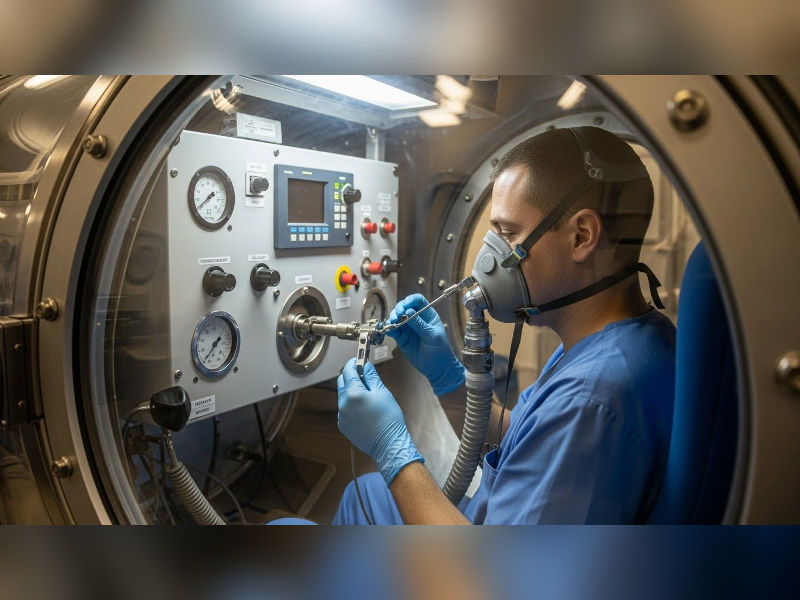
Pressure control is central. You practice controlled compression and decompression, adjusting to patient tolerance: rushing compression causes ear barotrauma, and rushing decompression risks decompression illness. Daily maintenance checks become routine, covering pressure gauges and relief valves, oxygen delivery systems, communication equipment, and door seals and chamber integrity.
Patient monitoring runs throughout treatment. Baseline assessments screen for contraindications, since an untreated pneumothorax is an absolute contraindication and certain medications and uncontrolled claustrophobia require evaluation first. Oxygen toxicity is a real risk that rises with pressure and duration; early signs include nausea, muscle twitching, and visual field narrowing, and seizures can occur without warning. Ear and sinus equalization causes problems for many patients, so teaching equalization techniques is a standard part of patient education. Oxygen toxicity and barotrauma are covered from the patient side in the HBOT side effects guide.
How often do you recertify as a hyperbaric technologist?
CHT recertification is required every 2 years; CHRN every 4 years. Initial certification is only the start, because the field evolves as research continues and protocols and technology change.
CHT recertification requires 24 CE hours, with at least 12 in Category A (hyperbaric-specific topics), plus at least 100 documented clinical hours. CHRN recertification requires 60 CE hours including 30 Category A. Category A topics include barotrauma management, CNS oxygen toxicity recognition and response, infection control in hyperbaric settings, decompression procedures, tissue oximetry, and chamber safety and emergency procedures.
Career growth leads toward specialization. Some technicians focus on wound care (diabetic ulcers, radiation injuries, necrotizing infections), while others specialize in diving medicine. Facilities range from hospitals and outpatient wound centers to sports-medicine and military settings, and the nearest hyperbaric facility may shape which niche you can build toward. Professional organizations including the UHMS and the Baromedical Nurses Association host events for networking and continuing education.
What qualifications do I need before starting hyperbaric chamber training?
CHT certification requires a qualifying healthcare credential: Respiratory Therapist, EMT or Paramedic, RN or LPN, Physician Assistant, Nurse Practitioner, or Physician. Candidates without a qualifying credential typically obtain EMT certification first. Some programs may accept candidates with strong science and patient-care backgrounds in specific circumstances, but the underlying clinical credential is the standard entry requirement set by the NBDHMT.
Are there online options for hyperbaric certification?
Partly. Some theoretical components can be completed online through NBDHMT-approved providers, but hands-on training with actual chamber equipment is mandatory for certification. Hybrid programs combine online coursework with in-person lab sessions for the required practical training. A fully online certification with no supervised equipment time would not meet NBDHMT standards, so treat any such offer as a red flag.
What is the difference between CHT and CHRN?
Both certifications share similar training and competency requirements and are issued by the NBDHMT. CHT is designed for technicians, respiratory therapists, EMTs, physician assistants, and military corpsmen in technical operations roles. CHRN is nursing-specific, integrating hyperbaric training with the nursing scope of practice. The main practical differences are the eligible credentials and the recertification cycle: CHT recertifies every 2 years, CHRN every 4.
Sources
- National Board of Diving and Hyperbaric Medical Technology. “Certified Hyperbaric Technologist (CHT) certification requirements and Resource Manual.” nbdhmt.org
- Undersea and Hyperbaric Medical Society. “Hyperbaric Facility Accreditation; Education and Credentialing.” uhms.org
- National Fire Protection Association. “NFPA 99: Health Care Facilities Code, Chapter 14 (Hyperbaric Facilities).” nfpa.org
- Undersea and Hyperbaric Medical Society. Hyperbaric Oxygen Therapy Indications, 14th Edition. uhms.org
Medical Disclaimer
The content on BaricBoost.com is for informational purposes only and is not intended as a substitute for professional medical advice, diagnosis, or treatment. Always seek the advice of your physician or other qualified health provider with any questions you may have regarding a medical condition. Never disregard professional medical advice or delay in seeking it because of something you have read on this website.

Author
Seph Fontane Pennock is the founder of BaricBoost.com and Regenerated.com, a clinic directory for regenerative medicine serving 10,000+ providers across the United States. He previously built and sold PositivePsychology.com, which grew to 19 million users and became the largest evidence-based positive psychology resource on the web. Seph brings direct experience as an HBOT patient, having completed protocols at clinics across three continents while navigating mold illness, systemic inflammation, and autoimmune conditions. His treatment journey includes hyperbaric oxygen therapy, peptide protocols, NAD+ therapy, and consultations with specialists from Dubai to Cape Town to Mexico. This combination of entrepreneurial track record and lived patient experience shapes everything published on BaricBoost.com. Every article is grounded in peer-reviewed research, informed by real clinical encounters, and written for patients making high-stakes treatment decisions. Seph's focus is on bringing transparency, scientific rigor, and practical guidance to the hyperbaric oxygen therapy space.