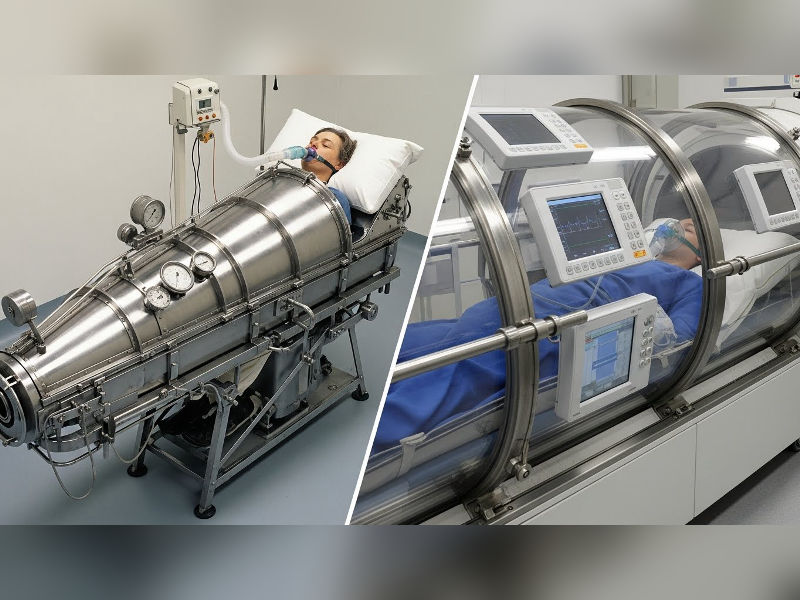
An iron lung and a hyperbaric chamber both use pressure, but for opposite ends. An iron lung creates negative pressure around the chest to force breathing in patients whose respiratory muscles have failed. A hyperbaric chamber creates positive pressure so you breathe near 100% oxygen at up to 3 times normal atmospheric pressure, dissolving extra oxygen into blood plasma. One is obsolete. The other has 14 approved medical indications.
What is the difference between an iron lung and a hyperbaric chamber?
An iron lung is a mechanical ventilator that moves air in and out of paralyzed lungs. A hyperbaric chamber does not breathe for you at all. You breathe on your own while the chamber raises the surrounding pressure and delivers oxygen at high concentration. The first is life support for respiratory failure. The second is a treatment that pushes oxygen into injured or oxygen-starved tissue.
The iron lung worked by negative pressure ventilation. The patient lay sealed inside a metal cylinder from the neck down, head out through a rubber collar. Bellows lowered the pressure inside the tank, which pulled the chest wall outward and drew air into the lungs. When the pressure returned, the chest relaxed and air flowed out. The machine did the mechanical work of breathing that the patient’s own muscles could not.
A hyperbaric chamber relies on the opposite physics. Pressure is raised above normal, typically between 1.5 and 3.0 atmospheres absolute, while the patient breathes oxygen through the chamber atmosphere or a mask. The elevated pressure forces oxygen to dissolve directly into blood plasma, reaching tissue that red blood cells alone cannot supply. This drives angiogenesis, immune function, and stem cell mobilization in damaged tissue (Thom, 2011; Hadanny and Efrati, 2020).
1.5 to 3.0 ATA
The positive-pressure range used in modern hyperbaric chambers. Iron lungs did the reverse, cycling to sub-atmospheric pressure to pull air into the lungs.
Mathieu, Marroni, and Kot, 2017
| Feature | Iron Lung | Hyperbaric Chamber |
| Pressure mechanism | Negative pressure around the chest | Positive pressure throughout the chamber |
| What it does | Mechanically ventilates paralyzed lungs | Dissolves oxygen into plasma and tissue |
| Oxygen concentration | Room air (about 21% O2) | Near 100% medical oxygen |
| Patient role | Passive, fully enclosed, immobilized | Breathes independently, can move, read, sleep |
| Session length | Continuous, hours to years | Sessions of 60 to 120 minutes |
| Era and current use | Obsolete since the 1960s; a handful of polio survivors remain | Growing; 14 approved indications plus active research |
What does each device actually treat?
Iron lungs treated respiratory failure caused by neuromuscular paralysis, most famously bulbar and spinal polio. Hyperbaric oxygen therapy treats a different set of problems entirely: conditions where tissue is starved of oxygen or fighting infection. The two are not interchangeable, and a hyperbaric chamber cannot substitute for a ventilator.
The iron lung kept patients alive when their diaphragm and chest muscles stopped working. During the 1952 polio epidemic, hospital wards held rows of these cylinders, each breathing for a paralyzed patient. Some people lived inside them for decades. The device bought time for the nervous system to recover, or, when it did not, it became permanent life support.
Modern hyperbaric oxygen therapy targets oxygen-dependent tissue injury. The Undersea and Hyperbaric Medical Society recognizes 14 approved indications, including:
- Non-healing diabetic foot ulcers
- Carbon monoxide poisoning
- Decompression sickness from diving
- Radiation tissue injury after cancer treatment
- Gas gangrene and certain necrotizing infections
14
Approved medical indications for hyperbaric oxygen therapy, from carbon monoxide poisoning to diabetic wounds. Research into stroke and brain injury is ongoing but not yet approved.
Undersea and Hyperbaric Medical Society, 2023
None of these involve breathing assistance. The goal is therapeutic oxygen delivery, not mechanical ventilation (Mathieu, Marroni, and Kot, 2017). That is the core reason the question “is an iron lung a hyperbaric chamber” has a simple answer: no. One replaces the work of the lungs. The other changes what dissolves into the blood while the lungs work normally.
Why did iron lungs disappear while hyperbaric chambers grew?
The iron lung became obsolete once positive-pressure ventilators arrived in the 1950s and 1960s. Those machines pushed air into the lungs through a tube rather than sealing the whole body in a tank. They were smaller, worked during surgery and in ambulances, and handled many kinds of respiratory failure. Hyperbaric chambers grew for the opposite reason: research kept finding new conditions where dissolved oxygen changed outcomes.
Positive-pressure ventilators solved every practical problem the iron lung had. They did not require immobilizing a patient for months, they did not fail catastrophically during a power cut, and they could be moved. By the time polio vaccination cut the number of new cases, the iron lung was already being retired. A few long-term survivors still use them today because their bodies adapted to that specific machine.
Hyperbaric medicine moved the other way. You now find chambers in hospitals, wound care centers, and sports medicine facilities, alongside home and portable units. If you are weighing options, the differences between a hard-shell and soft-shell chamber and the various alternatives to HBOT matter far more than any comparison to a 1930s ventilator.
What is HBOT actually like compared to an iron lung?
The experience is nothing like being sealed in an iron lung. In a monoplace chamber you lie in a clear acrylic tube, breathe normally, and can see out the whole time. In a multiplace chamber you sit in what feels like a small room and breathe oxygen through a mask. You equalize your ears the way you would on a descending plane, then wait while the oxygen does its work.
A typical course runs 20 to 40 sessions of 60 to 120 minutes, scheduled as outpatient visits. Patients read, watch a screen, or sleep. Iron lung patients had no such freedom; the machine and the confinement were continuous. The safety concerns also differ. Iron lungs risked skin breakdown, claustrophobia, and death within minutes of a power failure. Hyperbaric chambers carry fire risk from the oxygen-rich atmosphere, which is why electronics and petroleum products are banned inside, plus the risk of ear barotrauma if pressure is not equalized (Mathieu, Marroni, and Kot, 2017).
The takeaway for anyone researching treatment: HBOT is current, evidence-based medicine, not a vintage device. What has not changed is the underlying physics. Negative-pressure ventilation to breathe for a patient, positive-pressure oxygenation to treat tissue. Two different tools for two different problems. For related comparisons, see EWOT versus HBOT and the CVAC pod versus hyperbaric chamber.
Frequently Asked Questions
Can a hyperbaric chamber replace an iron lung for respiratory failure?
No. A hyperbaric chamber does not provide ventilation, so patients must breathe on their own inside it. Respiratory failure requires a mechanical ventilator, which is the modern positive-pressure device that replaced the iron lung in the 1950s and 1960s. HBOT changes how much oxygen dissolves into the blood; it does not move air in and out of paralyzed lungs (Mathieu, Marroni, and Kot, 2017).
Are iron lungs still used in modern medicine?
Almost never. Positive-pressure ventilators replaced them decades ago because they are smaller, portable, and do not require sealing the whole body in a tank. A small number of polio survivors still use iron lungs by personal choice because their bodies adapted to that machine over many years. Hospitals stopped producing new ones long ago.
What conditions does hyperbaric oxygen therapy actually treat?
The Undersea and Hyperbaric Medical Society recognizes 14 approved indications. These include decompression sickness, carbon monoxide poisoning, non-healing diabetic foot ulcers, radiation tissue injury, gas gangrene, and certain other infections and oxygen-starved wounds. Uses for stroke and traumatic brain injury are still investigational and not on the approved list (Mathieu, Marroni, and Kot, 2017).
Sources
- Drinker P, Shaw LA. An apparatus for the prolonged administration of artificial respiration. Journal of Clinical Investigation, 1929;7(2):229-247. doi:10.1172/JCI100226
- Thom SR. Hyperbaric oxygen: its mechanisms and efficacy. Plastic and Reconstructive Surgery, 2011;127(Suppl 1):131S-141S. doi:10.1097/PRS.0b013e3181fbe2bf
- Mathieu D, Marroni A, Kot J. Tenth European Consensus Conference on Hyperbaric Medicine: recommendations for accepted and non-accepted clinical indications. Diving and Hyperbaric Medicine, 2017;47(1):24-32. doi:10.28920/dhm47.1.24-32
- Hadanny A, Efrati S. The hyperoxic-hypoxic paradox. Biomolecules, 2020;10(6):958. doi:10.3390/biom10060958
- Undersea and Hyperbaric Medical Society. Hyperbaric oxygen therapy indications. UHMS approved indications
Medical Disclaimer
The content on BaricBoost.com is for informational purposes only and is not intended as a substitute for professional medical advice, diagnosis, or treatment. Always seek the advice of your physician or other qualified health provider with any questions you may have regarding a medical condition. Never disregard professional medical advice or delay in seeking it because of something you have read on this website.

Author
Seph Fontane Pennock is the founder of BaricBoost.com and Regenerated.com, a clinic directory for regenerative medicine serving 10,000+ providers across the United States. He previously built and sold PositivePsychology.com, which grew to 19 million users and became the largest evidence-based positive psychology resource on the web. Seph brings direct experience as an HBOT patient, having completed protocols at clinics across three continents while navigating mold illness, systemic inflammation, and autoimmune conditions. His treatment journey includes hyperbaric oxygen therapy, peptide protocols, NAD+ therapy, and consultations with specialists from Dubai to Cape Town to Mexico. This combination of entrepreneurial track record and lived patient experience shapes everything published on BaricBoost.com. Every article is grounded in peer-reviewed research, informed by real clinical encounters, and written for patients making high-stakes treatment decisions. Seph's focus is on bringing transparency, scientific rigor, and practical guidance to the hyperbaric oxygen therapy space.