How often do hyperbaric chambers catch fire?
Between 1923 and 1996, 77 people died in 35 hyperbaric chamber fires worldwide. Every fatal fire occurred in an enriched oxygen atmosphere above 28% O2. Under modern safety protocols, serious incidents in accredited facilities have dropped to near zero. The risk is real but quantifiably small, and the data shows exactly what causes these events.
The definitive academic analysis is Sheffield and Desautels (1997) in Undersea and Hyperbaric Medicine. Analyzing 73 years of records from 1923 to 1996, the study documented 77 deaths across 35 hyperbaric chamber fires.1 A broader UHMS Mishap Database, covering all chamber incidents rather than fires alone, documents 135 deaths across 113 incidents over a 75-year period.3 Fires are a subset of that larger tally, which is why the two figures differ.
“From 1923 to 1996, 77 people died in 35 hyperbaric chamber fires worldwide. Every fatal fire occurred in an enriched oxygen atmosphere above 28%.”
Sheffield and Desautels, Undersea and Hyperbaric Medicine, 1997
Fire fatalities in accredited US clinical facilities operating under modern NFPA 99 protocols. The documented deaths cluster in older, non-certified, or unsupervised settings.1
Notable incidents
The incidents below span multiplace hospital chambers, aging non-certified units, and home or off-label settings. The clustering matters: the fatal modern cases involve non-accredited or unsupervised chambers, a pattern documented in the 2023 Polish Hyperbaric Research review of chamber fires.5
| Year | Location | Chamber type / setting | Outcome | Cause |
|---|---|---|---|---|
| 1997 | Milan, Italy | Hospital multiplace | 11 deaths (10 patients + 1 nurse) | Multiplace chamber fire5 |
| 1998 | Istanbul, Turkey | 1947-vintage chamber | 3 deaths | No water deluge system |
| 2009 | Florida, USA | Non-certified, off-label | 2 deaths (grandmother + 4-year-old boy) | Off-label cerebral palsy treatment5 |
| January 2025 | Troy, Michigan | Non-accredited pediatric clinic | 1 death (5-year-old, Thomas Cooper) | Under investigation; criminal charges filed |
| July 2025 | Lake Havasu City, Arizona | Private clinic | 1 death (43-year-old, Walter Foxcroft) | Fire in chamber at his own clinic |
The 2025 Michigan case at the Oxford Center in Troy led to criminal charges, including second-degree murder against the facility’s CEO and two staff members, following the death of 5-year-old Thomas Cooper on January 31, 2025.
Why are fires so dangerous inside a hyperbaric chamber?
Fire in a hyperbaric chamber is a fire-triangle problem intensified by pressure and oxygen. Three elements must be present at once:
- Fuel: any organic material (clothing, bedding, hair, skin oils, cosmetics).
- Oxygen: dramatically elevated in HBOT environments (21% ambient versus up to 100% in hard chambers).
- Ignition source: static electricity, battery-operated devices, friction, or metal-on-metal sparks.
In a 100% oxygen environment at 2.0 or more ATA, materials that resist combustion at normal pressure ignite easily, combustion is faster and more intense, and fire spreads rapidly in an enclosed space with no escape during pressurization. The Sheffield analysis found that all survivors of hyperbaric chamber fires were in chambers pressurized with air containing less than 23.5% oxygen.1 Fire is the most severe entry among the broader hyperbaric chamber side effects patients should understand. For the physics of how ignition escalates under pressure, see our explainer on how a hyperbaric chamber can explode.
“Before 1980, chamber fires were primarily caused by electrical ignition. Since 1980, fires have been primarily caused by prohibited items that occupants brought inside.”
Sheffield and Desautels, 1997
Which chamber type has higher fire risk?
| Factor | Hard Chamber | Soft Chamber |
|---|---|---|
| Oxygen environment | 100% O2 at 2.0-3.0 ATA | ~24% O2 from concentrator at 1.3 ATA |
| Fire risk level | Higher combustion intensity (oxygen-enriched) | Lower (near-ambient O2) |
| Escape difficulty | Difficult (metal chamber, pressurized) | Easier (zipper, can be cut open) |
| Fire suppression | Required in accredited facilities (NFPA 99) | Typically absent |
Hard chambers concentrate oxygen and are harder to exit, but in accredited facilities they carry deluge suppression and strict protocols. Soft chambers run near ambient oxygen but are often used at home without a safety net, which is where several recent fatalities occurred. Neither setting is risk-free; the difference is supervision and engineering controls.
What fire-safety rules do accredited HBOT facilities follow?
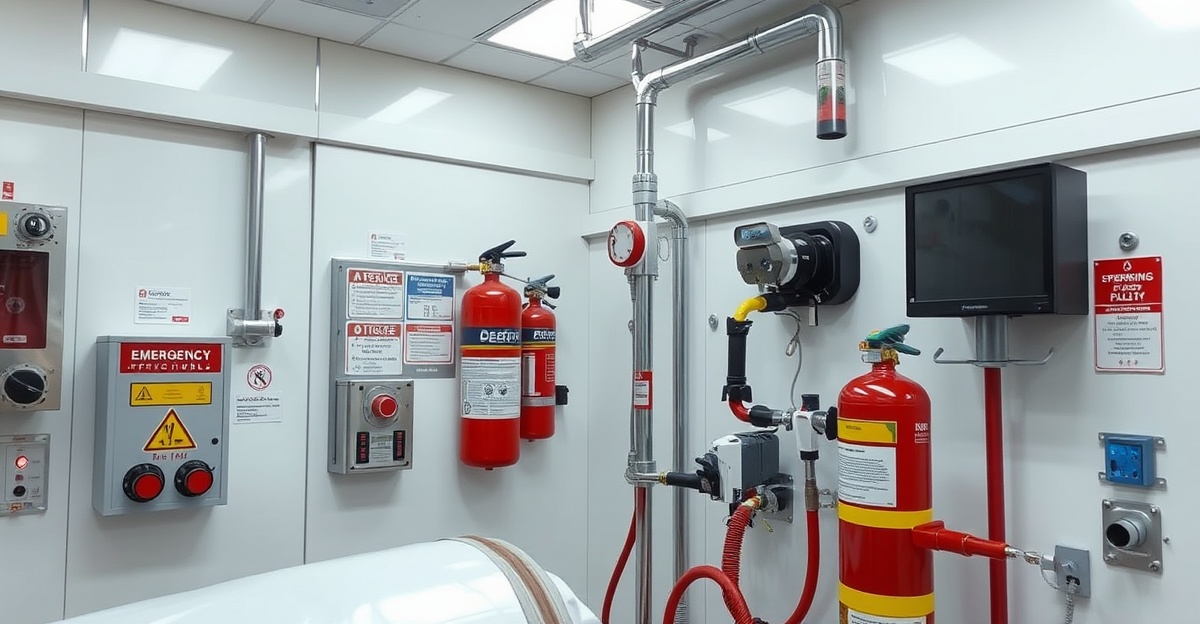
Accredited HBOT facilities in the United States operate under NFPA 99 Chapter 14 (Health Care Facilities Code, 2024 edition), with chambers built to the ASME PVHO-1 pressure-vessel standard.26 Key requirements include:
- Fire suppression: deluge suppression must activate within 3 seconds (NFPA 99 section 14.2.6.2.4).2
- Construction: 2-hour fire-rated construction; noncombustible or limited-combustible finishes.
- Clothing: only 100% cotton or specifically approved fabric blends (no nylon, polyester, rayon, wool, or Gore-Tex).
- Personnel: every program must designate an on-site Hyperbaric Safety Director.
- Electrical: full isolation of chamber wiring and the ability to de-energize circuitry in an emergency.
- Oxygen monitoring: continuous monitoring with automatic shutoff capability.
Maximum activation time required for HBOT facility fire suppression systems under NFPA 99, section 14.2.6.2.42
What items are banned inside a hyperbaric chamber?
- All battery-operated devices (phones, watches, hearing aids, e-cigarettes)
- Lighters, matches, or any ignition source
- Petroleum-based products (Vaseline, lip balm, hair products, cosmetics)
- Synthetic clothing that generates static (nylon, polyester)
- Hand warmers or heat packs
- Lithium-ion batteries of any kind
What did the FDA’s August 2025 safety warning say?
Following the 2025 incidents in Michigan and Arizona, the FDA issued a letter to health care providers on August 25, 2025, warning about fire risks tied to HBOT devices and citing recent reports of fires that resulted in serious injuries and deaths.4 The letter urged providers to follow manufacturer instructions, maintain fire-prevention and grounding measures, and ensure patients wear hyperbaric-compatible clothing such as cotton. It is the most recent federal regulatory response to hyperbaric chamber safety incidents.
How likely is a fatal chamber fire today?
With millions of HBOT sessions conducted annually in the US and fire incidents occurring rarely, the per-session fatality risk from fire at accredited clinical facilities is extraordinarily low. The UHMS Mishap Database records 135 deaths across 113 incidents over 75 years, a tally that, while tragic, represents a very small fraction of the millions of treatments delivered.3 The overwhelming majority of modern incidents involve home or unaccredited facilities where safety protocols are absent or poorly enforced. For the full fatality breakdown, see our related post on how many people have died in a hyperbaric chamber, and our overview of hyperbaric chamber fire safety.
Sources
- Sheffield PJ, Desautels DA. Hyperbaric and hypobaric chamber fires: a 73-year analysis. Undersea and Hyperbaric Medicine. 1997;24(3):153-164. PMID: 9308138
- NFPA 99 Health Care Facilities Code, Chapter 14 (Hyperbaric Facilities), 2024 edition. nfpa.org
- Undersea and Hyperbaric Medical Society. Chamber Experience and Mishap Database. uhms.org
- U.S. Food and Drug Administration. Follow instructions for safe use of hyperbaric oxygen therapy devices: letter to health care providers. August 25, 2025. fda.gov
- Zieliński E, et al. Fire in the hyperbaric chamber: review of the literature. Polish Hyperbaric Research. 2023. DOI: 10.2478/phr-2023-0020
- ASME. PVHO-1: safety standard for pressure vessels for human occupancy. asme.org
Medical Disclaimer
The content on BaricBoost.com is for informational purposes only and is not intended as a substitute for professional medical advice, diagnosis, or treatment. Always seek the advice of your physician or other qualified health provider with any questions you may have regarding a medical condition. Never disregard professional medical advice or delay in seeking it because of something you have read on this website.

Author
Seph Fontane Pennock is the founder of BaricBoost.com and Regenerated.com, a clinic directory for regenerative medicine serving 10,000+ providers across the United States. He previously built and sold PositivePsychology.com, which grew to 19 million users and became the largest evidence-based positive psychology resource on the web. Seph brings direct experience as an HBOT patient, having completed protocols at clinics across three continents while navigating mold illness, systemic inflammation, and autoimmune conditions. His treatment journey includes hyperbaric oxygen therapy, peptide protocols, NAD+ therapy, and consultations with specialists from Dubai to Cape Town to Mexico. This combination of entrepreneurial track record and lived patient experience shapes everything published on BaricBoost.com. Every article is grounded in peer-reviewed research, informed by real clinical encounters, and written for patients making high-stakes treatment decisions. Seph's focus is on bringing transparency, scientific rigor, and practical guidance to the hyperbaric oxygen therapy space.