Affiliate Disclosure
This article contains affiliate links. If you purchase through these links, we may earn a commission at no additional cost to you. This does not influence our evaluations or rankings.
Hyperbaric oxygen therapy is not an evidence-supported treatment for Lyme disease. The published clinical evidence is a single case report, no randomized trials exist, and in a survey of 347 Lyme patients only 22 percent who tried HBOT rated it effective. Major clinical guidelines do not recommend it. This guide covers the biological rationale, the thin evidence, the protocols clinics use, and the cost, so you can weigh HBOT honestly against proven care.
Editor’s Note: HBOT for Lyme disease is contested. The mainstream medical community does not endorse it, while some Lyme-literate physicians use it inside broader protocols. This article presents the evidence behind each position without overstating either.
From the author
My own health issues started with mold exposure that triggered a system-wide inflammatory cascade. The overlap between mold illness and chronic Lyme, in symptoms, immune dysregulation, and treatment approaches, is something I have navigated personally. I write about HBOT for Lyme knowing these patients are often desperate for something that works, and that honest reporting on the evidence matters more here than almost anywhere else.
How does HBOT work for Lyme disease?
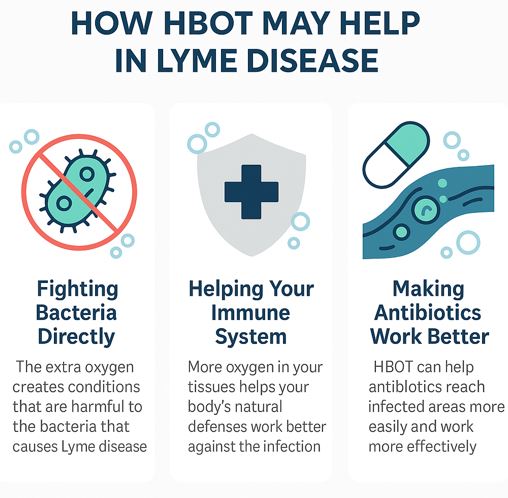
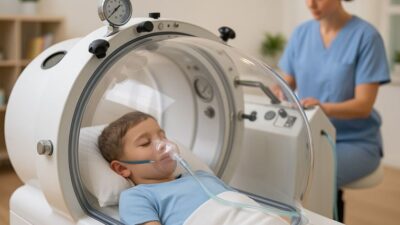
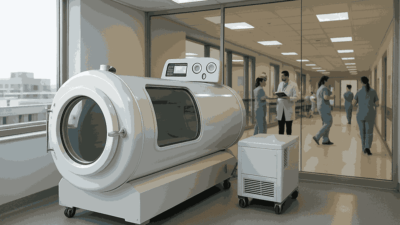
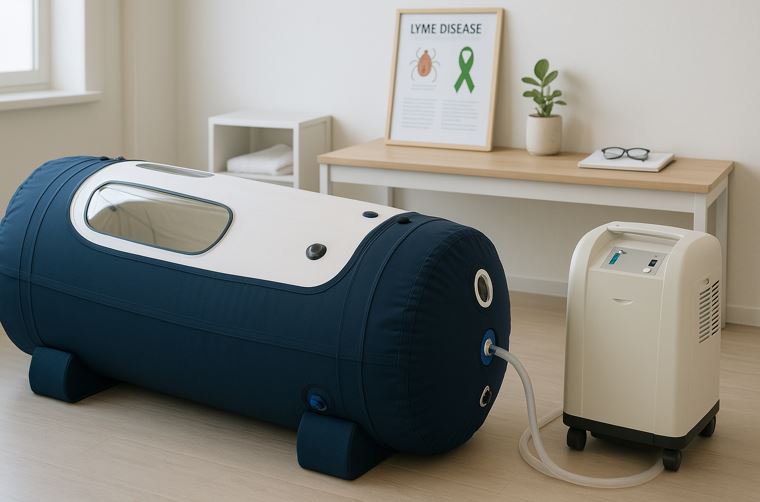
The rationale is biological, not proven in patients. In a hyperbaric chamber you breathe 100 percent oxygen at 1.5 to 3 times normal atmospheric pressure. That dissolves far more oxygen into blood plasma than usual, raising oxygen levels even in tissue with poor blood flow. Borrelia burgdorferi, the bacterium that causes Lyme, is microaerophilic: it grows best at low oxygen tension. The theory is that flooding tissue with oxygen creates conditions the organism tolerates poorly.
That is the extent of the mechanism argument. It is plausible on paper. It has not been demonstrated to clear infection or resolve disease in controlled human studies, and no replicated, peer-reviewed laboratory study confirms that hyperbaric oxygen kills Borrelia in a way that translates to treatment. Lyme is among the harder cases in our broader guide to hyperbaric oxygen for chronic conditions, where evidence ranges from strong to speculative. It sits at the speculative end.
Key terms
- Post-treatment Lyme disease syndrome (PTLDS): persistent fatigue, pain, or cognitive symptoms lasting six months or more after standard antibiotic treatment for Lyme.
- Borrelia burgdorferi: the spirochete bacterium transmitted by tick bites that causes Lyme disease.
- Microaerophilic: an organism that grows best at oxygen levels lower than in room air, the basis for the HBOT rationale.
What does the research say for HBOT and Lyme?
The research base is thin enough to describe in a sentence: one published clinical case report, no randomized controlled trials, and patient-survey data showing low self-rated effectiveness. This is not a foundation for clinical recommendation.
The single case report, Huang and colleagues in the Journal of the Chinese Medical Association in 2014, documented one patient with chronic Lyme whose joint pain, eye twitch, sleep disturbance, numbness, and short-term memory problems improved after 30 HBOT sessions of 90 minutes each.1 A single patient’s improvement cannot separate treatment effect from natural fluctuation or placebo, and the authors did not claim otherwise.
On the guideline side, the 2020 clinical practice guidelines from the Infectious Diseases Society of America, the American Academy of Neurology, and the American College of Rheumatology (Lantos et al., 2021) do not include HBOT among recommended treatments for Lyme disease or for persistent post-treatment symptoms, and advise against unproven therapies in this setting.3 Standard antibiotics remain the first-line and only proven treatment.
What the evidence actually supports
| Claim | Evidence type | Strength |
|---|---|---|
| Symptom relief in chronic Lyme | Single case report (Huang 2014) | Limited |
| Kills or inhibits Borrelia in the lab | No replicated peer-reviewed study | Very limited |
| Cures Lyme disease | No controlled evidence | None |
| Recommended by major guidelines | IDSA/AAN/ACR 2020 | Not recommended |
What HBOT protocol is used for Lyme?
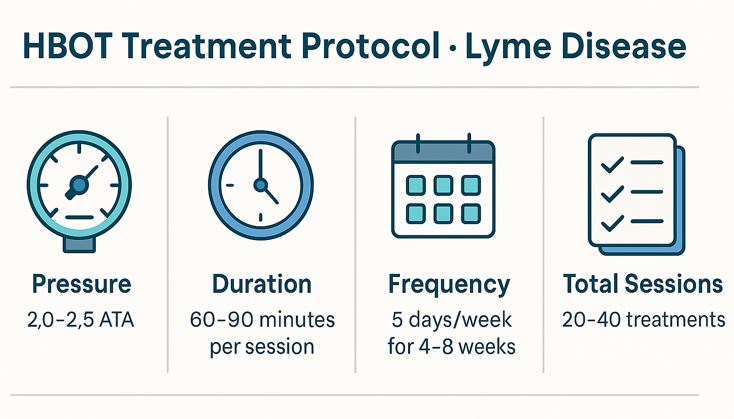
There is no standardized, validated protocol, because the treatment has not been established for Lyme. The parameters clinics use are borrowed from other hyperbaric indications:
- Pressure: 2.0 to 2.5 ATA
- Duration: 60 to 90 minutes per session
- Frequency: 5 days per week for 4 to 8 weeks
- Total sessions: typically 20 to 40
A course of 20 to 40 sessions is a significant time and cost commitment for an unproven treatment, and that trade-off should be explicit before starting. Our session guide explains how frequency and course length are set in indications where the evidence is stronger.
How does HBOT compare to antibiotics?
Antibiotics are the standard, evidence-based first-line treatment for Lyme disease. HBOT is not a substitute. Some Lyme-literate physicians add HBOT as an adjunct when standard treatment has not resolved symptoms, but that combined approach lacks controlled trial evidence.
The argument made for HBOT rests on known challenges with antibiotic treatment in persistent cases: difficulty reaching all infected tissue, possible bacterial biofilms, and survival in low-oxygen niches. Whether raising tissue oxygen meaningfully addresses any of these in patients is unknown. Anyone considering HBOT should keep proven treatment in place and treat HBOT as experimental. Related conditions with overlapping symptoms are covered in our guides to HBOT for autoimmune conditions and HBOT for fibromyalgia, where the evidence is similarly limited.
Who is considered a candidate, and where does it fit?
Because the evidence is so limited, no group is an established candidate. In practice, the people who pursue HBOT for Lyme are those with long-term symptoms that persisted after antibiotic treatment, often diagnosed with post-treatment Lyme disease syndrome. An estimated 10 to 20 percent of treated Lyme patients develop lingering symptoms, and this group has the fewest proven options, which is part of why unproven treatments attract interest.
Neurological Lyme is sometimes raised as a theoretical target, on the reasoning that dissolved oxygen crosses the blood-brain barrier more readily than some antibiotics. That remains theory; no clinical evidence supports HBOT specifically for neurological Lyme. The honest position is that HBOT for Lyme is a personal decision made with limited data, best taken with a provider who understands both Lyme disease and hyperbaric medicine, and without abandoning standard care. Bacterial and other infections where HBOT has a clearer role are discussed in our guide to HBOT for infections.
What are the side effects and risks?
HBOT is generally well tolerated when delivered by trained staff, but it is not risk-free. Common side effects include ear or sinus pressure, temporary vision changes, fatigue after early sessions, and sinus congestion. Rare but serious risks include pneumothorax (collapsed lung), oxygen toxicity, and fire hazard from the high-oxygen environment. Our full guide to HBOT side effects and risks covers these in detail.
Who should not try HBOT
HBOT is not appropriate for everyone. Discuss your full medical history with your provider before starting.
Absolute contraindications
HBOT should not be used if you have an untreated pneumothorax (collapsed lung), where pressure changes can become life-threatening, or if you are taking certain chemotherapy drugs (bleomycin, cisplatin, doxorubicin, and disulfiram may interact dangerously with high-oxygen environments).
Relative contraindications
Extra precautions or postponement may be needed with an upper respiratory infection or sinus congestion (barotrauma risk), a seizure disorder (high-pressure oxygen can lower the seizure threshold), chronic obstructive pulmonary disease, high fever, a history of ear surgery or chronic ear problems, claustrophobia (which may call for sedation or a multiplace chamber), or pregnancy, where routine safety data are insufficient. Always consult your physician first, especially if you use insulin, have an implanted device, or take other medications.
Sources
- Huang CY, Chen YW, Kao TH, et al. “Hyperbaric oxygen therapy as an effective adjunctive treatment for chronic Lyme disease.” Journal of the Chinese Medical Association, 2014;77(5):269-271. doi:10.1016/j.jcma.2014.02.001
- LymeDisease.org. “MyLymeData” patient registry, chart book, 2019. Patient-reported HBOT outcomes (N=347). lymedisease.org
- Lantos PM, Rumbaugh J, Bockenstedt LK, et al. “Clinical Practice Guidelines by the Infectious Diseases Society of America (IDSA), American Academy of Neurology (AAN), and American College of Rheumatology (ACR): 2020 Guidelines for the Prevention, Diagnosis, and Treatment of Lyme Disease.” Clinical Infectious Diseases, 2021;72(1):e1-e48. doi:10.1093/cid/ciaa1215. PMID: 33417672
Medical Disclaimer
The content on BaricBoost.com is for informational purposes only and is not intended as a substitute for professional medical advice, diagnosis, or treatment. Always seek the advice of your physician or other qualified health provider with any questions you may have regarding a medical condition. Never disregard professional medical advice or delay in seeking it because of something you have read on this website.

Author
Seph Fontane Pennock is the founder of BaricBoost.com and Regenerated.com, a clinic directory for regenerative medicine serving 10,000+ providers across the United States. He previously built and sold PositivePsychology.com, which grew to 19 million users and became the largest evidence-based positive psychology resource on the web. Seph brings direct experience as an HBOT patient, having completed protocols at clinics across three continents while navigating mold illness, systemic inflammation, and autoimmune conditions. His treatment journey includes hyperbaric oxygen therapy, peptide protocols, NAD+ therapy, and consultations with specialists from Dubai to Cape Town to Mexico. This combination of entrepreneurial track record and lived patient experience shapes everything published on BaricBoost.com. Every article is grounded in peer-reviewed research, informed by real clinical encounters, and written for patients making high-stakes treatment decisions. Seph's focus is on bringing transparency, scientific rigor, and practical guidance to the hyperbaric oxygen therapy space.
Why Trust Our Evaluations
Our rankings are based on hands-on testing, published clinical data, and verified manufacturer specifications. We apply the same criteria to every product regardless of affiliate status. Editorial Process · Evaluation Methodology