Affiliate Disclosure
This article contains affiliate links. If you purchase through these links, we may earn a commission at no additional cost to you. This does not influence our evaluations or rankings.
A 2022 randomized controlled trial (n=35) found that 60 HBOT sessions produced a 1.64 effect size on CAPS-5 scores in veterans with treatment-resistant PTSD, with gains that held at 2-year follow-up. Brain imaging showed matching changes in fear- and memory-processing regions. It is one of the largest effect sizes reported for any PTSD treatment, though it rests on a single small trial. It is part of the wider study of HBOT for mental health conditions.
HBOT does not replace psychotherapy or medication. The strongest evidence positions it as an add-on that may improve brain conditions for recovery, not a cure. Earlier sham-controlled military trials in blast-related mild TBI were largely negative, so the positive PTSD signal below should be read against that mixed backdrop. This oxygen-based intervention works, when it works, by addressing neuroinflammation and improving brain perfusion.
How Does Oxygen Under Pressure Affect a Traumatized Brain?
The proposed mechanism is physiological. Trauma is associated with ongoing inflammation in neural tissue and altered activity across the amygdala, hippocampus, and prefrontal cortex, structures central to fear regulation. During HBOT, a patient breathes 100% oxygen at raised pressure, which drives oxygen into stressed tissue through blood plasma rather than red cells alone.
In the Doenyas-Barak 2022 trial, this translated into measurable change: fMRI and DTI showed improved activity and microstructure in the dorsolateral prefrontal cortex, hippocampus, insula, and thalami after 60 sessions.1 The authors propose that repeated sessions enhance mitochondrial function, lower inflammatory signaling, and support angiogenesis, though these mechanistic steps are inferred from imaging and biomarkers rather than proven one by one.5
In a randomized controlled trial, 60 sessions of HBOT produced significant improvement in treatment-resistant PTSD symptoms in veterans, with a large effect size of 1.64, and benefits that persisted at 2-year follow-up.
Doenyas-Barak et al., PLoS ONE, 2022
What Improvements Do PTSD Patients Report After HBOT?
Two kinds of change appear in the HBOT-for-PTSD literature, and they carry very different evidentiary weight. Some are measured endpoints from controlled studies. Others are patient-reported experiences from clinics and case narratives. Both are worth knowing, but only the first counts as evidence.
Measured in controlled studies:
- Symptom severity. CAPS-5 scores improved significantly (P<0.0001) in the 2022 RCT and remained improved at 2 years (26.6 versus 47.5 pre-treatment, P<0.001).12
- Sleep. Sleep-quality measures improved in Harch’s earlier veteran cohort using validated indices.3
- Prefrontal regulation. Neuroimaging showed increased activity in executive-control regions, consistent with better emotional regulation.1
- Real-world function. At 2-year follow-up, employment rose from 41% to 73% and partnership rates from 46% to 77%, with reduced benzodiazepine use.2
Reported by patients but not yet measured as endpoints: reduced hyperarousal (for example, veterans describing being able to sit with their back to a door without distress), less avoidance of previously triggering activities, and clearer thinking. These accounts are common in clinical settings and consistent with the imaging findings, but they are anecdotal and should not be read as proven outcomes.
Veterans who received HBOT for PTSD showed not only sustained symptom improvement but also meaningful life changes at 2 years: employment rates rose from 41% to 73%, partnership rates from 46% to 77%, and benzodiazepine and cannabis use decreased significantly.
Doenyas-Barak et al., Military Medicine, 2023
What Does an HBOT Protocol for PTSD Involve?
Research protocols use moderate pressure, typically 1.5 to 2.0 ATA, in sessions of 60 to 90 minutes with 100% oxygen and gradual pressurization to prevent barotrauma. Most trials run 40 to 60 sessions, five days a week, because the repetition appears important for neuroplasticity, the brain’s capacity to form new pathways.
| Treatment Phase | Typical Duration | Primary Biological Effect |
| Initial Saturation | Weeks 1-3 (15 sessions) | Reduced inflammation, improved blood flow |
| Consolidation | Weeks 4-8 (25 sessions) | New blood vessel formation (angiogenesis) |
| Integration | Weeks 9-12 (20 sessions) | Stabilized neural connectivity |
Access is a real constraint. Sixty sessions over twelve weeks is a heavy time commitment, and HBOT insurance coverage for PTSD is inconsistent because it is an off-label use. Some patients report transient symptom worsening early in the course. For how session counts are set across conditions, see our HBOT sessions guide.
How Strong Is the Evidence for HBOT and PTSD?
The field has moved from anecdotal reports to controlled studies with neuroimaging, but the controlled base is still thin. The Doenyas-Barak 2022 RCT enrolled 35 veterans with treatment-resistant PTSD (18 HBOT, 17 control). After 60 daily sessions at 2.0 ATA, CAPS-5 scores improved significantly (P<0.0001) with a net effect size of 1.64, and fMRI and DTI confirmed structural and functional change.1 A longitudinal follow-up of 22 of those veterans found the benefits persisted about 2 years after treatment ended.2
Earlier work by Harch et al. in 16 military personnel with TBI and PTSD (40 sessions at 1.5 ATA) reported PCL-M scores falling from 67.4 to 47.1 (P<0.001), though that study had no control group.3 A 2023 review in Frontiers in Neuroscience summarizing the available clinical data concluded the results are encouraging and mechanistically plausible while calling for larger blinded trials.5 One such trial is now running: a $28 million, state-funded, placebo-controlled study at USF Health is enrolling veterans and service members to test HBOT for TBI and PTSD (ClinicalTrials.gov NCT06581003).4 Set against the earlier negative sham-controlled military mTBI trials, the current picture is promising but unsettled.
HBOT vs First-Line PTSD Care
| Approach | Evidence base | Mechanism | Role |
|---|---|---|---|
| Trauma-focused therapy (CPT, PE, EMDR) | Strong: multiple RCTs, guideline first-line | Extinction learning, memory reprocessing | Primary treatment |
| SSRIs/SNRIs (sertraline, paroxetine, venlafaxine) | Strong: FDA-approved for PTSD | Serotonergic modulation | First-line pharmacology |
| HBOT | Emerging: one positive RCT, mixed military trials | Reduced neuroinflammation, improved perfusion | Adjunct, off-label, for treatment-resistant cases |
What Are the Access and Cost Barriers?
Despite promising outcomes, HBOT for PTSD faces real barriers. Coverage is inconsistent, and many people cannot reach facilities with medical-grade hard chambers. Without insurance, a full course can exceed $10,000. Some VA medical centers now run HBOT programs, but availability varies widely by region, and this remains an off-label use.
The best results in the literature come from combined care. HBOT supports treatment but does not replace it. Cognitive Processing Therapy and EMDR remain essential because oxygen can improve brain function but cannot teach coping skills. For veterans specifically, our guide to the hyperbaric chamber for veterans covers program access, and the overlap with brain injury is detailed in our HBOT TBI and concussion data.
What Are the Side Effects and Risks?
HBOT has a favorable safety profile when administered correctly, but some conditions preclude it. The most serious risk is an untreated pneumothorax, which can worsen catastrophically under pressure. Screening also checks for certain lung diseases and severe claustrophobia.
Barotrauma to the middle ear or sinuses is the most common complication and is usually mild and preventable with proper equalization. Patients with upper respiratory infections should postpone sessions. Oxygen toxicity is a concern only at pressures well above standard PTSD parameters. Temporary short-sightedness can develop over a long course and typically resolves within weeks of finishing.
How Does HBOT Fit Into a Full Treatment Plan?
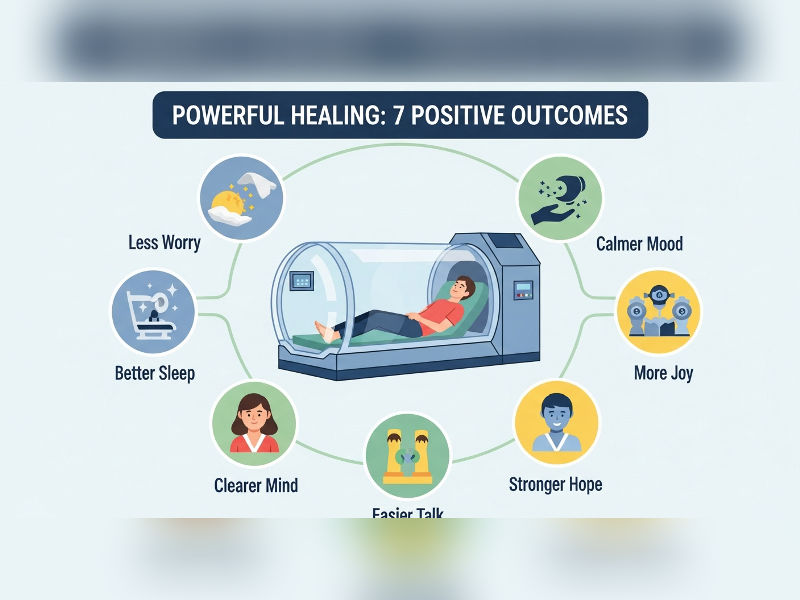
The most effective programs treat HBOT as one component within multidisciplinary care alongside psychotherapy and, where appropriate, medication. The rationale is that reduced inflammation and improved perfusion create conditions more favorable to psychological work, but capitalizing on that still requires active engagement in therapy. Some clinicians schedule trauma-processing sessions shortly after HBOT on the theory that better oxygenation aids emotional regulation. That specific sequencing has not been validated, so treat it as a hypothesis, not a protocol. For related mood applications, see our guide to HBOT for depression.
Frequently Asked Questions
How does HBOT target PTSD symptoms at the neurological level?
In the Doenyas-Barak 2022 RCT, HBOT was associated with reduced inflammation and improved oxygen delivery to regions with compromised blood flow, alongside fMRI and DTI changes in the prefrontal cortex, hippocampus, insula, and thalami.1 The proposed effect is restored regulation in structures that govern fear and memory. These are imaging-based findings from a single small trial, so the mechanism is supported but not fully established.
How long before patients notice improvement?
In published protocols, changes commonly appear within 15 to 20 sessions, with larger gains after 30 to 40. In Harch’s veteran cohort, sleep and mood measures improved over a 40-session course, and the Doenyas-Barak trial ran 60 sessions.13 Response varies by individual, and some people report transient worsening early on. There is no guaranteed timeline.
Can HBOT replace therapy and medication?
No. The evidence positions HBOT as an adjunct, not a standalone treatment. Trauma-focused psychotherapy (CPT, PE, EMDR) and, where indicated, SSRIs remain the guideline first-line care.5 HBOT may improve the biological substrate, but it does not teach coping skills, and no study has tested it as a replacement for evidence-based therapy.
Do some PTSD presentations respond better than others?
The strongest data come from combat veterans with treatment-resistant PTSD, many of whom also had traumatic brain injury.12 The 2023 review notes that cases with higher baseline neuroinflammation are a plausible responder group, but this is a hypothesis from small studies, not an established predictor.5 Broader HBOT research is still working out who benefits most.
What should someone weigh before trying HBOT for trauma?
Consider access and cost (often over $10,000 out of pocket), whether standard care has been tried, and whether medical screening has ruled out contraindications such as untreated pneumothorax. Because this is off-label, an experienced provider is essential for setting safe pressure and session parameters. Treat it as an adjunct to, not a substitute for, first-line therapy.
Sources
- Doenyas-Barak K, Catalogna M, Kutz I, et al. Hyperbaric oxygen therapy improves symptoms, brain’s microstructure and functionality in veterans with treatment resistant post-traumatic stress disorder: a prospective, randomized, controlled trial. PLoS ONE. 2022;17(2):e0264161. doi:10.1371/journal.pone.0264161
- Doenyas-Barak K, Kutz I, Levi G, et al. Hyperbaric oxygen therapy for veterans with treatment-resistant PTSD: a longitudinal follow-up study. Mil Med. 2023. doi:10.1093/milmed/usac360
- Harch PG, Andrews SR, Fogarty EF, et al. A phase I study of low-pressure hyperbaric oxygen therapy for blast-induced post-concussion syndrome and post-traumatic stress disorder. J Neurotrauma. 2012;29(1):168-185. doi:10.1089/neu.2011.1895
- USF Health. USF Health granted $28 million for traumatic brain injury research study. 2024. ClinicalTrials.gov NCT06581003. usf.edu
- Doenyas-Barak K, Kutz I, Lang E, et al. The use of hyperbaric oxygen for veterans with PTSD: basic physiology and current available clinical data. Front Neurosci. 2023;17:1259473. PMC10630921
Medical Disclaimer
The content on BaricBoost.com is for informational purposes only and is not intended as a substitute for professional medical advice, diagnosis, or treatment. Always seek the advice of your physician or other qualified health provider with any questions you may have regarding a medical condition. Never disregard professional medical advice or delay in seeking it because of something you have read on this website.

Author
Seph Fontane Pennock is the founder of BaricBoost.com and Regenerated.com, a clinic directory for regenerative medicine serving 10,000+ providers across the United States. He previously built and sold PositivePsychology.com, which grew to 19 million users and became the largest evidence-based positive psychology resource on the web. Seph brings direct experience as an HBOT patient, having completed protocols at clinics across three continents while navigating mold illness, systemic inflammation, and autoimmune conditions. His treatment journey includes hyperbaric oxygen therapy, peptide protocols, NAD+ therapy, and consultations with specialists from Dubai to Cape Town to Mexico. This combination of entrepreneurial track record and lived patient experience shapes everything published on BaricBoost.com. Every article is grounded in peer-reviewed research, informed by real clinical encounters, and written for patients making high-stakes treatment decisions. Seph's focus is on bringing transparency, scientific rigor, and practical guidance to the hyperbaric oxygen therapy space.
Why Trust Our Evaluations
Our rankings are based on hands-on testing, published clinical data, and verified manufacturer specifications. We apply the same criteria to every product regardless of affiliate status. Editorial Process · Evaluation Methodology