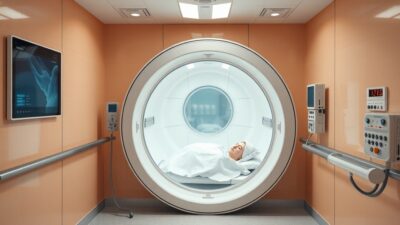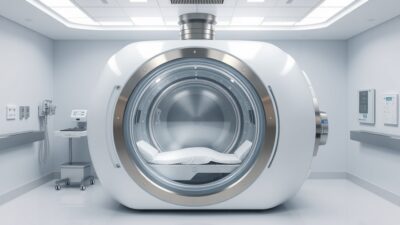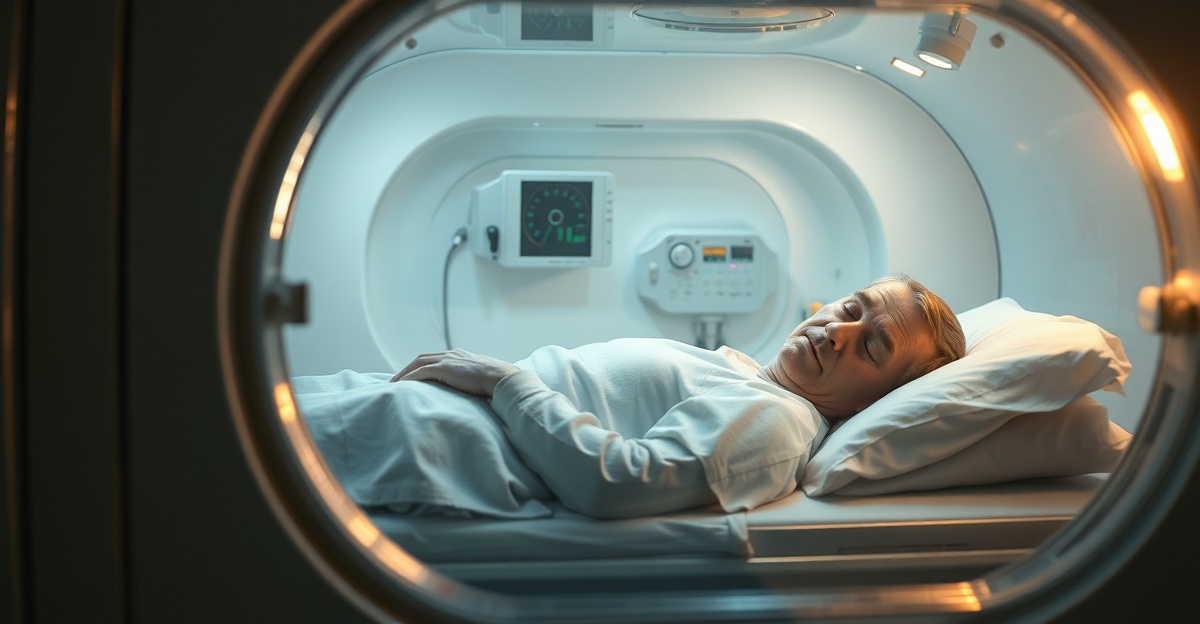
HBOT is FDA-cleared for two neurological emergencies: carbon monoxide poisoning and decompression sickness. Beyond those, a 2025 meta-analysis of 250 traumatic brain injury patients found significant gains in memory, attention, and processing speed, and retrospective data from 162 stroke patients showed cognitive improvement in 86 percent of cases. Every other neurological use is off-label, and the evidence ranges from moderate for acute brain injury to insufficient for Parkinson’s and dementia. It is one of several neurological applications of hyperbaric oxygen therapy under active study.
Why Does the Brain Respond to Hyperbaric Oxygen?
The brain responds to HBOT because pressurized oxygen reaches injured but surviving tissue that normal blood flow cannot, and because it triggers repair processes: mitochondrial biogenesis, neurogenesis, synaptogenesis, and reduced neuroinflammation. These mechanisms are documented in imaging and molecular studies, though demonstrating a mechanism is not the same as proving a clinical cure.
Normal air is about 21 percent oxygen at sea level. In a chamber at 2.0 ATA breathing 100 percent oxygen, the partial pressure of oxygen in blood and tissue rises roughly 10 to 15 times above normal. Injured brain tissue often sits in an ischemic penumbra, alive but barely, because of compromised blood flow. HBOT delivers plasma-dissolved oxygen to this tissue, bypassing damaged vessels.
Beyond immediate oxygenation, a 2024 review by Bin-Alamer et al. in Frontiers in Neurology identified four mechanisms through which HBOT promotes brain recovery: mitochondrial biogenesis (increased Bcl-2, reduced Bax, more ATP), neurogenesis (Wnt-3 and VEGF/ERK signaling), synaptogenesis (elevated GAP43 and synaptophysin), and anti-inflammatory effects (reduced TNF-alpha and IL-6) (Bin-Alamer et al., Frontiers in Neurology, 2024).
HBOT promotes neuroplasticity through four mechanisms: mitochondrial biogenesis, neurogenesis via VEGF/ERK signaling, synaptogenesis through GAP43 upregulation, and anti-inflammatory effects via TNF-alpha and IL-6 reduction.
Bin-Alamer et al., Frontiers in Neurology, 2024
The HBOT research overview covers these mechanisms across conditions in more detail.
How Mechanisms Map to Conditions
HBOT repair mechanisms and where the evidence is strongest
| Mechanism | Molecular markers | Most relevant conditions | Source |
|---|---|---|---|
| Mitochondrial biogenesis | Bcl-2 up, Bax down, ATP up | TBI, post-stroke, post-COVID fatigue | Bin-Alamer 2024 |
| Neurogenesis | Wnt-3, VEGF/ERK | Chronic TBI, stroke recovery | Bin-Alamer 2024; Tal 2015 |
| Synaptogenesis | GAP43, synaptophysin | Cognitive recovery after brain injury | Bin-Alamer 2024 |
| Angiogenesis | VEGF, perfusion MRI change | Chronic post-concussion syndrome | Tal 2015 (n=10) |
| Anti-inflammatory | TNF-alpha down, IL-6 down | Neurodegeneration (preclinical), TBI | Bin-Alamer 2024; Mensah-Kane 2023 |
What Does the Research Say by Condition?
The evidence splits into three tiers. HBOT is standard of care for carbon monoxide poisoning and decompression sickness. It has moderate support for acute moderate-to-severe TBI and mixed support for chronic brain injury and stroke. For Parkinson’s, Alzheimer’s, and multiple sclerosis, the human evidence is preclinical or negative. The table below pairs each condition with its sample size and anchor study.
HBOT for neurological conditions: evidence, sample size, and anchor study
| Condition | Evidence level | Sample size | Key study | FDA status |
|---|---|---|---|---|
| Carbon monoxide poisoning | Strong | 152 (RCT) | Weaver 2002, NEJM | FDA-cleared |
| Decompression sickness | Strong | Standard of care | UHMS / DAN | FDA-cleared |
| Acute moderate-severe TBI | Moderate | 8 studies pooled | Wang 2016, Neurol Sci | Off-label |
| Chronic TBI neurocognition | Moderate | 250 across 4 studies | Shahid 2025, Ann Med Surg | Off-label |
| Chronic mild TBI (military) | Null vs sham | 4 RCTs (~240) | Miller 2015 (HOPPS); Weaver 2018 (BIMA) | Off-label |
| Chronic stroke recovery | Emerging | 74 (RCT); 162 (retrospective) | Efrati 2013; Hadanny 2020 | Off-label |
| Post-COVID cognition | Emerging | 73 (RCT) | Zilberman-Itskovich 2022 | Off-label |
| Multiple sclerosis | Limited (no benefit) | Cochrane review | Bennett & Heard 2004 | Off-label |
| Cerebral palsy | Limited (no benefit) | 111 (RCT) | Collet 2001, Lancet | Off-label |
| Parkinson’s / Alzheimer’s | Insufficient | Preclinical / pilots | Shapira 2018; Lin 2024 | Off-label |
Carbon Monoxide Poisoning
This is HBOT’s clearest neurological success. Carbon monoxide binds hemoglobin far more tightly than oxygen, and severe poisoning can cause confusion, cognitive impairment, and delayed neurological syndrome. A 2002 randomized trial by Weaver et al. in the New England Journal of Medicine found that three HBOT sessions within 24 hours reduced cognitive sequelae at six weeks and one year compared with normobaric oxygen (Weaver et al., NEJM, 2002). It is one of the FDA-cleared indications and standard of care where facilities exist.
Decompression Sickness with Neurological Involvement
When nitrogen bubbles form in tissue or blood after diving, they can lodge in the spinal cord or brain. Recompression with HBOT is the definitive treatment, reducing bubble size and restoring perfusion. Both the UHMS and Divers Alert Network name it the mainstay of care, and it is another FDA-cleared indication.
Does HBOT Help Traumatic Brain Injury?
The TBI evidence is genuinely split. Meta-analyses of acute and chronic patients show cognitive and functional gains, while several sham-controlled military trials found HBOT no better than pressurized air. The honest reading is moderate evidence for benefit in some populations, undercut by a real placebo signal that the field has not resolved.
A 2016 meta-analysis by Wang et al. in Neurological Sciences pooled 8 studies and found HBOT improved Glasgow Coma Scale scores (pooled difference 3.13, 95 percent CI 2.34 to 3.92, P<0.001), with better Glasgow Outcome Scale scores and lower mortality (Wang et al., Neurological Sciences, 2016).
TBI patients across 4 pooled studies had significant cognitive gains with HBOT (memory mean difference 10.13, P<0.00001)
Shahid et al., 2025, Annals of Medicine and Surgery
A 2025 meta-analysis by Shahid et al. in Annals of Medicine and Surgery analyzed 4 studies and 250 patients, reporting significant improvements across cognitive domains: memory (mean difference 10.13, P<0.00001), attention (7.99), executive function (7.16), and processing speed (7.48) (Shahid et al., Annals of Medicine and Surgery, 2025). In the largest single cohort, Hadanny et al. (2018) in BMJ Open retrospectively followed 154 chronic TBI patients (mean 4.6 years post-injury); all cognitive domains improved and SPECT imaging confirmed increased metabolic activity in the affected regions (Hadanny et al., BMJ Open, 2018).
In 154 chronic TBI patients treated a mean of 4.6 years after injury, all cognitive domains improved significantly, and SPECT imaging confirmed corresponding increases in brain metabolic activity.
Hadanny et al., BMJ Open, 2018
A mechanistic clue comes from Tal et al. (2015) in Restorative Neurology and Neuroscience, who used perfusion MRI in 10 chronic post-concussion patients and found increased cerebral blood flow after HBOT, consistent with angiogenesis (Tal et al., Restorative Neurology and Neuroscience, 2015). Biggs et al. (2021) in the Journal of Applied Physiology argued that effect sizes for symptomatic and cognitive improvement in TBI following HBOT are clinically meaningful, though their paper is an analysis rather than a new trial (Biggs et al., Journal of Applied Physiology, 2021).
The Military Study Paradox
Four sham-controlled military trials tell a different story. Wolf et al. (2012) in the Journal of Neurotrauma (n=50), Cifu et al. (2014) in Annals of Neurology, Miller et al. (2015, the HOPPS trial) in JAMA Internal Medicine, and Weaver et al. (2018, the BIMA trial) in Undersea and Hyperbaric Medicine (n=71) each found HBOT no more effective than sham for persistent post-concussion symptoms. In 2018 the Department of Defense advised against prescribing HBOT for these symptoms, consistent with the VA/DoD clinical practice guideline.
The nuance is the sham itself. These trials used pressurized air at 1.2 to 1.3 ATA, which may have therapeutic effects of its own. When both groups improved equally, it raised the possibility that pressure, not 100 percent oxygen specifically, drives some of the benefit. This sham problem remains the central methodological challenge in HBOT neurological research. Clinical guidelines from Hadanny et al. (2023) in Medical Research Archives tried to reconcile the picture, recommending patient selection with cognitive testing plus functional imaging, and assigning Level A evidence to acute moderate-severe TBI and Level B-R evidence to chronic mild TBI with metabolic dysfunction visible on neuroimaging (Hadanny et al., Medical Research Archives, 2023).
The HBOT and brain injury page covers the TBI-specific evidence, the TBI clinical data page breaks down the numbers, and for the overlap of TBI and PTSD see the veterans and HBOT guide.
Can HBOT Aid Stroke Recovery?
The stroke evidence is emerging, not established. A randomized trial and a large retrospective analysis both report cognitive gains in patients months to years after stroke, but neither is a large multi-center RCT, and acute-phase use remains logistically difficult. HBOT is not yet a standard stroke rehabilitation tool.
The strongest controlled data is Efrati et al. (2013) in PLOS ONE, a randomized crossover trial of 74 patients treated 6 to 36 months after stroke. HBOT produced significant neurological improvement and neuroplasticity even at these chronic stages, with SPECT imaging showing activation of stunned brain regions (Efrati et al., PLOS ONE, 2013). A larger retrospective analysis by Hadanny et al. (2020) in Restorative Neurology and Neuroscience followed 162 post-stroke patients through 40 to 60 daily sessions at 2 ATA.
of 162 post-stroke patients achieved clinically significant cognitive improvement (greater than 0.5 SD), regardless of stroke type or side, in a retrospective analysis without a control group
Hadanny et al., 2020, Restorative Neurology and Neuroscience
In that analysis, 86 percent of patients achieved clinically significant cognitive improvement, defined as greater than 0.5 standard deviation, with only baseline cognitive function predicting response (Hadanny et al., Restorative Neurology and Neuroscience, 2020). The caveat is important: this is a retrospective study without a control group, so improvement cannot be cleanly separated from natural recovery. The field awaits randomized multi-center confirmation. See HBOT and stroke recovery, the stroke recovery statistics page, and guidance on timing HBOT after a stroke.
What About Neurodegenerative and Other Conditions?
For degenerative diseases the human evidence is weakest. Parkinson’s and Alzheimer’s data is largely preclinical or from small, unblinded trials, and multiple sclerosis trials have been negative. HBOT should be viewed as experimental here, not as a treatment with demonstrated benefit.
Parkinson’s Disease
Parkinson’s involves progressive loss of dopaminergic neurons driven partly by oxidative stress and mitochondrial dysfunction. HBOT’s anti-inflammatory and mitochondrial-supporting properties make it theoretically interesting, and preclinical animal work reviewed by Mensah-Kane and Sumien (2023) points to some neuroprotection, but human trials are small and preliminary. There is no basis yet for recommending it.
Alzheimer’s Disease and Dementia
The human dementia evidence is limited and mixed. Shapira et al. (2018) in Neurobiology of Aging showed HBOT reduced amyloid, tau, and neuroinflammation in the 3xTg-AD mouse model, an animal result (Shapira et al., Neurobiology of Aging, 2018). A 2024 meta-analysis by Lin et al. in Frontiers in Aging Neuroscience pooled 11 randomized trials and 847 participants and reported cognitive gains, but the authors stressed that all trials were conducted in China, none blinded participants or assessors, and most were small, which can introduce bias (Lin et al., Frontiers in Aging Neuroscience, 2024). Mensah-Kane and Sumien (2023) in GeroScience reviewed the preclinical rationale and concluded that animal models do not reliably translate to human neurodegenerative disease (Mensah-Kane and Sumien, GeroScience, 2023). The FDA specifically lists Alzheimer’s among conditions HBOT is marketed for but not proven to treat. See the Alzheimer’s and HBOT and dementia and HBOT pages.
Multiple Sclerosis
MS was among the earliest neurological conditions studied with HBOT in the 1980s. Early enthusiasm did not survive controlled testing. A Cochrane review by Bennett and Heard (2004) concluded there was no consistent evidence of benefit and that routine use is not justified, though some patients report subjective improvements in fatigue or bladder function (Bennett and Heard, Cochrane Database of Systematic Reviews, 2004). HBOT is not a standard MS treatment.
Post-COVID Neurological Symptoms
Long COVID brings brain fog, cognitive dysfunction, and fatigue. Zilberman-Itskovich et al. (2022) in Scientific Reports ran a randomized, double-blind, sham-controlled trial of 73 patients (40 sessions) and found improvements in global cognition, attention, energy, and quality of life, with MRI perfusion changes (Zilberman-Itskovich et al., Scientific Reports, 2022). A 2024 follow-up by Hadanny et al. in Scientific Reports found the gains persisted at roughly one year (Hadanny et al., Scientific Reports, 2024). See the long COVID and HBOT article and long COVID clinical data.
Cerebral Palsy and Peripheral Nerve Conditions
HBOT for cerebral palsy is heavily marketed but poorly supported. The strongest RCT, Collet et al. (2001) in The Lancet, randomized 111 children and found HBOT did not improve outcomes over slightly pressurized room air (Collet et al., The Lancet, 2001). Cochrane and pediatric neurology guidelines do not support it. Evidence for peripheral neuropathy is similarly preliminary outside of diabetic wound-related indications. The cerebral palsy and HBOT article gives the full picture.
What Should You Expect from Neurological HBOT?
Neurological protocols typically run 40 to 60 sessions at 1.5 to 2.0 ATA, lower than wound-healing protocols, with sessions of 60 to 90 minutes. Improvement, when it happens, tends to be gradual and may not be fully apparent until weeks after the course ends. HBOT is most compelling when paired with active rehabilitation.
The mechanisms HBOT stimulates, neuroplasticity, angiogenesis, and BDNF production, build the biological substrate for recovery, while physical, occupational, speech, and cognitive therapy provide the activity-dependent stimulation that shapes it. Most neurological recovery specialists recommend running both together rather than choosing one. The what to expect guide explains the logistics and the before and after page shows typical outcome patterns.
Is HBOT Right for Your Neurological Condition?
It depends on the specific condition, severity, duration, and what else has been tried. For FDA-cleared indications (CO poisoning, decompression sickness), HBOT is standard of care. For stroke, TBI, and acquired brain injury, the evidence supports careful consideration with realistic expectations. For degenerative disease, it is experimental. A board-certified hyperbaric physician can weigh your situation against the time and cost involved, and against likely insurance coverage.
How Do You Find the Right Clinic?
Neurological HBOT is more nuanced than wound care, and not all facilities are equally equipped. Hospital-based programs tied to neurology or rehabilitation medicine are generally better positioned than standalone wellness centers. Ask whether a facility has treated your condition, whether it coordinates with your neurology team, and what outcome measures it uses. Be cautious with claims made for low-pressure soft chambers; most published neurological trials used 1.5 to 2.0 ATA hard chambers with 100 percent oxygen, as discussed in our analysis of soft chambers and neurological conditions.
Can HBOT repair damaged brain tissue?
HBOT can support recovery of tissue in the ischemic penumbra (injured but not dead cells) and appears to promote neuroplasticity. It cannot regenerate fully infarcted tissue, but it may help recover function in areas around the core injury. A systematic review of 42 studies by Marcinkowska et al. (2022) in Neuropsychology Review found cognitive improvements are demonstrable but vary across conditions and cognitive domains (Marcinkowska et al., 2022).
How many sessions does neurological HBOT typically require?
Most neurological protocols involve 40 to 60 sessions at 1.5 to 2.0 ATA. Unlike wound healing, where outcomes appear relatively quickly, neurological recovery unfolds slowly, and full benefit may not be apparent until several weeks to months after completing treatment. Session counts should be set by a hyperbaric physician based on the specific condition and imaging findings (Hadanny et al., Medical Research Archives, 2023).
Is mild HBOT (1.3 to 1.5 ATA soft chambers) effective for neurological conditions?
The pressures in most wellness-oriented soft chambers (around 1.3 ATA with ambient air) are lower than those used in clinical research. Most published neurological trials used 1.5 to 2.0 ATA in hard chambers with 100 percent oxygen. Whether mild HBOT delivers meaningful neurological benefit is unproven, and the military sham trials suggest low-pressure air alone can produce nonspecific improvement. See our soft chambers analysis.
Can HBOT be combined with other neurological rehabilitation?
Yes, and most experts recommend it. There is no evidence that HBOT and standard rehabilitation interfere with each other, and the combination is theoretically synergistic because HBOT builds the biological substrate while rehabilitation drives activity-dependent remodeling. For acquired conditions like stroke and TBI, concurrent rehabilitation is the standard recommendation rather than HBOT alone.
Sources
- Wang F, Wang Y, Sun T, Yu HL. Hyperbaric oxygen therapy for the treatment of traumatic brain injury: a meta-analysis. Neurological Sciences. 2016;37(5):693-701. DOI: 10.1007/s10072-015-2460-2
- Shahid H, Shahid S, et al. Hyperbaric oxygen therapy (HBOT) for neurocognitive deficits following traumatic brain injury: a systematic review and meta-analysis. Annals of Medicine and Surgery. 2025;87(11). DOI: 10.1097/MS9.0000000000003902
- Hadanny A, et al. Effect of hyperbaric oxygen therapy on chronic neurocognitive deficits of post-traumatic brain injury patients: retrospective analysis. BMJ Open. 2018;8(9):e023387. DOI: 10.1136/bmjopen-2018-023387
- Hadanny A, Maroon J, Efrati S. The Efficacy of Hyperbaric Oxygen Therapy in Traumatic Brain Injury Patients: Literature Review and Clinical Guidelines. Medical Research Archives. 2023;11(7.2). DOI: 10.18103/mra.v11i7.2.4161
- Hadanny A, Rittblat M, Bitterman M, et al. Hyperbaric oxygen therapy improves neurocognitive functions of post-stroke patients: a retrospective analysis. Restorative Neurology and Neuroscience. 2020;38(1):93-107. DOI: 10.3233/RNN-190959
- Bin-Alamer O, Abou-Al-Shaar H, Efrati S, et al. Hyperbaric oxygen therapy as a neuromodulatory technique: a review of the recent evidence. Frontiers in Neurology. 2024;15:1450134. DOI: 10.3389/fneur.2024.1450134
- Marcinkowska AB, Mankowska ND, Kot J, Winklewski PJ. Impact of Hyperbaric Oxygen Therapy on Cognitive Functions: a Systematic Review. Neuropsychology Review. 2022;32(1):99-126. DOI: 10.1007/s11065-021-09500-9
- Mensah-Kane P, Sumien N. The potential of hyperbaric oxygen as a therapy for neurodegenerative diseases. GeroScience. 2023;45(2):747-756. DOI: 10.1007/s11357-022-00707-z
- Biggs AT, Dainer HM, Littlejohn LF. Effect sizes for symptomatic and cognitive improvements in traumatic brain injury following hyperbaric oxygen therapy. Journal of Applied Physiology. 2021;130(6):1594-1603. DOI: 10.1152/japplphysiol.01084.2020
- Tal S, Hadanny A, Berkovitz N, et al. Hyperbaric oxygen may induce angiogenesis in patients suffering from prolonged post-concussion syndrome due to traumatic brain injury. Restorative Neurology and Neuroscience. 2015;33(6):943-951. DOI: 10.3233/RNN-150585
- Efrati S, Fishlev G, Bechor Y, et al. Hyperbaric oxygen induces late neuroplasticity in post stroke patients: randomized, prospective trial. PLOS ONE. 2013;8(1):e53716. DOI: 10.1371/journal.pone.0053716
- Weaver LK, Hopkins RO, Chan KJ, et al. Hyperbaric oxygen for acute carbon monoxide poisoning. New England Journal of Medicine. 2002;347(14):1057-1067. DOI: 10.1056/NEJMoa013121
- Wolf G, Cifu D, Baugh L, Carne W, Profenna L. The effect of hyperbaric oxygen on symptoms after mild traumatic brain injury. Journal of Neurotrauma. 2012;29(17):2606-2612. DOI: 10.1089/neu.2012.2549
- Cifu DX, Hart BB, West SL, Walker W, Carne W. Hyperbaric oxygen for blast-related postconcussion syndrome: three-month outcomes. Annals of Neurology. 2014;75(2):277-286. DOI: 10.1002/ana.24067
- Miller RS, Weaver LK, Bahraini N, et al. Effects of hyperbaric oxygen on symptoms and quality of life among service members with persistent postconcussion symptoms: a randomized clinical trial (HOPPS). JAMA Internal Medicine. 2015;175(1):43-52. DOI: 10.1001/jamainternmed.2014.5479
- Weaver LK, Wilson SH, Lindblad AS, et al. Hyperbaric oxygen for post-concussive symptoms in United States military service members: a randomized clinical trial (BIMA). Undersea and Hyperbaric Medicine. 2018;45(2):129-156. PMID 29734568
- Zilberman-Itskovich S, Catalogna M, Sasson E, et al. Hyperbaric oxygen therapy improves neurocognitive functions and symptoms of post-COVID condition: randomized controlled trial. Scientific Reports. 2022;12(1):11252. DOI: 10.1038/s41598-022-15565-0
- Hadanny A, Zilberman-Itskovich S, Catalogna M, et al. Long term outcomes of hyperbaric oxygen therapy in post covid condition: longitudinal follow-up of a randomized controlled trial. Scientific Reports. 2024;14(1):3604. DOI: 10.1038/s41598-024-53091-3
- Bennett M, Heard R. Hyperbaric oxygen therapy for multiple sclerosis. Cochrane Database of Systematic Reviews. 2004;(1):CD003057. DOI: 10.1002/14651858.CD003057.pub2
- Collet JP, Vanasse M, Marois P, et al. Hyperbaric oxygen for children with cerebral palsy: a randomised multicentre trial. The Lancet. 2001;357(9256):582-586. DOI: 10.1016/S0140-6736(00)04054-X
- Shapira R, Solomon B, Efrati S, Frenkel D, Ashery U. Hyperbaric oxygen therapy ameliorates pathophysiology of 3xTg-AD mouse model by attenuating neuroinflammation. Neurobiology of Aging. 2018;62:105-119. DOI: 10.1016/j.neurobiolaging.2017.10.007
- Lin G, Zhao L, Lin J, Li X, Xu L. Clinical evidence of hyperbaric oxygen therapy for Alzheimer’s disease: a systematic review and meta-analysis of randomized controlled trials. Frontiers in Aging Neuroscience. 2024;16:1360148. DOI: 10.3389/fnagi.2024.1360148
- Undersea and Hyperbaric Medical Society. Hyperbaric Oxygen Therapy Indications (14th Edition). UHMS approved indications list
- U.S. Department of Veterans Affairs and Department of Defense. VA/DoD Clinical Practice Guideline for the Management of Concussion/Mild Traumatic Brain Injury. VA/DoD mTBI CPG
- U.S. Food and Drug Administration. Hyperbaric Oxygen Therapy: Get the Facts. FDA Consumer Update
Medical Disclaimer
The content on BaricBoost.com is for informational purposes only and is not intended as a substitute for professional medical advice, diagnosis, or treatment. Always seek the advice of your physician or other qualified health provider with any questions you may have regarding a medical condition. Never disregard professional medical advice or delay in seeking it because of something you have read on this website.

Author
Seph Fontane Pennock is the founder of BaricBoost.com and Regenerated.com, a clinic directory for regenerative medicine serving 10,000+ providers across the United States. He previously built and sold PositivePsychology.com, which grew to 19 million users and became the largest evidence-based positive psychology resource on the web. Seph brings direct experience as an HBOT patient, having completed protocols at clinics across three continents while navigating mold illness, systemic inflammation, and autoimmune conditions. His treatment journey includes hyperbaric oxygen therapy, peptide protocols, NAD+ therapy, and consultations with specialists from Dubai to Cape Town to Mexico. This combination of entrepreneurial track record and lived patient experience shapes everything published on BaricBoost.com. Every article is grounded in peer-reviewed research, informed by real clinical encounters, and written for patients making high-stakes treatment decisions. Seph's focus is on bringing transparency, scientific rigor, and practical guidance to the hyperbaric oxygen therapy space.