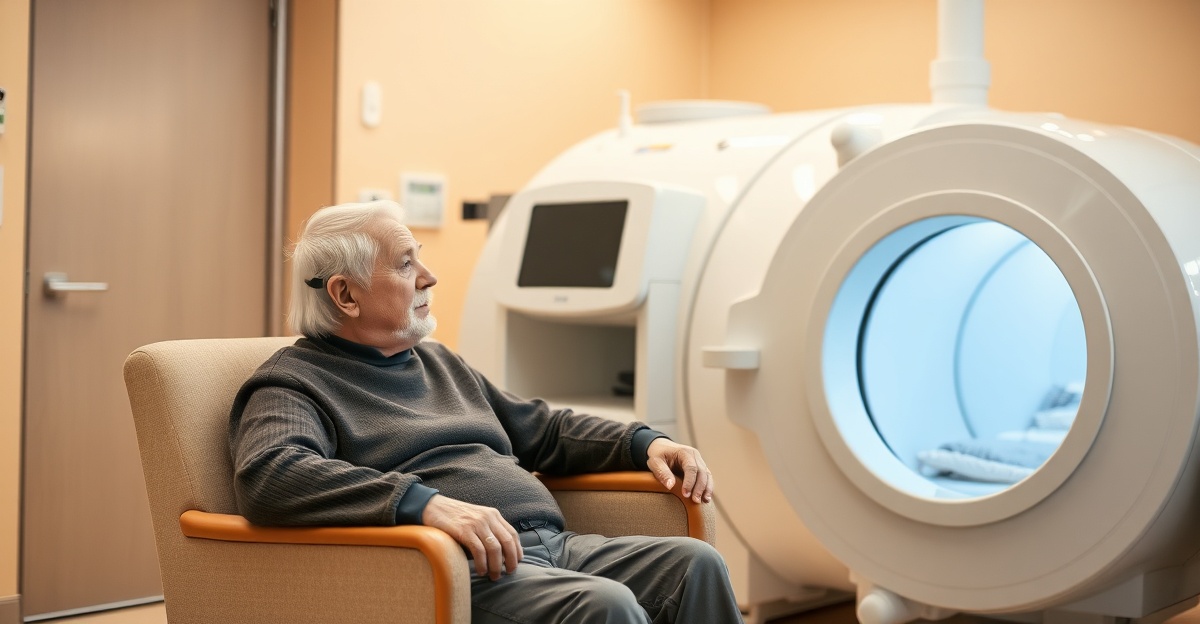
No large Western randomized trial has confirmed HBOT as a standalone treatment for any form of dementia, and the evidence is best described as emerging and mostly from small studies. The most-cited synthesis, a 2019 meta-analysis of 25 mainly Chinese trials in nearly 2,000 patients, found HBOT added to standard medication improved cognitive scores, but with acknowledged limits on study quality. The signal is strongest for vascular dementia as an adjunct, not a cure. It sits among several neurological conditions studied with HBOT.
The honest framing matters here because families are making high-stakes decisions. What follows separates the mechanism (plausible and partly imaged), the human evidence (promising but methodologically limited), and the practical reality (off-label, expensive, no guarantees). Because cognitive decline overlaps with mood and behavior, dementia also features in our broader coverage of HBOT for mental health.
How could HBOT help dementia?
The rationale is that HBOT targets several drivers of dementia at once: reduced cerebral blood flow, chronic inflammation, and, in Alzheimer’s, amyloid accumulation. Whether hitting these pathways changes the disease course in people is still an open question, but the mechanisms are grounded in imaging and laboratory work rather than pure speculation.
Increased cerebral blood flow
A consistent finding in dementia is reduced cerebral blood flow, or hypoperfusion. HBOT delivers oxygen at elevated pressure, saturating plasma and reaching tissue that red blood cells may no longer supply, and SPECT studies have shown it can increase perfusion in previously hypoxic regions.5 A 2019 RCT of 158 vascular dementia patients found HBOT at 2.0 ATA improved MMSE scores while elevating serum Humanin, a neuroprotective peptide, with levels correlating to cognitive improvement (r=0.409, p<0.05).2
Neuroplasticity and reduced inflammation
HBOT has been shown to stimulate brain-derived neurotrophic factor (BDNF) and promote new blood vessel growth in brain tissue. A 2020 study in Aging found HBOT improved cerebral blood flow and produced microstructural brain changes in older adults, consistent with a neuroplasticity mechanism relevant to early-stage decline.5 Chronic neuroinflammation is a hallmark of both Alzheimer’s and vascular dementia, and improved oxygenation is proposed to dampen the activated microglia that release damaging cytokines, though the human anti-inflammatory data in dementia remains preliminary. For related mechanisms, see our HBOT for brain health page.
Amyloid clearance
Preclinical work suggests better oxygenation and blood flow may support the glymphatic system that clears amyloid-beta. Shapira et al. 2021 found HBOT reduced amyloid plaque burden and improved spatial memory in an Alzheimer’s mouse model, with parallel cognitive gains reported in elderly patients on imaging.6 Whether this translates to disease modification in humans is unproven.
What does the research say about HBOT for dementia?
The most comprehensive human evidence is You et al. 2019, a meta-analysis of 25 RCTs with 1,954 patients in Frontiers in Aging Neuroscience, which tested HBOT combined with standard medications such as oxiracetam, butylphthalide, donepezil, and nicergoline.1
Adding HBOT to standard drug therapy improved Mini-Mental State Examination scores by about 4 points and nearly quintupled the odds of treatment response, with no significant increase in adverse events.
You et al., 2019, Frontiers in Aging Neuroscience
The headline figures were an MMSE improvement of MD = 4.00 (95% CI 3.28 to 4.73, p<0.00001), an activities-of-daily-living gain, a total treatment efficacy rate of OR = 4.84 (95% CI 3.19 to 7.33, p<0.00001), and no significant rise in adverse events (OR = 0.85, p=0.79). The important caveat is that most included trials were small, conducted in China, and had limitations around blinding, so the pooled effect likely overstates what a rigorous Western trial would find.
The counterpoint is the 2012 Cochrane Review, which included only one small study of 64 patients and concluded there was insufficient evidence to support HBOT for vascular dementia.3 That review has not been updated. A more recent 2024 systematic review by Lin and colleagues pooled 11 RCTs with 847 participants for Alzheimer’s disease and reached a similarly cautious verdict, calling for higher-quality trials.4 The picture across all three is consistent: encouraging adjunctive signals, thin methodology, no confirmation from a large sham-controlled Western trial.
Stated plainly: no large multi-center Western RCT has confirmed HBOT as an effective standalone treatment for any dementia. Families should treat it as an emerging option alongside standard care, not an established therapy. For Alzheimer’s specifically, see our page on HBOT for Alzheimer’s patients, and for the overlap with memory complaints our page on HBOT for memory loss.
Which types of dementia respond to HBOT?
Vascular dementia has the strongest rationale because it is caused by reduced blood flow, exactly what HBOT augments, and it is the population the You 2019 meta-analysis mainly covered. Alzheimer’s has a more complex pathology of amyloid plaques, tau tangles, and inflammation, so its evidence is more preliminary and rests largely on the Shapira 2021 preclinical data and the cautious Lin 2024 review. Mixed dementia may share in the vascular benefit, while Lewy body dementia has no dedicated trials and should only be considered with a neurologist familiar with the condition.
| Dementia type | Evidence level | Strongest rationale | Key evidence |
|---|---|---|---|
| Vascular dementia | Moderate (as adjunct) | Direct cerebral blood flow improvement | You 2019 meta-analysis (25 RCTs) |
| Alzheimer’s disease | Emerging | Amyloid clearance, reduced inflammation | Lin 2024 review (11 RCTs); Shapira 2021 (preclinical) |
| Mixed dementia | Emerging | Combined vascular + Alzheimer’s mechanisms | Extrapolated from above |
| Lewy body dementia | Insufficient evidence | Theoretical only | No dedicated trials |
What is the HBOT protocol for dementia?
The studies used broadly similar protocols: 40 to 60 sessions (60 is common), at 1.5 to 2.0 ATA, 60 minutes of oxygen breathing per session, five days a week, making a 60-session course roughly 12 weeks. The You 2019 trials typically used 2.0 ATA alongside standard medication. Cognitive changes, when they occur, generally appear only after 40 or more sessions, so families should plan for at least a three-month commitment before judging whether it is helping.
Patients most likely to see a signal are those with vascular or mixed dementia, in early to moderate rather than advanced stages, who can tolerate a consistent five-day schedule and whose families treat HBOT as a complement to standard medication rather than a replacement. Optimal maintenance schedules have not been established; our guide on how long HBOT effects last covers what is known about durability, and the HBOT sessions guide explains a typical course.
Who should not try HBOT?
HBOT is not appropriate for everyone. It should not be used with an untreated pneumothorax (collapsed lung) or alongside certain chemotherapy drugs such as bleomycin, cisplatin, doxorubicin, and disulfiram. Extra caution or postponement applies with upper respiratory infection or sinus congestion, a seizure disorder, COPD, high fever, a history of ear surgery, claustrophobia, or pregnancy. Discuss your full medical history with your provider, especially if the patient uses insulin or has a pacemaker or implanted device. For the full risk list, see our guide to HBOT side effects.
Is HBOT FDA-approved for dementia?
No. HBOT is not FDA-approved for dementia, so its use is off-label. Some clinics offer it for cognitive conditions under informed consent, but that is not the same as regulatory approval or insurance coverage. The strongest human evidence comes from adjunctive trials in vascular dementia, most of them small and outside the West, which is why it should be approached as an emerging option discussed with a neurologist.1
Can HBOT reverse dementia?
No. Current evidence does not support reversing dementia. What the trials report is improvement in specific cognitive scores and increased cerebral blood flow, which may slow the rate of decline in some patients when added to standard medication.1 Families should treat HBOT as a possible tool for quality of life and slowing progression, never as a cure, and be cautious of any clinic that promises reversal.
How much does HBOT for dementia cost?
Sessions typically cost $150 to $300 each, depending on location and chamber type, so a full 60-session protocol runs roughly $9,000 to $18,000. Because dementia is not an FDA-approved indication, insurance almost never covers it, and families pay out of pocket. That cost, against uncertain benefit, is a central part of the decision.
Is it safe for elderly patients?
In the You 2019 meta-analysis of nearly 2,000 mostly elderly patients, HBOT added no significant increase in adverse events, and it is generally considered safe for older adults in supervised settings.1 Elderly patients with mobility limits, claustrophobia, or certain respiratory conditions should review those factors with the treating physician first. Safety, though, is not the same as proven benefit, which remains uncertain for dementia.
Sources
- You Q, Li L, Xiong SQ, et al. “Meta-Analysis on the Efficacy and Safety of Hyperbaric Oxygen as Adjunctive Therapy for Vascular Dementia.” Frontiers in Aging Neuroscience. 2019;11:86. DOI: 10.3389/fnagi.2019.00086
- Xu Y, Wang Q, Qu Z, et al. “Protective Effect of Hyperbaric Oxygen Therapy on Cognitive Function in Patients with Vascular Dementia.” Cell Transplantation. 2019;28(8):1071-1075. DOI: 10.1177/0963689719853540
- Xiao Y, Wang J, Jiang S, Luo H. “Hyperbaric oxygen therapy for vascular dementia.” Cochrane Database of Systematic Reviews. 2012;(7):CD009425. DOI: 10.1002/14651858.CD009425.pub2
- Lin G, et al. “Clinical evidence of hyperbaric oxygen therapy for Alzheimer’s disease: a systematic review and meta-analysis.” Frontiers in Aging Neuroscience. 2024;16:1360148 (11 RCTs, 847 participants). DOI: 10.3389/fnagi.2024.1360148
- Hadanny A, Daniel-Kotovsky M, Suzin G, et al. “Cognitive enhancement of healthy older adults using hyperbaric oxygen: a randomized controlled trial.” Aging. 2020;12(13):13740-13761. DOI: 10.18632/aging.103571
- Shapira R, Gdalyahu A, Gottfried I, et al. “Hyperbaric oxygen therapy alleviates vascular dysfunction and amyloid burden in an Alzheimer’s disease mouse model and in elderly patients.” Aging. 2021;13(16):20935-20969. DOI: 10.18632/aging.203485
- Alhewiti A. “Effectiveness of Hyperbaric Oxygen Therapy for Treating Neurodegenerative and Non-neurodegenerative Dementia.” South Eastern European Journal of Public Health. 2025. DOI: 10.70135/seejph.vi.4828
Medical Disclaimer
The content on BaricBoost.com is for informational purposes only and is not intended as a substitute for professional medical advice, diagnosis, or treatment. Always seek the advice of your physician or other qualified health provider with any questions you may have regarding a medical condition. Never disregard professional medical advice or delay in seeking it because of something you have read on this website.

Author
Seph Fontane Pennock is the founder of BaricBoost.com and Regenerated.com, a clinic directory for regenerative medicine serving 10,000+ providers across the United States. He previously built and sold PositivePsychology.com, which grew to 19 million users and became the largest evidence-based positive psychology resource on the web. Seph brings direct experience as an HBOT patient, having completed protocols at clinics across three continents while navigating mold illness, systemic inflammation, and autoimmune conditions. His treatment journey includes hyperbaric oxygen therapy, peptide protocols, NAD+ therapy, and consultations with specialists from Dubai to Cape Town to Mexico. This combination of entrepreneurial track record and lived patient experience shapes everything published on BaricBoost.com. Every article is grounded in peer-reviewed research, informed by real clinical encounters, and written for patients making high-stakes treatment decisions. Seph's focus is on bringing transparency, scientific rigor, and practical guidance to the hyperbaric oxygen therapy space.