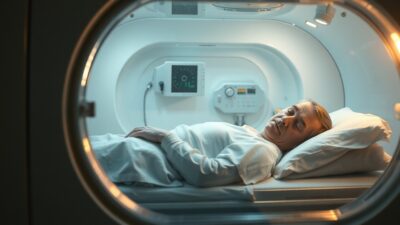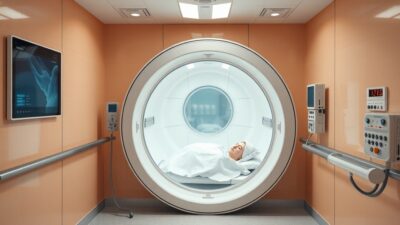
No randomized controlled trial has tested hyperbaric oxygen therapy (HBOT) as a hair loss treatment, and no medical guideline recommends it for hair regrowth. The interest is mechanistic: HBOT increases blood flow, tissue oxygenation, and angiogenesis, all of which matter to hair follicle health. But mechanism is not outcome. The strongest human data is a single 2026 preliminary study and one hair-transplant adjunct trial, not proof that a chamber grows hair.
Randomized controlled trials of HBOT as a standalone hair loss treatment. The direct evidence is one 2026 preliminary follicle study with no control group and one 2020 hair-transplant adjunct study.
Lee et al., 2026; Fan et al., 2020
How Might HBOT Support Hair Growth?
The rationale is circulatory and anti-inflammatory, not follicle-specific. Hair follicles are metabolically active and depend on oxygen and nutrient delivery through a dense capillary network. HBOT delivers 100% oxygen at raised pressure, saturating plasma with far more oxygen than red blood cells alone carry. These are plausible mechanisms, but none has been shown to regrow hair in a controlled trial.
Increased Blood Flow and Oxygen Delivery to Follicles
HBOT improves microcirculation in treated tissue. The dermal papilla cells at the base of each follicle, which regulate the growth cycle, are oxygen-dependent, so higher tissue oxygen could in principle support their function. This is mechanism, not a measured hair outcome. Most HBOT research on oxygenation and angiogenesis comes from wound healing rather than the scalp.
Angiogenesis in Scalp Tissue
Stimulating new blood vessel formation is one of the best-documented effects of hyperbaric therapy and is central to its wound-healing role. Around follicles, new vessels could theoretically restore nutrient supply where circulation has declined. This effect is why HBOT is used to improve graft survival after surgery, and it is the single mechanism with any direct hair data behind it.
Stem Cell Mobilization
Thom et al. (2006) showed that HBOT roughly doubles circulating stem/progenitor cells released from bone marrow, a mechanism studied in the context of wound healing rather than hair.2 Hair follicles hold their own stem cell reserve in the bulge region, but no study has linked HBOT-induced stem cell activity to follicle regeneration. It is a hypothesis, not a finding. This is one of the same mechanisms explored in HBOT and anti-aging research.
Reduced Scalp Inflammation
Chronic inflammation around follicles contributes to alopecia areata and some scarring alopecias. HBOT reduces pro-inflammatory cytokines in other settings, so lowering scalp inflammation could create more favorable conditions for growth. Again, this is a theoretical bridge, not evidence that HBOT reverses inflammatory hair loss.
What Does the Research Actually Show?
The direct evidence for HBOT as a hair growth treatment is thin. There are no randomized controlled trials, no large cohorts, and no clinical guidelines recommending HBOT for any form of hair loss. What exists is one preliminary human study, one surgical adjunct study, and a body of indirect wound-healing research.
A 2026 preliminary study in Bioengineering reported subjective improvements in hair follicle characteristics in healthy adults after HBOT, but it used no control group and no objective regrowth endpoint.1 Separately, a 2020 study found that HBOT combined with hair transplantation surgery improved graft outcomes, which fits the angiogenesis mechanism.3 Anyone presenting HBOT as a proven hair regrowth treatment is ahead of the science.
Which Types of Hair Loss Might HBOT Help?
Plausibility varies sharply by cause. HBOT targets circulation and inflammation, so it is most relevant where those are the problem and least relevant where hormones are the driver.
HBOT Plausibility by Hair Loss Type
| Hair loss type | Proposed HBOT rationale | Evidence |
|---|---|---|
| Post-surgical / graft | Angiogenesis, tissue repair | 1 adjunct study (Fan 2020) |
| Alopecia areata | Anti-inflammatory, immune modulation | Theoretical, no trials |
| Androgenetic (pattern) | Circulatory only | Unlikely, does not address DHT |
Post-Surgical or Trauma-Related Hair Loss
Hair loss after scalp surgery, burns, or radiation involves tissue damage and compromised blood supply. HBOT is already used clinically to support healing in damaged tissue, which makes this the most logical application. Improved oxygenation and new vessel formation could help restore conditions for follicle recovery, and the one hair-transplant adjunct study supports this direction.
Alopecia Areata
This autoimmune condition causes patchy loss when the immune system attacks follicles that are suppressed, not destroyed. Because HBOT has anti-inflammatory and immune-modulating effects, it has theoretical overlap here. No clinical study has tested HBOT for alopecia areata directly, so this remains rationale only.
Androgenetic Alopecia (Pattern Baldness)
The most common hair loss in men and women is driven by follicle sensitivity to dihydrotestosterone (DHT). Because the cause is hormonal rather than circulatory or inflammatory, HBOT is unlikely to address the primary mechanism. It cannot counteract DHT-driven follicle miniaturization, whatever it does to local blood flow.
What Works Better Than HBOT for Hair Loss?
Given the absent evidence for HBOT, proven treatments should come first. Minoxidil and, for pattern hair loss, low-level laser therapy have far more clinical data than HBOT for this use.
HBOT vs Established Hair Loss Treatments
| Treatment | Primary mechanism | Evidence level for hair loss |
|---|---|---|
| Minoxidil | Follicle blood flow, prolonged anagen | FDA-approved, multiple RCTs |
| Low-level laser therapy | Cellular energy, follicle stimulation | FDA-cleared, RCT-backed |
| PRP injections | Concentrated growth factors | Growing trial data |
| HBOT (standalone) | Oxygenation, angiogenesis | No RCTs |
Minoxidil is approved for pattern hair loss with multiple randomized trials behind it. HBOT holds no FDA approval for any hair loss indication.
Suchonwanit et al., 2019
- Minoxidil: the most studied topical for hair loss, working partly by improving follicle blood flow, one of the same mechanisms attributed to HBOT.5
- Low-level laser therapy (LLLT): FDA-cleared devices with randomized evidence for male and female pattern hair loss.6
- PRP (platelet-rich plasma): autologous injections delivering concentrated growth factors to follicles, with more trial data for androgenetic alopecia than HBOT.
- Nutrition: deficiencies in iron, zinc, vitamin D, and omega-3 fatty acids are linked to hair loss and are a practical first check.
- Scalp health: treating conditions like seborrheic dermatitis removes barriers that no amount of oxygen therapy would overcome.
What Would an HBOT Protocol Look Like?
There is no standardized HBOT protocol for hair growth, because no medical body has issued one. The parameters below reflect general wellness protocols used in HBOT clinics, not a validated hair regimen. Read our guide to HBOT sessions for what a course involves and how long HBOT effects last.
- Pressure: 1.5 to 2.0 ATA, with most wellness protocols at the lower end
- Session duration: 60 to 90 minutes
- Frequency: 3 to 5 sessions per week
- Total sessions: 20 to 40 in an initial course
Because follicles cycle over months, any effect would take a long time to appear, and results are not guaranteed. Anyone exploring HBOT for hair should work with a provider who is transparent about the evidence limits. For cost context, see our HBOT cost guide.
Who Should Not Try HBOT?
HBOT is generally safe when administered by trained professionals, but it is not appropriate for everyone. Discuss your full medical history with your provider first. HBOT should not be used with an untreated pneumothorax (collapsed lung), where pressure changes can be life-threatening, or alongside certain chemotherapy drugs (bleomycin, cisplatin, doxorubicin, disulfiram).
Your provider may need extra precautions if you have an upper respiratory infection or sinus congestion, a seizure disorder, COPD, high fever, a history of ear surgery, claustrophobia, or are pregnant. Always consult your physician before starting, especially if you take insulin or have a pacemaker. For a full overview, see our HBOT side effects and risks guide.
Frequently Asked Questions
Can hyperbaric oxygen therapy regrow hair?
There is no controlled clinical evidence that HBOT regrows hair. Its mechanisms (improved blood flow, tissue oxygenation, reduced inflammation) are relevant to follicle health, and a 2026 preliminary study reported subjective improvement in healthy adults, but that study had no control group (Lee et al., 2026). Some people undergoing HBOT for other conditions report thicker hair, but these are anecdotes, not proven outcomes. More research is needed before any claim can be made.
How many HBOT sessions would be needed to see hair benefits?
There is no established protocol for HBOT and hair growth. General wellness protocols run 20 to 40 sessions over several weeks. Because follicles cycle through growth phases over months, any potential effect on hair would take considerable time to become visible. Given the cost and the absence of trial evidence, results are not guaranteed for this application, and expectations should be set accordingly with your provider.
Is HBOT better than PRP or minoxidil for hair loss?
No. Minoxidil is FDA-approved for hair loss with multiple randomized trials (Suchonwanit et al., 2019), and PRP has a growing body of clinical data. HBOT has neither for this use. If regrowth is the goal, proven treatments should be the starting point. HBOT shows more promise as an adjunct to hair transplant surgery, where improved blood flow can aid graft survival (Fan et al., 2020), but standalone HBOT for pattern hair loss is not supported by evidence.
Sources
- Lee HY, Lee JY, Kim SC, Lee Y. “Preliminary Effects of Hyperbaric Oxygen Therapy on Hair Follicle Characteristics in Healthy Subjects.” Bioengineering (Basel), 2026. PMC12937892
- Thom SR, Bhopale VM, Velazquez OC, et al. “Stem cell mobilization by hyperbaric oxygen.” Am J Physiol Heart Circ Physiol, 2006. 10.1152/ajpheart.00888.2005
- Fan ZX, Gan Y, Qu Q, et al. “The effect of hyperbaric oxygen therapy combined with hair transplantation surgery for the treatment of alopecia.” J Cosmet Dermatol, 2020. 10.1111/jocd.13665
- Undersea and Hyperbaric Medical Society. “HBO Indications, 13th Edition,” 2020. Hair loss is not an approved indication. UHMS
- Suchonwanit P, Thammarucha S, Leerunyakul K. “Minoxidil and its use in hair disorders: a review.” Drug Des Devel Ther, 2019. 10.2147/DDDT.S214907
- Lanzafame RJ, et al. “Efficacy and safety of a low-level laser device in the treatment of male and female pattern hair loss.” Am J Clin Dermatol, 2014. 10.1007/s40257-013-0060-6
Medical Disclaimer
The content on BaricBoost.com is for informational purposes only and is not intended as a substitute for professional medical advice, diagnosis, or treatment. Always seek the advice of your physician or other qualified health provider with any questions you may have regarding a medical condition. Never disregard professional medical advice or delay in seeking it because of something you have read on this website.

Author
Seph Fontane Pennock is the founder of BaricBoost.com and Regenerated.com, a clinic directory for regenerative medicine serving 10,000+ providers across the United States. He previously built and sold PositivePsychology.com, which grew to 19 million users and became the largest evidence-based positive psychology resource on the web. Seph brings direct experience as an HBOT patient, having completed protocols at clinics across three continents while navigating mold illness, systemic inflammation, and autoimmune conditions. His treatment journey includes hyperbaric oxygen therapy, peptide protocols, NAD+ therapy, and consultations with specialists from Dubai to Cape Town to Mexico. This combination of entrepreneurial track record and lived patient experience shapes everything published on BaricBoost.com. Every article is grounded in peer-reviewed research, informed by real clinical encounters, and written for patients making high-stakes treatment decisions. Seph's focus is on bringing transparency, scientific rigor, and practical guidance to the hyperbaric oxygen therapy space.