Affiliate Disclosure
This article contains affiliate links. If you purchase through these links, we may earn a commission at no additional cost to you. This does not influence our evaluations or rankings.
HBOT has been studied for multiple sclerosis since the 1980s, and the strongest evidence is negative. A 2004 Cochrane review of nine randomized trials in 504 patients found no consistent benefit for disability progression; seven trials showed no treatment effect and only two were positive. HBOT does not appear to change the course of MS, though some patients report symptom relief. This guide walks through the full evidence, the protocols, and what to weigh before paying out of pocket.
Table of Contents
Why does oxygen matter in MS?
MS is an inflammatory condition in which the immune system damages myelin, the protective coating around nerve fibers. That slows or blocks nerve signals and sets off a cascade of inflammation, swelling, and reduced blood flow. In some brain and spinal cord lesions, researchers have described “virtual hypoxia,” a shortage of oxygen at the tissue level even when blood oxygen looks normal. That observation is the biological reason HBOT was tried in MS in the first place.
A hyperbaric chamber raises tissue oxygen by increasing atmospheric pressure. Under pressure, oxygen dissolves not only into red blood cells but into plasma, so it can reach areas with reduced blood flow. Whether that translates into clinical benefit is a separate question, and the answer from controlled trials has largely been no. MS is one of the long-term illnesses we compare in our overview of hyperbaric oxygen for chronic conditions, where results differ widely by diagnosis. For why pressure changes oxygen delivery, see our explainer on hard-shell versus soft-shell chambers.
Key terms
- Virtual hypoxia: a tissue-level oxygen shortage in MS lesions despite normal blood oxygen, linked to mitochondrial dysfunction and reduced perfusion.
- ATA (atmospheres absolute): the pressure unit for HBOT; 2.0 ATA is roughly double sea-level pressure.
- Spasticity: involuntary muscle tightness and stiffness, a common MS symptom that limits movement.
What does the science say?
The Cochrane systematic review by Bennett and Heard (2004) pooled nine randomized trials involving 504 MS patients and found no consistent evidence that HBOT provides meaningful benefit.1 Two trials produced generally positive results; the remaining seven reported no treatment effect. Isolated analyses hinted at benefit, for example a lower Expanded Disability Status Scale score at 12 months, but that signal came only from the two positive trials, which represented 16 percent of all participants, and the reviewers concluded routine use is not justified.
The double-blind trial by Wiles and colleagues, published in the BMJ in 1986, is representative. It randomized 84 MS patients to HBOT at 2 ATA or a sham treatment and found no clinically important benefit on the main outcome measures.2 Two other trials from the same era, Confavreux (1986) and Meneghetti (1990), likewise reported HBOT to be ineffective for progressive MS.3,4
One reason results are hard to compare is protocol variation: pressures from 1.3 to 2.0 ATA, sessions of 60 to 90 minutes, and courses of 10 to 40 sessions. Even accounting for that, the pattern holds. HBOT does not appear to stop or reverse MS. What some patients and small studies report is symptom-level change, particularly fatigue and muscle tightness, which is a different and weaker claim than altering the disease.
What are the possible benefits of HBOT for MS?
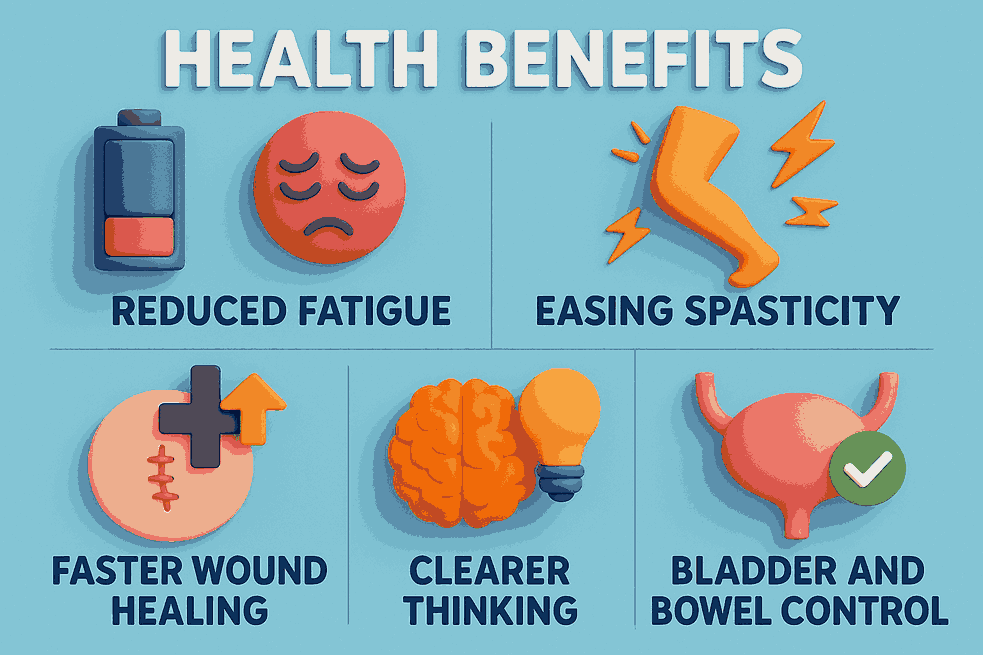
Where HBOT is described as helping in MS, the reported benefits are symptomatic and inconsistent between people. The table below separates what patients report from how strong the evidence is.
Reported benefits and evidence strength
| Reported benefit | What patients describe | Evidence strength |
|---|---|---|
| Reduced fatigue | More daytime energy in some people | Emerging: mixed small studies and patient reports |
| Easing spasticity | Looser muscles, easier movement | Emerging: small studies and clinical observation; best combined with physical therapy |
| Wound healing | Relevant for wheelchair users with skin breakdown | Moderate: HBOT is established for wound healing generally |
| Clearer thinking | Improved mental clarity | Limited: mostly anecdotal |
| Bladder and bowel control | Better urgency control for some | Limited: inconsistent, largely anecdotal |
How do sessions typically work?
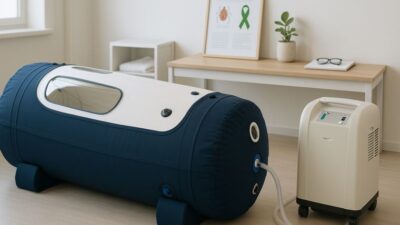
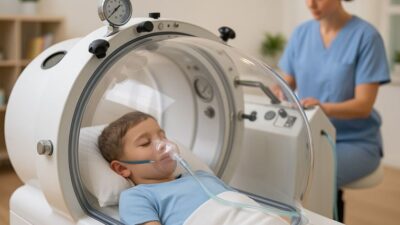
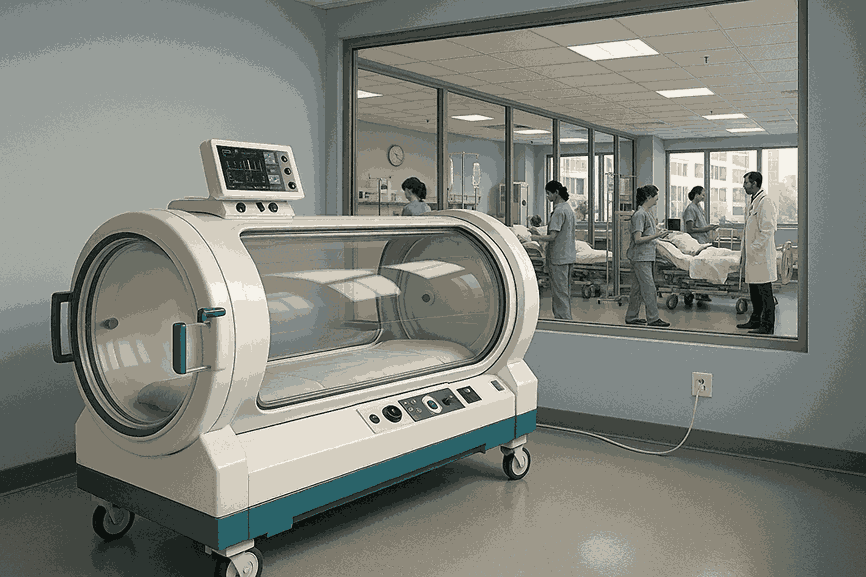
A typical HBOT course for MS follows the same shape as other indications: assessment of history, symptoms, and medications; sessions in a sealed chamber alone (monoplace) or with others (multiplace); pressure usually between 1.3 and 2.0 ATA while breathing 100 percent oxygen; 60 to 90 minutes per session; and blocks of 20 to 40 sessions, often five days a week. Soft chambers used at home cannot reach the pressures of clinic-based hard chambers, so results may differ. If you are weighing home use, our chamber rental guide covers the trade-offs and safety considerations.
Is HBOT safe for people with MS?
HBOT is generally safe in a certified facility with trained staff, but it is not for everyone. Common side effects of HBOT include ear or sinus discomfort from pressure changes, temporary and usually reversible vision changes, and fatigue after sessions. Rare but serious risks include oxygen toxicity (which can trigger seizures), barotrauma to the ears or lungs, and claustrophobia-related anxiety. People with untreated pneumothorax, certain lung diseases, or active ear infections should avoid HBOT unless cleared by a physician. If you have MS, talk to your neurologist first.
Who might consider HBOT for MS?
HBOT is not a general recommendation for MS, but it may be worth discussing if fatigue or muscle tightness significantly affects your quality of life, you have recurring slow-healing skin breakdown, you are stable on disease-modifying therapy but still have stubborn symptoms, and you have access to a reputable clinic and can commit to a multi-week course. It is a poorer fit during a relapse, with uncontrolled health issues, or if you cannot tolerate confined spaces.
Used well, HBOT is one part of a coordinated plan: continuing disease-modifying therapy, working with physical and occupational therapists, managing fatigue with pacing and rest, optimizing sleep, diet, and vitamin D, and tracking symptoms before, during, and after sessions. Without tracking outcomes, it is hard to separate any improvement from natural fluctuation. For how HBOT is studied across related diagnoses, see our guides to autoimmune conditions, fibromyalgia, and neurological conditions.
What does it cost, and is it covered?
For MS, HBOT is rarely covered by insurance, so most people pay out of pocket. Session costs start around $75 and rise depending on the facility; our HBOT cost guide has current pricing. Given the evidence, the cost question is central: a 20 to 40 session course is a significant outlay for symptom-level benefit that trials have not reliably confirmed. Before committing, ask the clinic about pressure and oxygen protocols, staff training and medical oversight, how they track outcomes, and emergency safety procedures.
Who should not try HBOT
HBOT is not appropriate for everyone. Discuss your full medical history with your provider before starting.
Absolute contraindications
HBOT should not be used if you have an untreated pneumothorax (collapsed lung), where pressure changes can become life-threatening, or if you take certain chemotherapy drugs (bleomycin, cisplatin, doxorubicin, and disulfiram may interact dangerously with high-oxygen environments).
Relative contraindications
Extra precautions or postponement may be needed with an upper respiratory infection or sinus congestion (barotrauma risk), a seizure disorder (high-pressure oxygen can lower the seizure threshold), chronic obstructive pulmonary disease, high fever, a history of ear surgery or chronic ear problems, claustrophobia (which may require sedation or a multiplace chamber), or pregnancy, where routine safety data are insufficient. Always consult your physician first, especially if you use insulin, have an implanted device, or take other medications.
Sources
- Bennett M, Heard R. “Hyperbaric oxygen therapy for multiple sclerosis.” Cochrane Database of Systematic Reviews, 2004;(1):CD003057. doi:10.1002/14651858.CD003057.pub2. PMID: 14974004
- Wiles CM, Clarke CR, Irwin HP, et al. “Hyperbaric oxygen in multiple sclerosis: a double blind trial.” BMJ, 1986;292(6517):367-371. doi:10.1136/bmj.292.6517.367. PMID: 3080173
- Confavreux C, Mathieu C, Chacornac R, et al. “Ineffectiveness of hyperbaric oxygen therapy in multiple sclerosis.” Presse Médicale, 1986. PMID: 2950392
- Meneghetti G, Cenacchi T, Iudice A, et al. “Hyperbaric oxygen therapy in the treatment of multiple sclerosis: a 24-month follow-up.” Rivista di Neurologia, 1990. PMID: 2247750
Medical Disclaimer
The content on BaricBoost.com is for informational purposes only and is not intended as a substitute for professional medical advice, diagnosis, or treatment. Always seek the advice of your physician or other qualified health provider with any questions you may have regarding a medical condition. Never disregard professional medical advice or delay in seeking it because of something you have read on this website.

Author
Seph Fontane Pennock is the founder of BaricBoost.com and Regenerated.com, a clinic directory for regenerative medicine serving 10,000+ providers across the United States. He previously built and sold PositivePsychology.com, which grew to 19 million users and became the largest evidence-based positive psychology resource on the web. Seph brings direct experience as an HBOT patient, having completed protocols at clinics across three continents while navigating mold illness, systemic inflammation, and autoimmune conditions. His treatment journey includes hyperbaric oxygen therapy, peptide protocols, NAD+ therapy, and consultations with specialists from Dubai to Cape Town to Mexico. This combination of entrepreneurial track record and lived patient experience shapes everything published on BaricBoost.com. Every article is grounded in peer-reviewed research, informed by real clinical encounters, and written for patients making high-stakes treatment decisions. Seph's focus is on bringing transparency, scientific rigor, and practical guidance to the hyperbaric oxygen therapy space.
Why Trust Our Evaluations
Our rankings are based on hands-on testing, published clinical data, and verified manufacturer specifications. We apply the same criteria to every product regardless of affiliate status. Editorial Process · Evaluation Methodology